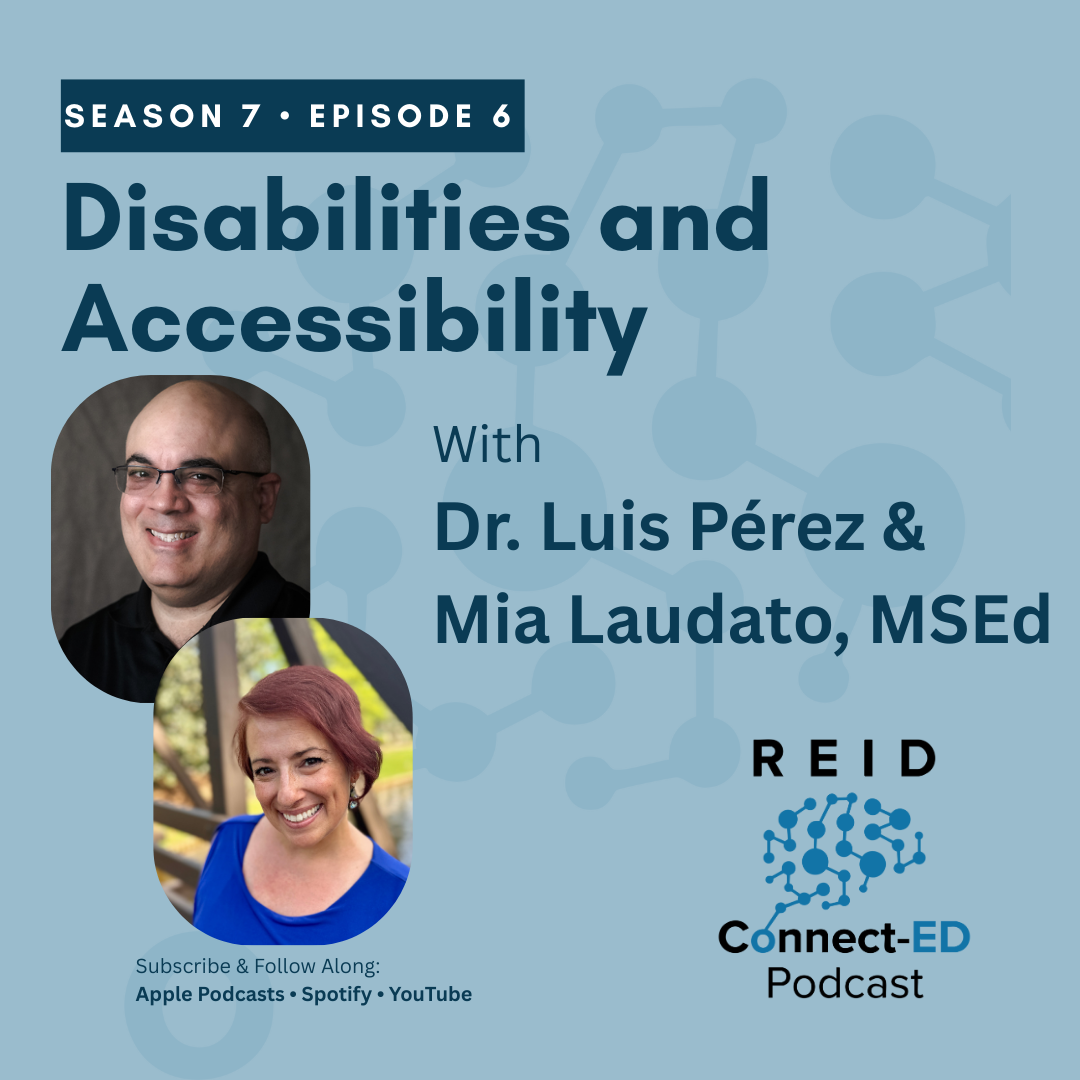
S7 E6: Disabilities & Accessibility w/Dr. Luis Pérez and Mia Laudato, MSEd
Listen Now!
-
https://udlguidelines.cast.org/
Meet Mia Laudato, a passionate leader in inclusive education and co-director of CITES—the Center on Inclusive Technology and Education Systems at CAST. With over 25 years of experience, she’s dedicated to making sure every learner—especially those with complex needs—has access to equitable, high-quality education.
Mia’s expertise in assistive technology, Universal Design for Learning, and inclusive design has taken her around the world as a speaker and change-maker. As a teacher from Pre-K to college, she brings humor, heart, and a few “punny” jokes to everything she does.
When she’s not transforming systems, you’ll find her kayaking, doing yoga, or laughing and sharing stories over good food with family and friends.
Luis Pérez is Senior Director of Disability and Accessibility CAST and the Principal Investigator for CITES, but the views shared on this podcast episode are all his own. He holds a doctorate in special education and a master’s degree in instructional technology from the University of South Florida. Luis was recognized with an International Society for Technology in Education (ISTE) Making It Happen! Award in 2020
Luis has published three books on accessibility, mobile learning and UDL: Mobile Learning for All (Corwin Press), Dive into UDL (ISTE) and Learning on the Go (CAST Publishing). He currently serves as an AT and Workplace strand advisor for the Assistive Technology Industry Association (ATIA).
-
Accessibility for those with disabilities can benefit everyone and are often not even seen in everyday life.
Anyone can become part of the disabled community at any point in their life.
UDL is not only about needs but also about preferences. Learning can be tailored to an individual as there are vast amounts of differences to which teaching and instruction can be personalized.
Accessibility allows everyone to contribute. Living in a complicated world, we need everyone to contribute in different ways. If you look back on history, you can find many individuals who have contributed greatly to society who have in some ways had their needs and preferences met to actualize their potential.
Empathy is developed through having a diverse range of individuals on the same team.
Belonging to a society is crucial, for which accessibility allows. As an example, imagine breaking your arm and not being able to type/write, this individual may lose their sense of belonging and contribution to their group.
Independence to do things on your own is as important as interdependence. Hyperfocus on independence can preclude the development of giving access and skills to be interdependent. As a community and society, we need to depend on each other to thrive. Especially in the digital age where people are losing more genuine connection, a true authentic sense of belonging is important.
To make someone feel valued may be more powerful than words to make someone feel good about themselves. Purpose and contribution seems to be missing from many youth, which has been shown to be so important through Positive Youth Development research.
Youth may need more support to elicit ideas about purpose and contribution and values. These aspects of a person, which are part of identities, values, and beliefs, are not ‘checkmarks’ but rather they can be complex. Connecting more with ourselves on a genuine level is an important part of connecting with a larger whole.
Inter-generational views can clash and each up and coming generation feels like they “get it” and “have the answer”.
Having at least one person who believes in someone can make a big difference to instill a sense of value, as well as the capacity to be resilient and believe in oneself. A mentor can be loving and still challenging. “Warm demander” is a recent term being used to explain this approach to believing that kids can learn and can have both flexibility and fun, along with high standards and consistent structure. Kids need both the expectations but also the support to reach those expectations. Theodore Rossevelt once said, “People don’t care how much you know until they know how much you care.”
The type of support and the way in which supports are provided could require critical and collaborative thinking. Those in power may have an aversion to a person’s difference especially if there is a lack of familiarity; they may also not feel confident in their ability to provide assistance/support, which can also lead to avoidance of interacting with a person’s disability and needs.
As a parallel, it took a large number of people to address large-scale problems in society. By addressing these problems, it turns out that everyone could benefit from the ideas that come from this collective approach to addressing problems. For instance, the collective process of getting to the moon led to and played a role in creating the internet.
If you are resistant to accessibility, think about “designing for your future self” because after the age of 65, at least half of individuals have some sort of disability.
Some with individuals do not prefer to be called an ‘inspiration’, but it depends on the person.
The word “help” can come from a positively intended place. However, it implies one person ‘doing something’ for someone else; whereas, UDL suggests it’s more about creating accessibility rather than doing something to help. It’s more about supporting people instead of helping people.
The late Joy Zebala was a large influence in the field of assistive technology and Universal Design for Learning (UDL). SETT framework is an example: https://www.joyzabala.com/links-resources There is a Joy Zebala fellowship. Being student-centered was at the forefront of her approach.
Language changes and is contextual. It’s okay to give yourself and others grace in getting a sense of appropriate language. It also helps to just ask.
The way people perceive language can be variable. Some with disabilities prefer person-first “person with disability” or identity-first “disabled person” language.
Some in the deaf community actually call it “deaf gain” instead of “hearing loss” since they view a lot of gains they have by being the way they are.
“Invisible disabilities” can make a person feel invisible. Instead, the terms can be “apparent” and “not apparent”.
“Special needs” can also be a term that is not taken well even if it came from a good place. It’s not ‘special’ to ask for access and to be given the opportunity to contribute and belong. Removing the barriers and providing additional support allows for this, which helps them to feel like any other kid. Again, it’s about removal of barriers instead of ‘helping’.
It can be a shift of recognizing if a particular word/language has a positive or negative impact.
It’s also important to consider how we use the terms “high functioning” and “low functioning”. There is not necessarily an objective list of what constitutes “high” or “low” functioning. Saying this about someone is making a statement on what you think they can and cannot do. UDL can help us to frame how we support the contributions and belonging for all people.
“Ableism” is the idea that we can disadvantage certain people through the design of systems and society. Integrating UDL into a system requires not starting with ableism. It starts with how we see ourselves and each other. A mindset of ‘othering’ interferes with the embrace of UDL. Aligning with communities allows you to understand the barriers and supports.
UDL is a reflective practice. It requires doing something to create access and then pausing to reflect on if it is working, and also if/how it can work for more people. It’s a feedback loop.
Collective efficacy is believing that we all together can make things better even if there is not a clear idea how to do it.
-
Gerald Reid 00:07
Gerald, welcome back to season seven of the Reid connected podcast co hosted by myself, licensed psychologist Dr Gerald Reid and my sister educational therapist Alexis Reid providing resources on mental health education and performance psychology
Alexis Reid 00:22
before we get started, if you're able to close your eyes and think of a time where a street light reminded you to wait before crossing, or a door automatically open after you progressed up a ramp to access a building, even captions running on a screen in a noisy bar that help you better understand what's happening in a game or in a news alert, the pictures to help you know what to order before you do. Have you even taken a mental health day recently, or the bumps before a railroad platform or even a curb cut or the curb cut itself. These are all supports for people with disabilities to gain access to public spaces, and have also benefited so many of us. Accessibility has become a part of most communities and hopefully integrated so seamlessly that you may not even realize that they're there. It's imperative that we all make a stand in how we discuss, describe and proactively plan to support all learners in educational and work environments as well as public spaces. In my opinion, this is more about us seeing each other in our humanity, to be able to come together and understand each other better, because language matters, especially in this world of disability, which is the only minority that anyone can potentially become a part of, and many have lived with their entire lives. Today, we're joined by two guests who teach me so much in every interaction we have, and who are on the front lines every day to initiate, educate and advocate for access to educational and work settings. We three have come together through our shared passion for creating access to learning opportunities for all in our work to train support and expand upon potential for all in educational systems, schools, organizations, workspaces, families and individuals about UDL, universal design for learning and have since become great friends and collaborators. Not only am I grateful for their friendship and the amazing work they do, and we'll speak more about that soon, but also for how they continue to lift me up and support the work that I do and so many others. So let's hear a bit more about our guests today. Mia Laudato is a passionate leader in inclusive education and co director of sites the center on inclusive technology and education systems at cast with over 25 years of experience, she's dedicated to making sure every learner, especially those with complex needs, has access to equitable, high quality education. Mia's expertise in assistive technology, universal design for learning and inclusive design has taken her around the world as a speaker and change maker as a teacher, from pre K to college. She brings humor, heart and a few punny jokes to everything she does. I can attest for that when she's not transforming systems, you'll find her kayaking, doing yoga or laughing and sharing stories over good food with family, for which I am also grateful to know and be a part of sometimes and friends and some of you may be familiar with our friend of the podcast, Dr Luis podes, a senior director of disability and accessibility, I cast, But the views shared here on this podcast episode are all his own. He holds a doctorate in special education and a master's degree in instructional technology from the University of South Florida. Luis was recognized with an International Society for Technology in Education. ISTE making it happen award in 2020 Luis has published three books on accessibility, mobile learning and UDL. Mobile learning for all by Corwin press dive into UDL by ISTE and learning on the go, published by cast. He currently serves as the as an AT and workplace strand advisor for the Assistive Technology Industry Association a TIA, and you can hear him in a few episodes here in the reconnected podcast. Before we get started, I just want to remind everybody that the views discussed here on this podcast from all of us are our own personal views and do not represent the organizations for which any of us are a part of, but we do believe that these are really important conversations to be able to better understand accessibility, better understand each other, and to allow for the audience to connect in a way that perhaps you might not always have the opportunity to so welcome Luis and Mia, we are so honored and privileged to have you as a part of this conversation today.
Luis Perez 05:00
It's an honor and a privilege always to be part of the reconnected podcast with just an amazing group here that is so passionate about the work that we do and really wants to make a difference in the world. So that's the reason why we bring these conversations to you all. And I'm just so excited whenever I get a chance to have some time together, because we work at the same organization, but we're both virtual, so we don't see each other that often. So anytime that I get a chance to have a conversation with my colleague and friend Mia lodato, I'll take it.
Mia Laudato 05:31
Yeah. All I can say is, ditto. I'm very excited to be here. This is great.
Alexis Reid 05:38
And before we get started, you know, I was telling Jerry, Mia, how you and I know each other, and I'll never forget the UDL symposium that we were at. And I remember coming off of a talk and finishing and exhaling, and you coming over to me and just you were so warm and loving and kind and supportive and and from that moment on, I think we just connected. And I similar situation happened with Luis, and I that we've talked about before on the pod. And I just want to emphasize that if you have people in your world, in your stratosphere, who are doing work that you agree with, that you're passionate about, that you connect to say something about it. Because these these small interactions and conversations have turned into years of friendship and and support that are so invaluable and just so important. So you know, if, if we say something here that you hear on the podcast that you're excited by and don't necessarily have people to talk about it with, reach out to us, right? We're all pretty active on social media, and we love having these conversations and bringing more people into this tribe, right, who are really passionate about supporting and helping others, especially through learning opportunities.
Gerald Reid 06:55
Can I set the stage with this conversation? Something just popped in my head that I want to bring in to the table here with these amazing people always. So I'm always thinking about things psychologically. And one of the topics today is going to be about accessibility and having personal needs met, regardless of what your your capacities are, abilities, disabilities, right? And so to bring in needs for people, I'm going to put this on the table and see what you all think. We live in a society that has progressively become more perfectionistic, right, where people have to think about, at least in our country, in the US, right? Work as hard as you can do everything you can do to get to the top. You know, everything has to be, you know, just grit it out. Do the best you can, right? And in this is seen in athletics a lot, right? And so one of the ideas is that by being so perfectionistic, you don't reflect on what your needs are at all. And so I'm wondering if this, this stuff, this context in which we're living, right, where it's everything's perfectionistic. Do everything the best you can, don't work, don't think about what your needs are, has, in turn, made it difficult for people to understand that people with disabilities could have needs, but also people all people have needs. And if the context could be more about understanding people's needs collectively, then maybe this conversation could be opened up to all people, rather than thinking this only applies to people with disabilities, with with the general public may not resonate with if they don't know anybody with a disability, that it's something that they're not familiar with, they haven't been exposed to. So I would like this conversation to open up to everybody about this topic, so everybody in society can can understand what this this topic really is about, about accessibility, about getting needs met, about understanding differences. Because, as you're saying with UDL, this applies to everybody, regardless of who you have a specific disability or not. So I'm just wondering if the context of the way we live in society and how it's become more perfectionistic has has prevented people from looking at personal needs and like, from my perspective, mental health wise, as a psychologist, it's so important to understand what your needs are, right? It just helps you have a long term functioning. Helps you have well being in the long term, rather than, you know, things kind of falling off, falling off from not getting your needs met in different ways, because your needs could be varied in different ways as well. So just want to, want to, want to
Luis Perez 09:20
hear your thoughts about that. So that's that's great framing, Jerry, I'm going to take it in a different direction, because you mentioned needs. The way that we expand this, we often just talk about needs. I like to talk about preferences, right? So it's not just needs. Whenever I see anybody writing about UDL, I'll often see that they'll say, we want to address everyone's needs, and then I'll just have to add over and over and over and their preferences, because the whole idea behind preferences is that you customize the environment to suit your needs and preferences, right? That's how you personal. Analyze it and you make it unique to you, because each of us is unique, right? We have different backgrounds, different experiences. We like to say in our work that, you know, our brains are as unique as our fingerprints, because they're shaped by experience, right? So we've seen that even with twins who have very similar genetic profiles, right? They may have had different experiences that shape how they view the world and how they act in the world in different ways. So I think it's important to include that part about preferences, and then to your question about perfectionism, right? Because I used to be an athlete too. You wouldn't know it now from looking at my dad bod, but yes, I used to be an athlete many, many years ago. I think we need to change the conversation to contribution. How are you contributing, right? So when you're part of a team, how do you contribute to the functioning of the team, to the team goals, not just your individual goals of like you got to hit, but did the team succeed right? Did we play the right way? Not only did we win, but did we play the right way? Are we proud of the performance that we just had? And so for me, when I try to think about accessibility, for me, it's about contribution, is making sure that everybody can contribute. Because, guess what? We live in a really complex world with really complex challenges. We need all the talent we can get. We need every person to be able to contribute. And if you look back through history, there's many you know luminaries that you can go back and find out, Oh, they had dyslexia or oh they had anxiety, right? Oh, they had these different conditions that the general public doesn't usually know about, but if they didn't get their needs and preferences met, we would have lost out on that talent.
Gerald Reid 11:58
There's an amazing surfer named clay marzo who has autism, and he's actually one of the best surfers currently in the world. To your point, absolutely.
Luis Perez 12:09
Or, you know, the late Steve Jobs, some people think that he had a learning disability. So some learning disabilities, right? So if we don't support that, that talent in different ways by responding not just to needs but their preferences, then we're losing out as a society. So for me, because I work in education, but I also work in workforce development, right? So my goal is to make sure that we get your full potential right. We remove those barriers that keep you from realizing your full potential, not just for you, but for all of us. We all benefit. I just
Gerald Reid 12:43
want to make one point. I'm going to let you all take the lead, because I'm going to stop talking here. I When you talk about potential, I also want to make the point that anybody contribute can contribute in different ways. So I've seen videos of a student with Down syndrome be part of the football team or the basketball team, where they are such an emotional support to the team, which is, at to your point, it's not necessarily that they're contributing in a, you know, in a more athletic way, but emotionally,
Alexis Reid 13:14
the leader score, the leading scorer, exactly.
Gerald Reid 13:17
But they're part of emotionally to the team, to the to the camaraderie, to the bonding of the team, absolutely.
Luis Perez 13:23
And we do sports for many, many reasons, like not all the reasons have to do with actual sport. For many people, it's a safe space, right? It's a community. It's a group of people that you share a common goal. And so having unified sports, I'm a big supporter of unified sports, because it's great for the people with disabilities who are part of it. It's also great for the other people, right? Because they learn things like working in a mixed team, a team of diverse abilities, and they learn empathy, so we can all benefit from those experiences.
Mia Laudato 13:58
And I was just going to say that you touched upon, Jerry, you touched upon something that I was going to talk to when Luisbrought up needs and preferences, which is belonging, right, and this idea of belonging to a society, and we, oftentimes, when We're talking about our our role right in society, everybody wants to belong, and what does it take to feel and and contribute to that belonging? Oftentimes, that's the difference between needs and preferences. So for example, you know, if I'm working with a student and or if I'm working in the workforce, and someone just broke their arm right, and they need to access, they need to be able to type right, and they're right handed, and they broke the right arm. Harm. So what happens now, and if they can't type and they don't have access to another way to write, right, how much do they belong to that space in which that basically defined their job? So like, what does that do to a person? And that also, to me, highlights a difference between independence, which I think you were almost kind of focusing on, is this perfection? Is this individual's strive for independence, right, versus interdependence? And I just heard this really wonderful either heard or read this really wonderful description of this and talking about how we can tend to be so hyper focused, especially in education. Alexis, you'd appreciate this, where we are talking about getting students to be independent, right? We want to make sure that students are independent and that we get them out into the real world. Luisright, in the workforce, and now a lot of them are failing. And I know you work with a lot of these students at the college level, because they were never taught how to and never given the skills and never given the access to be interdependent, yeah, and, and as a community, we if we don't depend on each other, we don't thrive, right? So those ideas of belonging are so core to who we all are, and those ideas of interdependence. How can we create interdependence and belonging so that our community can thrive?
Luis Perez 16:49
And I think it's becoming even more important. Jerry and Alexis and I have had a lot of conversations about where we live now, with AI and in a world where we're super connected, in a way, but very much disconnected, because the connection is very superficial, right? And so anything that we can do to encourage belonging to like send a message that, you know, people belong in this environment, that this environment is for you, that we can connect and build community. I think that's what people are really hungering for. I don't know if that's the term hungering, but you know
Mia Laudato 17:26
it is now, it is, who is hungry really?
Luis Perez 17:29
They're really, I see, like, the need for that, that sense of connection, like genuine connection, right? Not what you see on a screen, not the thing that's been filtered, right, so that you have no wrinkles. I This is a audio podcast, fortunately, but you do get to see my white hair, and you do get to see all my wrinkles and the bags under my eyes, because that's authentic. Yeah, I want to be authentic, and so I think that's part of when people, everybody can participate, everybody can contribute. That's authenticity, and that's the kind of thing that we need in a world of disconnection.
Alexis Reid 18:03
Well, Luis, it's a good thing we don't have a video today because I'm like a bobble head, and my head is just nodding. I'm I'm just so empowered by all of your words right now and and I know there's folks out there that believe and agree with what we're saying now, but there might be others who might not. My course that I teach child growth and development, one of the whole modules is about really understanding variability and understanding the different sides of variability, and thinking a little bit more broadly about things. And oh my God, there's so many things I wanted to say. Yeah, hold on a second I breathe. I should have written it all down, because there's like 12 things that just popped into my mind. Okay, I'm gonna rewind. You're gonna cut that part. So, Luis, to your point, we had a whole episode at the beginning of season seven that we plugged in because we thought it was so important to start this season, start this fall of 2025 talking about how overly connected we are, but also how disconnected we are. And this idea of belonging, this idea of being a part of a community, is something that everybody is really craving. And in fact, in this this desire to be connected, we somehow seem to be siloing ourselves into these smaller communities that I think is actually working against this broader goal. And you know, some of it might be part of our, our our values, system, instruction and structure as a society here in the US, where we're more individualistic versus a collectivistic society. But I I love that you brought up the idea of contribution, especially from my work in positive youth development, thinking about how the 6c is contribution. And how do we not only do for ourselves, but how do we do for the greater good, which sometimes we miss, as we're striving to do and be more
Gerald Reid 20:09
what's more important than feeling valued by other people,
Alexis Reid 20:12
totally in some capacity, it also, perhaps
Gerald Reid 20:16
it reflects inherent value in yourself. It's one of the most. I mean, if you want to think about self esteem, you can tell someone to feel good about themselves, but if you make them feel valuable, what's more powerful than that? It's more powerful than your own words towards that person.
Alexis Reid 20:30
And one of the things, you know, I often get questions from educators, from from family members, from managers, who say, you know, how do I help to motivate this student, this worker, this person, my child. And there is no like magic bullet or like special formula to motivate, right? But I would say, and I often do say, that they need to be feel valued. They need to feel purposeful. Motivation comes from feeling like anything you do, it makes a difference in a good, positive way that others are going to notice. That's essentially, I think, one of our biggest human needs right now.
Luis Perez 21:08
And in fact, what you just said is supported by some of the surveys that have been done of young people, right that having a sense of purpose, a sense of contribution, those are some of the things that they feel like it's missing. And I know we're going to talk about intersectionality next, so I'm going to provide you with segue here, because part of that feeling of being connected right is kind of recognizing your full self. We sort of like, don't provide our young people with enough support to like, understand themselves, like, their values, their what works best for them. Like these conversations are often left to like, Oh, you'll figure it out.
Gerald Reid 21:53
Or we know best, like the coach or the teacher, we know best, right?
Luis Perez 21:58
Yeah, either way. So when, when we talk about the self, right? Like you said, Alexis, I love that. You said, we often kind of silo different parts of ourselves, and that's where, like, intersectionality comes in. Because one of the things I like to say, like, we're not a series of check boxes. We're more like Venn diagrams. They're dynamic. Venn diagrams too, right? Because depending on the situation or depending on your stage in life, some van, some parts of that Venn diagram are going to be bigger and they're going to be sort of like pulsing just because they're it's more important at that time, right? So thinking about, how do we integrate different parts of our identities? Because if any of those are, like, siloed off. We're not being our full authentic self, right? That's when we experience, like, this feeling of alienation. So it's not just connection with others that's important in community, but also, like, a connection with our true selves, right? Our values, our core values, our beliefs and so on.
Mia Laudato 22:57
I'm so glad you brought that up, Luis, because that's what I was thinking when we were talking about that is like, you know, some of this is the onus is on us as a community, right? And then another part of this is the onus on us as an individual. And there's, you know, there's a balance there, right? And I think every generation feels like maybe they've got it. So that's even, even another, like, whole, whole conversation for another podcast, right? Is, like, not only intersectionality, but like, intergenerational, like, used on these things, like, I'm a Gen Xer, people can't tell by my voice. I mean, you know, so I'm, I'm a Gen Xer, and, you know, my generation was, quote, unquote, the latch key generation, right? Except for my mom actually stayed home. And, you know, I came home to a mom that was at home and older brothers and, you know, parents that poured into me and made sure that I had a really good sense of self, but I was also the kid with the big nose, the big Italian nose, that got bullied pretty viciously in elementary school, and I came home crying every day, and my mom was like, stop crying. You're fine. You go back in there and you smile every day. This is not about you. This is about them, and you know, so you know, would my would my mom and her and my dad think that, you know, maybe their generation did it right where they gave some tough love. But it really was tough love. It wasn't just tough it wasn't just get back in there you're worthless. Like I wasn't getting bullied from my parents and from school. It was more like I was getting bullied from school and then my parents were there to say, I hear you, but you've got this right, which created and instilled this idea in me that if I could go back. Another day, even though I didn't want to and survive, that I was going to be resilient, right? So, so, you know, we talk about that one person like, like kids need at least one person that believes in them, whether it be in the school, whether it be in the the parental, family, whatever group that is right, that that helps instill and gives them some tools to deal with that, whether it be a therapist, whether it be a coach, right? So I feel like it's, it's both of those things that really need, need to happen.
Alexis Reid 25:39
I'm so, I'm so so glad you said this, and I just want to validate how terrible that is that you had to experience that. And you know, some of what we'll talk more about here is this idea of sometimes when you go through really challenging situations or trauma with a uppercase or lowercase t, it can also provide us with these opportunities for growth when we do have the right guidance, support and love around us, and you know, to your point of having one solid person to support you, you know the research supports that too, from positive youth development, and I talk about this in child development all the time, that if you have one consistent mentor, an adult who's going to be supportive and guiding you throughout your life, it literally can change the trajectory of a child and a young person's life, and it's an incredible thing. And this idea of understanding ourselves and seeing things in ourselves that sometimes we miss or we only hear what others are telling us, it reminded me so much Mia of really my work that I do, where I often tell the people who I'm sitting across the table with or across the computer with, you know, my job sometimes is just to be a mirror to reflect back what Sometimes you miss and don't always see in yourself, so that you can see it in a different light, or you can Remember these parts of you that really are the things that make you you. And sometimes it is that challenge, right? We watched the movie A star is born with Lady Gaga in it, and, you know, she, at the beginning of the movie, was like, you know, I can't be a star. Everybody tells me, because I do have this big Italian nose. I'm never going to be the face for music. I'm never going to be this huge success. And in reality, you know, she had to tap into who she really was and the gift. She had to be able to share them and release them. And I love this idea. And you know, a lot of people might say I don't, I don't have a mother who talks to me like that, or I never had a mentor that guided me in that way. But I want to just remind the audience that if you're hearing those thoughts in your head or other things telling you, well, I just don't or that will never be me, just to remember that sometimes, when we do, like you said, Luis, get in tune with these parts of ourselves. Connection to ourself, it can sometimes unlock these beautiful opportunities that maybe we never thought existed.
Luis Perez 28:03
That's why I think mentoring, or trying to find a mentor is so important. Here's an activity that I often ask educators when I do UDL workshops, and we'll get to UDL right at some point, yes, but I often ask people like, think back to the educator that's had the biggest influence in your life. And what do you remember? What was it about them that had that big influence? You know people who are listening right now, you can do this too, right? If you're driving, don't close your eyes. You can pull aside for a second, pause the podcast, and just kind of do that activity and think back to all the adults and supporters in your life that you know have believed in you. And when I do this with educators, it's never like, oh, it's the person that helped me master the quadratic equation or the person that helped me in organic chemistry, right? It's the mentors, yes, it's the helpers, right? It's the people that said, you can do this, yeah, that believed in you. So I'm an example of that. Like the biggest person in my life was my Spanish teacher. But I didn't take Spanish. I knew Spanish already, so I didn't have that as a requirement in my program. But it was the Spanish teacher that reached out to me and continue to check in with me and say, Are you doing okay? Yeah, you know. So even though I was not in their class, they were still a huge part in my life, and they were like a second father to me, yeah. And so I wouldn't be here without that person. And I bet you many of us have those people in our lives, right that there they were mentors. Maybe they weren't like our boss, they're not like one of our teachers, but they're within our sphere, right? And they see something in us, and like you said, they just help unlock it in some ways, because it's always there with you. It's always been there with you, but they just help, kind of ask the right questions and unlock it for you.
Alexis Reid 29:57
Can we press pause? Because we have this beautiful. Platform here, can we give credit to the person that the mentor in our lives? I know you mentioned me, your mom, but I wonder if there's someone else, will you just give a shout out to that person? Luis, I'm glad you mentioned your Spanish teacher. But if there's someone else too, just take a second to share
Luis Perez 30:17
well for sure. Dr David Rose, yeah, the funny story is that the first time that I did a presentation at a public space on UDL, he was in the audience, but because I have no peripheral vision, I didn't know he was in the audience. So I presented on UDL for about an hour, and then at the end of the presentation, somebody came up to the front of the room and we were introducing ourselves, and he said, Oh, I'm David Rose from cast, and I just about went white at that point, but, but ever since that moment, he's been a big supporter. And when there's somebody like David Rose that believes in you. Then you, you, you know, you take that seriously, and you, you think that you can do it so, but all of you too, right? Like everybody on this call is a mentor, because we share knowledge and ideas and but also challenge ourselves, right? So a mentor doesn't just say, hey, everything you're doing is right. Sometimes, like you said, yeah, there's some tough love, right? But the love part is what's important. The mentor will challenge you, like, you can do this in a different way, that can provide different results or better results.
Mia Laudato 31:34
What are the word? What's the word? Now, I think it's like, warm demander. Like, I know a lot of this, I know a lot of this podcast, is actually supposed to kind of talk about language, right, like how we how we say things, and how it's perceived. And it is kind of funny how language changes over time, right? And how those changes also change our perception of it, right? So I would say tough love, because I grew up a Gen Xer, right? But you know now it's warm demander. I think whichever way you say it, those people that hold us to a certain standard, and I think that's important too, right? We're talking about, we're talking about humanity. You said it in the beginning, when we when we tap into our humanity, right? No one I don't know, at least in my life, people with disabilities that want to be pitied, or, you know, seen a certain way, or you know, look down upon, or you know, there's this whole conversation in the disability community about, please don't call me a inspiration, right? And you know that depends on the person that you talk to, right? We talk about variability in UDL, right? So language can be variable, but also how people perceive the language can also be variable. And I think about the people in my life that that were the warm demanders and gave the tough love and and held me to a certain standard of I know this is tough, but I also know you can do it, and you know you can do it. And for me, that worked. I don't know if you you guys had those similar experiences, and I think every kid is different, but I do think even the science shows that you have to hold people to a certain level and then give them the tools to get there. You can't just say, Hey, this is the level that I want to hold you to, but I'm not going to give you the steps to get there like you just keep jumping and see if you can, you see if you can slam dunk. You know what? I am, five foot one on a good day. And if you gave me a ball and told me to slam dunk on a standard basketball hoop, there is no way I can do it right unless someone gave me the stairs or the ramp.
Alexis Reid 34:05
Yeah, to do this,
Gerald Reid 34:09
well, you don't need to slam dunk to contribute to the team either.
Mia Laudato 34:15
How about if I wanted to right? How about if I wanted to slam dunk, and that's where the bar was set for me and and right, it's, it's that idea of, okay, well, if that's the bar that we're setting, and that's what I want, and that's what the contribution, right, is needed, well then I need the ramp. You can't just tell me that that's where the bar is and not give me the ramp, because it's not
Gerald Reid 34:39
going to happen. Let me there's, a couple threads I want to pull on that you all are making. One, you know, there's an old quote by Theodore Roosevelt, people don't care how much you know until they know how much you care. People don't care how much you know until they know how much you care. And I think that's really exemplifying what you what everybody here is saying is that love that. Care, and you can still hold a high standard and still show that you care and and this also ties into some what I think is critical thinking, which is needed to in this, in helping anybody right with different accessibility needs, right? I had a class yesterday, and I said, look, let's imagine this person struggling with this problem. And there's like 35 students, grad students, I said, come up with as many examples or ideas on how to address this issue with this person as you can. And they came up with all these different versions of how to help this person with this academic issue that they had, right? It was, you know, part mental health, part academic issue, right? And I asked them, What was that like to go through that process of brainstorming collectively and listening to other people's ideas? And a lot of them said, Well, I actually wouldn't have thought of most of what other people came up with. I was like, Oh, wow. I never would have even thought of them out of that until that person said that. And so I think when we're thinking about helping people with their accessibility needs or supports or whatever the accommodation, whatever the word is, to help them, to help the person, to work through challenges, reach their potential, whatever that potential might be in that particular area, I think it requires patience, love and critical thinking to really Think critically and creatively to come up with ideas, because the idea may be so subtle, so simple, or just a slight shift in perspective. And so if we can open up our minds, you know, the answers may just come to us naturally, if we can do that, and I think that's a critical element of this, rather than people thinking, oh, this person has, you know, you know, I'm thinking of the person who might not want to do this. They might be afraid of the disability, or be afraid of, oh, I don't know what they do to help. I can't help, or I don't know. I don't understand it, right? And kind of this aversion to a person's difference, rather than being open minded and realizing, through their own exposure therapy that, hey, if you begin to get to know this person, understand them, and begin to think critically with them and with other people, the ideas might come and you, as a person trying to support might actually feel confident that you can support them as well, because that person might actually be feel insecure that they can't help, which could lead to kind of this down, downward spiral of like, oh, I can't help. Therefore, I'm not going to try. I don't want to look like I can't help them. I want to just focus on other people I can help, right? All that stuff. So I think that aspect of critical thinking is an important part of it. I want to hear what you all think about that.
Luis Perez 37:32
I think, like the experience that you just relayed Jerry having to do with, like, brainstorming, right? How those students were able to come up with more ideas or new ideas that they hadn't thought of. At the end of the day, it all comes about, or it comes down to how we think about intelligence, like we so much emphasize individual intelligence, when really it's really collective intelligence that gets us to accomplish most of the big things that we've done. Right? We got to the moon not because one person mastered, you know, getting to the moon. We got to the moon because it took a whole society changing how we do things, and that's a corollary here to accessibility. I'm going to make it in a second. But we got to the moon, because all of these people put their minds together. They put their effort together, their innovation together, right? And that's what got us to accomplish that big thing. So we need to think about intelligence differently. We need to begin by thinking about this is fish scale metaphor when it comes to intelligence, right? With a fish it's not an individual scale that keeps us safe and allows it to survive, right? It's the fact that they're all linked together, right? And so collective intelligence is important. But the reason why I want to go back to that metaphor of getting to the moon is how many things that we benefit from on a daily basis. Because we set this goal of getting to the moon. New foods were invented, right? New technologies like, say, the internet, really what do you think the internet was started out as as a way to share information amongst government agencies, defense agencies, right? So many things were developed because we had this goal of getting to the moon. And so accessibility is the same. We have a goal, and the goal is to include other people in our society, right, so that they can contribute. But it turns out that we all benefit from it. And you gave some great examples at the beginning here, things like captioning things like the ramp right or the curb cut, which, again, that's not just people with wheelchairs, but parents pushing a stroller, or delivery people pushing a cart. So to benefit from so again, there are all these like secondary benefits that benefit us all and for anybody who. Like, really resistant to accessibility. I have a saying for you, design for your future self. Wow, because everybody at some point in their life is going to need an accessibility support of some fashion. It turns out that over the age of 65 about half of people have a disability. So you may not need it today, but you'll definitely at some point in your life need it or just want to take advantage of it, right? And so design not just for your future self, but for yourself that can become it at any point, as as Mia said, right? You could break your arm, you could have an illness. So this is not just for one group of people. It's really for all of us. All of us benefit from these innovations.
Mia Laudato 40:48
Yeah, and I would love to just add that the word that I kept on hearing you say Jerry, and we use this word so often, and I'm kind of bringing it back to the language, right? Is help, right? I think I was, at one point, I kept on. I was, like, counting, and I think you probably said it 20 times, and I think that, and in the, let me tell you why I was concentrating on that, because I think that the word help can be really wonderful, right? Like, when you think of help, I love everybody. We're doing all of this, like visualization right now, like when you think of the word help,
Gerald Reid 41:25
what comes to mind? Like, someone doing something
Mia Laudato 41:28
for you. Yeah, something, someone, yes, someone doing something for you. I'm so glad you just said that someone doing something for you. Now, the feeling oftentimes is a good feeling, right? Like it's when you, when you, when you connect feeling words to help. It's like, Oh, it feels good to help someone, but you just said doing something for someone. So I challenge people when they're thinking about accessibility and when they're thinking about design and designing lessons, or designing work spaces, or even designing for themselves, as Luiswas talking about, that you shift the word help to Removing barriers, because when we remove barriers, that allows people to do things for themselves, and oftentimes, that's what we're doing, right? And when we use the word help, what that does is it conjures up this image that people can't do it for themselves. And in UDL and in universal design, we're saying we want to remove barriers, because people have the ability, have the intelligence, right in general, humanity has all of these skills, and by removing the barriers, we allow every single person to show what they know, access what they need right and engage with what they want to
Gerald Reid 43:08
Mia, thank you for correcting the language, but I want to emphasize how you did that in such a validating way for me, and how I think important that is for just helping people to grow and evolve with these types of societal topics and aspects of how we function in life and how we go about life. So I think that was a really good example of helping you were trying to understand where I was coming from, rather than saying, like, that's the wrong way to say that you need to be corrected. I thought that was a really, a really graceful way of empowering me to evolve, right? And so thank you, and I'll humbly accept that feedback. I think it's, I think it's exceptional feedback for me to shift that language, and I will take that with me. I just
Mia Laudato 43:50
say thank you for being open.
Alexis Reid 43:52
No, totally. And I, I think this is, this is why we have this conversation. Because there's so many limitations to language, right, language that we're not exposed to, language that maybe we don't interact and communicate with on a daily basis. One of my students this week, as we're wrapping up our course, was reflecting on her experience, and said My boyfriend even mentioned how much different I describe and talk about situations now, after I've been exposed to learning about child development in a different way, and all the things we talked about, I'm like, I'm feeling so validated because all of it is incorporated into this course that I teach on child development, right? I talk about variability, but I also talk about ableism, I talk about language, I talk about intersectionality. I talk about how we approach and understand intelligence, what information it gives us and how we can use it to not only look at the areas for development, but also really to honor own and celebrate the strengths, so that individuals and learners of all ages, not just children, can better understand themselves. And all of this is to. Say, and I think, to really celebrate in going back to the thing that brought us together, the fact that universal design for learning has become a framework that helps us, not only in education, but really to broaden this, this this language, this definition of learning that we are constantly learning as we interact and have experiences in our life, and that Universal Design for Learning isn't just about being in a classroom and gaining access to a traditional learning opportunity, but that we need to consider accessibility across the board. And really this is my goal of our conversation here today, is that we create access by how we talk about how we learn, right? And I just want to bring it back. I'm so glad Luis, that you mentioned your mentor being David Rose, because I think all of us, maybe even you, Jerry, a little bit too, because by me knowing David Rose and having him in my life, I've influenced you in thinking differently about access and universal design for learning too in your work, even though it wasn't a part of your work as you were trained. But David Rose, Ann Meyer, Grace, Mayhew, skip Stahl, Chuck Hitchcock, all of these like incredible for us, icons in the world of education, Universal Design for Learning. Who paved this road for us to think differently about education and learning in its entirety, and I'm going to pass the baton to you both to maybe describe and define a little bit more about what Universal Design for Learning is, so that our audience can join us in better understanding our approach and our passions, and that we can bring it back to how the language that we have operationalized over time through this framework of UDL has really empowered us so many educators, learners organizations, to better understand varying support needs and preferences in how we navigate through life and learning.
Mia Laudato 46:58
Yeah, I also just wanted to give a shout out to someone who is a mentor to me, and I know that Luishas mentioned her as well as a mentor, and that's Joy Zavala. And you know, when we when we talk about UDL, I think I'm actually going to throw it to Luisat first, because the reason people probably don't know who Joy Zavala is, and she did a lot of work in accessibility, in assistive technology, which is something that I'm super passionate about. And the project that I work on currently at CAST is dedicated to intentional collaboration between ed tech, it and assistive technology in districts and to help them create an inclusive technology ecosystem, right? And that is completely and directly related to Universal Design in creating systems through the framework that all students and all people can be the best version of themselves, right? So I'm just going to throw it back to Luis, but I definitely wanted to give that shout out to Joy because she was an incredible mentor. So glad you did.
Luis Perez 48:17
I'm so glad that you did that as well. Mia joy, the late joy. Sabala was a big influence in the field of assistive technology and universal design for learning. And in fact, she's the person, the reason why I'm a cast, because she was a long time member of the staff at cast and really influenced the field. And if you want to look up some of her work, look up the set framework, s, e, t, t, that has to do with how we select assistive technology and other technologies, right? Ed Tech to make sure that it really is well matched to the needs of the student, the environment in which they use it and the task that they're involved in, right? Because too often we just focus on the tool and the shiny, glistening thing, right? The cool features, but we really want to make sure that we do that feature matching, so that people are finding the technologies that really work for her. So absolutely the late Joyce Zavala, and we maintain her legacy at cast by having a Joyce Zavala fellowship of assistive technology professionals that come together to share knowledge. Basically what we've been talking about mentorship, which was the big value of joys and community.
Alexis Reid 49:29
I was gonna just jump into Luis, because I think, you know, when I think of joy, I think of how focused she was on being student centered. And almost everything we've talked about here was, was at the forefront of every single thing she did, you know. So I'm so glad, Mia, that you brought her into this conversation, because she's in all of us, in all we do every day.
Luis Perez 49:51
And she had the most appropriate name,
Alexis Reid 49:53
absolutely, I think, joy,
Mia Laudato 49:55
smiley, Joy.
Luis Perez 49:58
Somebody was doing. Been right when they came up with the naming for joy. That's something that we're really emphasizing with the latest version of our framework or our guidelines, right? Is that learning should be joyful. Yeah, it should be challenging, right? Because we learn by being challenged. It should be rigorous, but it should also be joyful. So I do want to address the issue of language, because, like you said, Alexis, with UDL, we try to change our mindset. It really starts with mindset. And the mindset is that we're focused on the design, that the barriers are in the design, right, not in learners. So if people are not learning, it's because our design needs to change. Needs to be adjusted, right? It needs to be changed. That, to me, is empowering, because it's much easier to change designs than it is to change people. So I think that's that's one thing, but also changing from like we're not helping people, we're supporting people, we're providing support so that they themselves can do what they want to do, right? So that's really behind the philosophy of people like joy. How do we find the support? So for instance, you know, there's been these debates about language, and by the way, language is contextual, language changes. So give yourself some grace if you don't get it right, that's okay. Like Jerry, like you said, we grow, and we grow by asking other people, you know, what? What language do you prefer? Because, again, that's what really shows respect for people and helps them feel like they belong. But some of the things that I do want to get to, you know, person first versus identity or disability first language. I often start my presentations by just explaining the difference and which one I use and why, because I feel like that really helps to avoid misunderstandings. So person first would be person with a disability, right? We put the word person in front of it, person who is blind, person who's autistic, and then identity or disability first language is just you're autistic, you're blind, right? And they can both have value, right? There's just different ways of looking at the same idea, but professionals have typically been trained to use person first language, whereas the disability community, in many cases, prefers identity or disability first language, because the disability is not something extra. It's not like extra sprinkles on top. It is an integral part of our experience, not just in terms of our conditions, but like the way we've grown up, the communities that we're part of. And so, you know, many in the especially, I shout out to the Autistic community for really championing this, or the deaf community for really championing these ideas of, you know, disability first language. In fact, the Deaf community has an idea that I love, which is Deaf Gain, because often when we think about hearing right, we hear words like hearing loss and hearing impairment. And the Deaf community has kind of flipped that on its side and said, You know what? There's also Deaf Gain. I get a lot by having another language. I get a lot by being part of a community, so kind of shifting the mindset from loss or missing to I gain a lot as well, right? So let's look at both sides of that equation. The other part of it has to do with how we discuss learning disabilities. In the past, people would say hidden disabilities or invisible disabilities, and many in the disability community now prefer a parent and not a parent, because it's not like we've been hiding. We've been present in society, you know, throughout from the beginning of time, basically. So we're not intentionally hiding anything, but also we're not invisible like that recognizes that there's been a community that, just like there was a civil rights movement, there was also a disability rights movement, and a very visible one, if you want to check out a documentary, crip camp, the study of Judy human and the work that they did to bring about things like section 504 of The Rehabilitation Act, or the Americans with Disabilities Act, right? So we've been visible. We have not been hiding anywhere, and we've been very active in advocating for ourselves as people with disabilities or disabled people. So thinking about these disabilities, they're apparent or non apparent. And Mia, you may want to say something about high functioning and low functioning. That's another one. But before I turn it over to you, here's the one term that really gets me tingling a little bit. I'll put it that way, special needs. There's nothing special about what we're asking for, right? What we're asking is. Is a fair society. What we're asking for is, you know, the ability to contribute. Like, there's nothing special about that. That should be a given for everybody. So I typically tend to shy away from that idea of like, Oh, he's, you hear this in schools all the time. He's a special needs kid. I'm like, no, he's a kid that has additional support needs, and if you provide those supports, if you remove those barriers that are keeping them from attaining their goals, they're just going to be like any other kid that feels like they belong and they can succeed.
Mia Laudato 55:33
Yeah, and Luis, I would actually say to that, like, we all have special needs, right? Like, I don't even get annoyed, right?
Mia Laudato 55:43
Like, I also have a special need. I've heard people in the disability community say that, like, when you use special needs, yes, we understand that it came from a good place. Like, I think, you know, just to your point, right? Jerry, when we were talking about, when we were talking about help versus removal of barriers, right? I think a lot of these words came from good places, but then turned into something that was not a good thing, right? So, you know, the word Special Needs came from a good place growing up in the 90s, right? Like we thought it was supportive saying special needs or I didn't grow up in the 90s. I was in college the 90s anyway, see, I need special needs to help me with remembering things. But you know, so, so I agree with you. I agree with you, Luis, but yet you would ask a parent like I my my nephew has autism. And if you asked my brother and sister in law, like, how they felt about that language and my nephew, they would just be like, that's fine. Like, some people are completely not bothered by it, and they feel like, Yeah, I do have a special need. I mean, maybe everybody else does, right? But then there's other people where, like me and Luis are like, like, it just gives us the, you know, like your little shifting in your seat, and it really kind of annoys you, right? I, you know. And that's another one for me. Like you said, high functioning and low functioning. Luis, like, there are things that feel like nails on a chalkboard, right? And isn't it funny how it depends on the time in place, right in your life, when you hear it right before I used, I used all of these words, high functioning, low functioning, right? Like, we are, like, what are we we started the group. Should we say we started the group, and now we're asking everybody to say, Okay, you're in our group. Can you also join us in shifting your language? Right? We were the ones that were saying it, too. So we're not saying we're better than anybody in using this language. It's that once you know better, you can do better, right? And when you realize that these words have impact that are negative, that it's helpful to shift them like we No one says the R word anymore and thinks that that's helpful, right? It is not helpful anymore. So when we realize those things, we can shift because we realize the impact negative or positive, that it has to an individual or a group, right? And so high functioning and low functioning for me, you know, we struggle with ways to describe how people fit into an academic society or how people fit into the world society. And I would like to bring it back to what Jerry said, which is, Jerry, you were talking about this idea of perfectionism, right? And then I was talking about belonging, right? Coming off of what Luis was talking about. And when we think about perfectionism and belonging. We're always searching for words to describe how people belong in society. And I think the perfectionism thing is how we kind of, we use that as our compass, maybe, is that like a good visual? So when we say high functioning or low functioning, the compass is, well, you know, to function in society, we need this amount of criteria, right to function well in society. Well, who made that up? Like who's the arbiter of functioning in society, right? Like, who made this list? I mean, do you guys know of any list or rubric that is out there that we're all being held to, right? But yet, we all seem to use it right there. I don't know what rubric is being used, right? All I know is that there's an actual framework that we can use called the Universal Design for Learning guidelines. Right? They can help us frame, you know, our contributions and frame belonging in society for all people. But I don't know where on high functioning or low functioning. Because if I ask you, Jerry, what high functioning is, you will probably give me a different answer than Alexis, than Luis, than my own, than my own answer. So I think that's why high functioning or low functioning is such an annoying term to me, because it is not defined like, it's so subjective, it's so like, vague. And what are we looking at the functioning? Are we looking at intelligence functioning? Are we looking at physical functioning? Are we looking at memory functioning? Because I would be really low functioning on that right now
Luis Perez 1:00:57
interpersonal, but it also me again, puts the burden on the person, right? 100% yes, as opposed to the supports that they would need to, you know, to be able to do the things that they want to do, right? So we think about, with UDL, we really think about removing barriers and then providing supports and challenge that's appropriate for removing,
Mia Laudato 1:01:20
necessarily a label, right? Like we're labeling something as high functioning. Now, listen, disability is different, like Luis, and I will tell you I'm hard of hearing, and that is actual language that I have learned to use for myself, because I used to say I was hearing impaired. And then I did some research into, you know, the deaf and hard of hearing community, and it was like, Oh, I guess that's not acceptable. I shouldn't be using that, right? And so I've learned myself the background, and have come to using that as as a way to describe myself into my identity. But disability is something that's protected, right? And so that's why we'll say that disabled is not a bad word, like people used to think that disabled was like it used to be, right again language shift that disabled was a bad word, but now disabled is something that those of us who are part of that see themselves as a part of that community we're proud of, like I and I'm also protected by the law. So that's a whole nother like that's a whole nother shift. So I like to say that disability and labels are different things, right? When I label someone as high functioning or low functioning, I'm putting that label on a person and making I am making a statement about what I think they can do and what I think they can't do, regardless of like their own
Luis Perez 1:02:49
right, it's where the label comes from, right? Is it a label that somebody's put on you with a set of expectations about what you can and can't do, or is it a label that you've come up with for yourself and one that you feel proud of and that so a lot of these terms the disability community has come up with over time, and they're terms that are meant to empower right there. In many cases, I share the name of the documentary crip camp. Crip was a word that, for a long time had really bad connotations, but then the disability community started sort of taking that word and taking some of the power away from it and use it in a different context. So we saw campaigns like crypt the vote right that has to do with getting more people with disabilities or disabled people to register to vote and to be active in politics and so on. So basically, again, I want to give people grace, but also know that language is fluid. Language changes. We change. We change individually, we change as a society, right? So, like you said, the R word, it's not useful. We don't use that word. There are other words, right? You can think of that we don't use for for specific reasons, right? Because they're hurtful. And so I think it's important, like, just to kind of wrap it up a little bit. The reason why we focus on language a little bit is because, you know, it has to do with mindset, like we start with language, but really what we're getting after with things like Universal Design for Learning is your mindset about what represents like identity, what represents intelligence. We need to think about those things before we even start applying specific strategies. So the way that I like to think about it is like ableism, which we've been dancing around for a while, but I'm going to get back to it. So ableism, right? Is that idea that in some ways we can disadvantage people, certain people, people with disabilities, through the design of our systems, our societies and so on. But. And you can't, like, just implement universal design for learning or any kind of instructional strategy if you don't first address ableism. Otherwise, it's like you're building on shaky ground, and eventually, even if you start with a good foundation, eventually cracks are going to start to show, because things are going to shift. Right? So I don't know if it's a good metaphor, but I like to think that you first have to address those big issues that we've been talking about today that have to do with how we see ourselves in terms of identity, belonging, you know, the terms that we use and so on. Then we can build on top of that, that's when we can apply strategies like universal design for learning, and I'm simply not ableism. But, you know, we talked about intersectionality, I'm also Hispanic, I'm also an immigrant, I'm also I also came from poverty. Those are all part of my experience, right? So we need to address classism, sexism, homophobia, racism, all of those things that create othering and that don't allow people to feel like they fully belong and that they're fully part of, you know, the work.
Mia Laudato 1:06:15
And you know, I was also going to just call out safety, because a lot of the things that you're talking about in the guidelines, there's a, you know, a definite attention to people feeling safe. And you know, when we talk about psychology, right? What's that basic level that we need? And what is it? Maslow, right? Like safety and security is one of them. And so if we don't feel safe, how are we going to engage?
Luis Perez 1:06:44
And that's emotional safety, too. Mia, right? No, that's
Mia Laudato 1:06:47
specifically emotional safety, yes, and physical safety, yeah.
Alexis Reid 1:06:51
I'm so glad you all are talking about this. There's, there's so many things going through my head, and we can talk about this for hours, as we sometimes do when we're together. But I also want to call out of my own experience, because I don't see myself as someone in the disability community, as in, I don't have a disability that's been diagnosed myself, but I am a part of the disability community in that I work with folks to better understand their experiences, to best advocate and support educators and people trying to do better for this collective community and and I will say that I even sometimes have a difficult time because I realize that I don't know what I don't know sometimes, and that sometimes the language I use might be invalidating or unsupportive. And I just want to call out that I imagine a lot of people who maybe don't think about this as much as I do might have a difficult time asking the right questions to even know how to engage in a conversation, to use the quote, unquote, right language of a moment. And I'm so glad that you, you both talked so much about how language is so fluid. And I want to just call out that, like support needs are also fluid, as we've discussed here today, too. And the way in which we connect with each other might be fluid. The roles and experiences that we have and share together might also be fluid across time and and I think, you know, I want to hear more from you all, because in my perspective and opinion, and please add, as you do more to my experience and my thinking, that I think the greatest thing that we can do is to be curious and ask each other what our preferences are To be able to better understand and acknowledge each other's experiences as variable and as different. And you know, when I work with educators or caregivers alike, I often will say, we need to remember that every single student, every single individual, walks into a space, carrying with them years of experiences, many different labels that that you're like you said, Luis, you're not just about disability, but also about who we are as individuals, that sometimes we might mask and hide, to be safe, to feel connected to a group that might not always allow for us to fully show up as our full selves and right. And sometimes there's a protective factor there, and sometimes there is, you know, being able to get our needs met or to achieve a goal based on the context or the situation. And you know, it can make people feel very uncomfortable. And I think this discomfort in not knowing exactly what to do and how to think or how to engage is is a part of the hesitation in being more open to the idea of looking through a different framework, having a different mindset, or engaging in a discourse that might feel uncomfortable at first, but can hopefully help bring us together. And I know Jerry wants to chime in too.
Gerald Reid 1:09:58
Yeah, this, this will be the last thing I say as. We get towards the end, I'll let you all wrap up just amazing points. I'm going to take what you have all been saying, I'm going to put it into practical use. So this is what's been floating through my head. I'm imagining an elementary school, middle school, high school activity where you have the class come together, and then you have different activities that you know, some will be naturally more capable of doing well, and then certain kids who may not be able to do well, right? On purpose, intentionally, right? All different types of activities, different sports, different like hobbies, different whatever it is. And actually have the kids be in all the different types of experiences where it's naturally, they can just do it well, naturally, they have a hard time with it. And to reframe the entire experience around having the kids reflect, oh, what would I need to reduce the barrier to do this thing that I don't feel like I can do currently, because there's a barrier and for the children to reflect on, wait, what is the barrier first of all, and what might be the need or the removal of that barrier to help me to be able to do the thing? As opposed to, oh, I just can't do it. I'm going to give up. Or, as opposed to kids judging each other, oh, you can't do that, or teasing each other, right? Where that lack of belonging all of a sudden starts to creep in, or, you know, reflecting on how they would want the teacher to speak to them about this. How would you want your teacher to approach you if you feel like you know you're just not able to do this currently, would you want them to just give up on you? Would I want you to ask you how we can make this more accessible, right? And so I'm imagining this experience with kids to begin to help everybody wrap their head around accessibility in a very meaningful way that's experiential and that creates empathy. Because when you're in the shoes of someone who maybe has those barriers to learning, all of a sudden you realize, oh, I can be in that same position. And it goes back to that perfectionist and idea, because if you want to be perfectionistic at everything, you're never going to be you're going to avoid situations where you're going to have to when you're going to have to recognize that there's a barrier, and to address that barrier, rather than just running away from those challenging situations where you're not going to feel very confident in doing something. So I'm just wondering, your all perspective on am I thinking about this in a way that makes sense? Is it? Is that a good way to teach empathy for people?
Luis Perez 1:12:27
I actually, I'm sorry. Go ahead, Luis, I have no I think you definitely are, Jerry, I think with Universal Design for Learning, like, it's not the again, going back to mindset, it's not the specific strategies, right? Like you can go and check out the UDL guidelines, but it's the idea that we create a system where there feedback loops, right? And I think that's what you're getting at, right? Like, big part of UDL that does not get enough attention, and it should get more attention, it's co designing SO, CO designing experiences, co designing tools. That's a lot of the work that we do at CAST, is we try to design with communities, rather than for communities. Because when you design for communities, you come up with things like sign language gloves, gloves, gloves that allow you to convert sign language or gestures, I wouldn't call it sign language. Convert gestures into text, right? And thinking that that's a solution that meets the needs and preferences of a community, but in fact, it misses a lot of what American Sign Language is, right? That there's body movement, that there is voicing in some cases, right? That there's facial gestures. So when we design with communities, then we come up with solutions that actually do, actually address the need or the challenge or the thing that people want. So we really emphasize co design when we think about universal design for learning and having feedback loops, is how we learn about like, does this language make sense, right? Is this language appropriate at this moment in time? Are these things working for people? And we can start that in another big word that we often use, metacognition, right? So thinking about your learning, and we can start that as like you said, as early as possible, right in, like, elementary school, we can start by adding more prompts to our work, more prompts that really cause people to, like, take pause and think, Is this really working for me? So that you're building in a habit of mine of, like, always being reflective, because we really like to think of UDL as a reflective practice, one where we do things, but we don't just do the things. We stop and pause and reflect. Why do we do these things? Do these things work? Do they work for everybody? How can we do them differently so that it works for more people? Does that make sense? That idea of CO design and feedback probably definitely. So your work a lot as a therapist, right? Because that's a lot of what you're doing. In a way, you are eliciting or trying to get information from people and then reflecting it back to them so that they can, in some ways, better understand this. So you are kind of like that feedback loop. In a way,
Gerald Reid 1:15:15
feedback is everything, I agree 100%
Mia Laudato 1:15:18
and the CO design is like, it's so it's so important even in leadership, right? Like, it's just a leadership principle, and we see it even in the sites framework. It is. It is literally that UDL principle is such a idea, is CO design is so important to all of our work, if we don't get different people on board working together, then we're really not designing for the community as a whole, intentionally, right? And so in, you know, in we do that at sites like that's why, when we look at district teams, we ask for a representative from curriculum, from Ed Tech from at from family being the heart of it, right? Oftentimes, who's the last person that we asked to be on a team? When we're talking about a K 12 education system, we have all of these people, but we leave out family. We're talking about learning Exactly. That's exactly where I was going. We leave out family in the student, right? So, and there they become the add on afterwards. And that doesn't really work very well, right? It's just like accessibility. It's the we should always design it within, because we all know what retrofitting is like. There's so many bad images of retrofitting, right? But when we design intentionally, with all the people at the table, right, we think about accessibility before we design something, it's going to be so much easier than going back and retrofitting. And what I was going to say to you, Jerry too, is that your visual and what you do with your students, like that visual that you created, of talking about having your students think about that scenario and going in is so powerful. And in addition one of my professors and my master's degree at Miami that this has always stuck with me. I don't know a lot that stuck with me through my education, but this one stuck with me. They said to us, I want you to envision something that you do very, very well and like, just take a moment. What's something that you are really good at? Think about it. How do you feel? Right? Okay? And for me, at the time, it was acting like I that's something that I love, and I do, and theater, I just, I love all of that. So that's, that was the visual that came up for me. I feel so empowered when I'm acting. I feel like I know what I'm doing. I feel very I belong in the space. And then they said, Now I want you to envision something that you don't do well. What is an activity or something that you don't do well, that you do not feel good when you do it? So everybody take a moment to envision that. What is that activity? How do you feel? How does it sound? And for me, it was skiing, or pretty much anything sports related, but skiing like I imagined myself, because when I first tried skiing, I ran into I couldn't stop myself. I ran into a wall, and it wasn't even a bunny hill, it was like the slope, and I felt so yucky and like I just I couldn't get myself together, and why couldn't I do this? And I'm so discombobulated and and I'm talking just really badly to myself. And they said, when you envision that thing that you didn't do well, well, multiply that times a million, that feeling, because that is what a kid who has a learning disability feels like every day when they go to school and they're interacting with the content that they're struggling with, and they have to go back every day and every night and do whatever, and have the resilience to keep on going back Like would I want to go back up and ski again? Quite frankly, I never did. So, right? Just having that own personal example of how that feels and what you would need, what supports would you need to feel better? I think
Alexis Reid 1:19:38
that's, I think that's so important, and it brings me too. I think our final thoughts, because Luisand I have been doing this a lot in presentations that we've been sharing together, and I'm so grateful for our collaboration around this, but we've been bringing a lot of the students that I work with into the room to share their experiences and their stories. Because this idea of CO designing, this idea of. Really better understanding the learner it this is what it all comes down to. We need to be asking the right questions so that we can develop a language collectively that is most supportive. And I think when we when we leave that out of the room, we lose so much so when we're unsure, we don't want to make assumptions. Because I'm thinking about a story that David Rose used to tell years ago, and I don't know if he would share differently now, but he used to say that he never really felt disabled until he was in a space where he did not have any skills to contribute and participate. And he tells a story about how when he sings alongside his wife, who has perfect pitch, he feels very disabled because he's not able to sing in a way that contributes the way he would want to. And I just want to remind our audience and each other that, you know, we can feel differently in our abilities depending on the context that we're in. And it's so important to remember that as our context shifts and changes, our our needs, as Jerry began, the conversation might shift and change. And I think that's what my biggest takeaway, I hope, is for today, is that when we change the conversation, when we accept that there are varying abilities across the board for all of us in so many different points in time, it helps us to better understand our individual differences, so that we can better come together and support each other. And I think you know when we start to just be more reflective on how our words, our interactions, the way we approach differences and things that we might not be familiar with or we might not understand yet, or that we haven't experienced ourselves, when we can get to a point where we can just be empathetic and open and curious to learn and Understand, I think this is where these bigger innovations and societal shifts and changes will happen. And I just there's so much more we can say and talk about today, and I want us to end with one quick question we usually ask, what we're grateful for and what we're looking forward to, but I want to end on this idea of what we're looking forward to, and I want to ask you both about what you're looking forward to in the future. I think we've touched upon so much of that throughout this conversation, but just to put a bow on it, anything you want to share.
Mia Laudato 1:22:41
You know, I'm, I'm personally looking forward to a lot, and that seems odd, I think, in a time where a lot of people are losing jobs and and there's a lot of strife, but John Hattie actually said in his research, it's an educational research. And, and he looked at, you know, effect sizes of things and, and he said that the effect size that had the most difference in in changing students outcomes was this idea of collective efficacy, right? And so for efficacy, it's like the thing that I believe, I believe that I can do something. And then collective efficacy, efficacy being that we all believe that we can do the thing, it doesn't mean that we know how to do the thing, but we believe that we can do the thing. And that's where I sit right now is that I don't know necessarily how to make life better in the grand scheme of things, but I believe that we can. I believe as a community, as people here together, like you guys, Luis, the people that I work with, the people in my family, my friends, I believe that together, we are going to not stop working until we make life better for the people around us, for the people that are in our lives. So that is what I look forward to, is making life better, removing barriers so that as many people can access learning and and claim independence and interdependence and and that's what I really look forward to.
Luis Perez 1:24:34
And for me, I'm grateful, because often we get really focused on what's wrong, and sometimes just shifting your perspective and thinking about what's right. And I think about the disability rights movement and how much progress we've made in, you know, just a few decades, if you think about the length of human history and all the changes have come about in just the last 40 years, in terms of you. Innovations with technology, legal frameworks. You know, we have legal framework you talked about protect the status, right? Mia, so we have the Americans with Disabilities Act. We have the Rehabilitation Act. So we've made a lot of progress, and that should be celebrated. That's why I often say, you know, I live in the best time in history to be blind or to have a disability, because what would life have been like in the 1960s without the technology that I rely on, without the laws to protect me and without the community right? So that's what I am. I want to end up with. What I'm looking most forward to is the fruits of the disability rights movement, and it's the young people that now believe that they can be advocate for themselves, that they can change the world. So I see people like my good friend Jordan simmerman. She's a AAC user, right? She uses alternative and augmentative communication, and she's a disability rights advocate, and she's going out there and meeting people you know, small people like the President of the United States or the head of the Department of Health and Human Services and advocating for herself, and not just herself, but her community, right and others, and saying, you know, these things are not right. They need to be changed. To me, that is the measure of success. It's not like did they accomplish something in school? I mean, that's a good part of what we do right at CAST. But for me is, are you a good citizen? Are you an engaged citizen? Are you a person that has agency over your life and that you know contributes for yourself and for others? So I'm really jazzed. I'm really excited about that. Is seeing these young people that are the result of the disability rights movement, and what they're going to do to change the
Alexis Reid 1:26:46
world absolutely beautifully. Said, I am with you. I think a lot of young people get a lot of flack for growing up in the world, but I think that they are truly our future, and they are making waves that are resounding in this reverbance of energy that I think is shifting things in a really positive direction. And I am so grateful for the work that you both do, for your collaborations and inspiration every single day, and for all the support and joy you share with me when we come together and just really grateful for this conversation, I think the more we can talk about these things, and the more we can bring folks into the discussions, I think the more we can value and appreciate humanity in each other, so that ultimately we can help to have a little bit more love And grace for ourselves, especially in the most challenging, difficult moments. So thank you all for all that you do, and thanks for being here with us.
Gerald Reid 1:27:47
Thank you so much. I learned so much from both of you, and my takeaways are helping people to be more independent and interdependent, both equally important. Thank you for for all your wisdom and knowledge.
Luis Perez 1:27:59
Thank you for the opportunity. Thank you. This was great.
Gerald Reid 1:28:06
Thanks for tuning in to the Reid Connect-ED podcast. Please remember that this is a podcast intended to educate and share ideas, but it is not a substitute for professional care that may be beneficial to you at different points of your life. If you are needed support, please contact your primary care physician, local hospital, educational institution, or support staff at your place of employment to seek out referrals for what may be most helpful for you. ideas shared here have been shaped by many years of training, incredible mentors research theory, evidence based practices and our work with individuals over the years, but it's not intended to represent the opinions of those we work with or who we are affiliated with. The reconnected podcast is hosted by siblings Alexis Reid and Dr. Gerald Reid. Original music is written and recorded by Gerald Reid (www.Jerapy.com) recording was done by Cyber Sound Studios. If you want to follow along on this journey with us the Reid Connect-ED podcast. we'll be releasing new episodes every two weeks each season so please subscribe for updates and notifications. Feel free to also follow us on Instagram @ReidConnectEdPodcast that's @ReidconnectEdPodcast and Twitter @ReidconnectEd. We are grateful for you joining us and look forward future episodes. In the meanwhile be curious, be open, and be well.
In this episode, Alexis and Gerald have an in depth discussion about the topic of disabilities and accessibility with two experts in the field of education and Universal Design for Learning (UDL) - Dr. Luis Pérez and Mia Laudato. We get into many topics. We start by discussing the way in which accessibility is such a prominent aspect of society already and is beneficial to those with and without disabilities. The conversation attempts to pull in listeners who may not realize that most of us in our elderly years are likely to have some kind of disability and in need of support to access aspects of society and daily living. Then, we discuss the way in which systems can be viewed as aiming to support individuals with disabilities as a way to help everyone to both contribute and also to feel a sense of belonging. Further, the difference between ‘helping’ versus ‘supporting’ by reducing barriers is discussed as a way to shift the frame around what it means to address the needs of those with disabilities. Lastly, we discuss the way in which language is used regarding disabilities, including how language is perceived, how it evolves, and how we can think more openly and reflectively about the language we use and also on the effectiveness of how we embrace inclusion.
Be curious. Be Open. Be well.
The Reid Connect-Ed Podcast is hosted by Siblings, educational therapist, Alexis Reid, M.A. and licensed psychologist, Dr. Gerald Reid, produced by CyberSound Recording Studios, and original music is written and recorded by www.Jerapy.com
*Please note that different practitioners may have different opinions- this is our perspective and is intended to educate you on what may be possible.