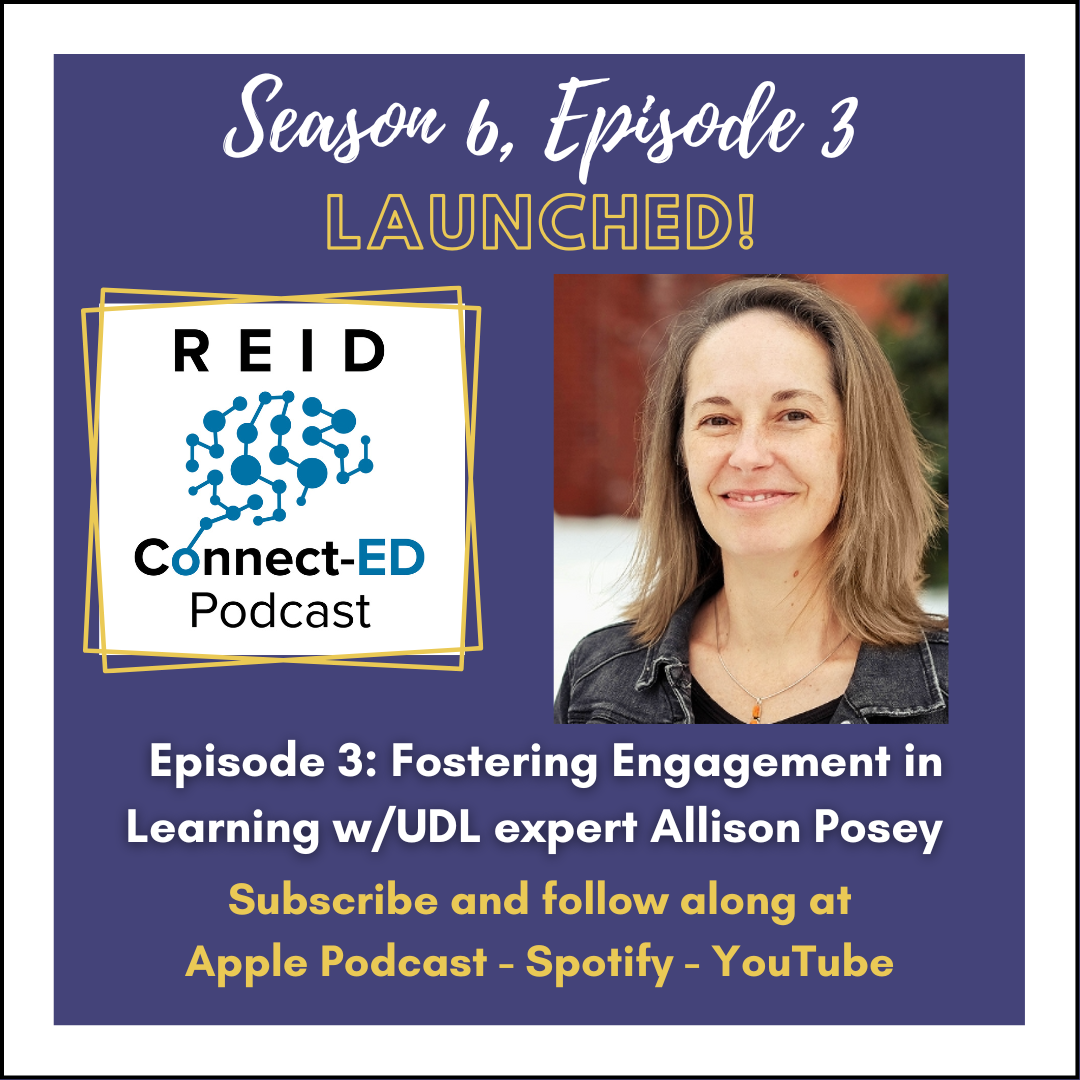
S6 E3: Fostering Learning Engagement w/UDL expert-Allison Posey
Listen Now!
-
-
Universal Design for Learning (UDL) gives us a language to help us to not look at students as having a ‘deficit’ in learning but that there is a ‘barrier’ to their learning that educators can try to better understand and address. Just like how doctors can utilize various ways of communicating to help their patients better understand their diagnosis and treatment. Just like how restaurants can find better ways of communicating what food items are on the menu to make decisions on what to order.
The UDL framework provides a way of looking at how to improve the access to curriculum. It’s not about just randomly trying different approaches to teaching (e.g., putting a video on; using technology), but it’s an intentional approach that is attuned to potential barriers and providing various options to get around those barriers.
The barriers to learning may vary across students but also may vary among students from moment to moment and context to context. That is why educators should be cautious about getting complacent in their approach to teaching.
Engagement is an essential part of learning that opens up learners into the process of learning. Engagement can come in many forms.
The idea of UDL is not to make the goals of learning easier. It’s keeping the goals rigorous, while providing flexible ways of getting to those goals. There is no right or wrong path toward that goal, there are just different ways of getting there. It’s not forcing students to utilize a particular tool that they may not want or need, it’s providing options that are aligned with helping learners reach their goal.
Allison shares stories from her own experiences in the classroom where she learned about barriers to learning and engagement in learning.
Sometimes teachers can have low expectations of specific learners, whereas the student may simply have different background experiences rather than different potential. This can lead to a self-fulfilling prophecy, where the teacher gives more attention and effort into the perceived ‘higher performing’ students, which leads them to excel more than the less attended to ‘lower performing’ students. This can happen even if there are no inherent differences in potential between the groups of students. Our expectations can bias us in nuanced ways, like how we give feedback, what we give students to do, how we separate students, etc.
It can take time, trial and error, and effort to make changes in expectations, approaches, and culture within a learning environment.
Learning is not just about acquiring knowledge but also being able to use that knowledge in a meaningful, contextual, and practical way. UDL provides options for how learning can be shown or expressed in multiple ways to facilitate this process.
Learning is a relational process and therefore is an emotional experience, as one of the founders of UDL, Dr. David Rose, would often say. The relationship can engage learners and open them up to possibilities.
It can be difficult to foster a relationship in particular learning environments, such as when there are large classroom sizes. It is definitely a challenge. At the same time, it’s possible to foster a sense of connection with students through the way you are teaching the material - in a way that is engaging and meaningful to the learners.
-
Alexis Reid 00:06
Music. Welcome to the ReidConnect-ED podcast. Today, we have a guest who I have known for many years and have had the privilege of working with through my adjacent affiliation with cast in my cadre and UDL faculty roles I've learned with and from at numerous conferences and conversations, and am honored to call a friend. Alison Posey is an international leader for implementation of brain based instructional practices and universal design. She collaborates with educators, administrators, trainers and families to apply this understanding of learning in the brain in their unique work environments. She is author of two books, engage the brain and unlearning, and has worked at cast for almost 15 years. She has taught science in high school and community colleges, and still teaches at La Salle University, just outside of Boston, Massachusetts. Allison earned a degree in mind, brain and education from the Harvard Graduate School of Education, and is an avid hiker and loves being a mom. Allison is someone who gets inspired by the teachers and students she works with every day. Her positive energy, kindness, care and passion resonates throughout any room she enters and leaves, a buzz that continues long after any presentation she delivers has ended. Her roots run deep in the field of education, and she has been recognized and honored around the world for her dedication to supporting teachers and learners through a UDL lens, but her approach and work really speaks for itself. Today, we're going to traverse many aspects of teaching and learning, but aim to focus on the core components of creating flexible learning environments that not only stimulate purposeful learning, but engage the brain to inspire learning across a lifetime. We are so excited to have you with us today. Allison,
Allison Posey 02:01
thank you. It's so great to be here, and thank you for that introduction. I'm already moved here, so I've appreciated our friendship. I'm so excited for this conversation and to continue to get to collaborate with you
Alexis Reid 02:15
Absolutely. And I'm glad to bring Jerry into this conversation, because every time we get together, we get so excited, and we probably aim to change the world, and have the gajillion ideas that come up. But you know, Jerry is in an adjacent field in mental health, and, you know, just going to graduate school in the same city together, he and I have collaborated and learned together across so many aspects of our fields, and I'll share a quick story that when cast had one of their anniversary parties, I brought Jerry long and he got to, you know, meet everybody that was there, and, you know, put faces to names and have these conversations that kind of bridge some of the work. And I remember years ago I came into cast when we would have those meetings to kind of debrief and share other things that were happening in the field. And I got to present a paper that Sherry and I wrote together about UDL and CBT, and I just remember David Rose saying, you know, Universal Design for Learning came from more of a clinical lens, and we're bridging that into learning environments around the world, not just traditional academic learning environments, but any place in space where you might learn. And I'm so excited to have this conversation with you, because first of all, we're kind of like opening the curtain so everybody can hear some of the things we talk about together, and hopefully we can inspire many others to think in this frame, to create accessibility for anyone who wants to learn. But I really am excited for us to all share together our collaborative thinking about accessibility and learning, especially in the brain, especially from a neuroscience perspective. So we're going to dive into and talk more about your journey, but before we do so, you know, almost everything we say and do comes through UDL lens. So I wonder if you can succinctly, which is nearly impossible, but we're going to try our best kind of orient the audience and the listeners to what Universal Design for Learning is
Allison Posey 04:19
absolutely and I will, just before I go into that, say, I remember when you both presented at CAST, I remember that day very well, because when are we ever not learning, right? I mean, we learn all the time, and I'll sometimes challenge my audiences like, don't learn. Right now, I do not learn, you know. So when we're thinking about learning and designing for learning, we literally mean anywhere, anytime, for anyone, because that's what our brains do. They are the ultimate learning machine. They are so strategically designed to be able to interact with environments, predict what they think is going to happen. And try to make the best move, to survive, to learn, to grow and to change. So So I was appreciative when you all came to cast and just reminded us this is not just for education. This is and there are so many times when I'm even in a doctor's office and they're telling me something and I'm like, wait a minute. Slow down. You give me that in another representation, because what you're saying verbally, I know I'm going to lose that right away. Can you give me a little more background understanding so that I can bring my own experiences to what you're saying? Can I have a 123, outline for what to do and a graphic organizer? You know, I just those moments can be designed differently. And so then when I get home, I understand it better. I would take the action more strategically. It just would help in so many ways. So which
Gerald Reid 05:51
is also important, Allison, too. Because first of all, I'm so happy to meet you. Well, I just said so many nice things about you, but it's so important. Because if you look at the literature on the the adherence of people in terms of what the doctors tell them, it's pretty low in general, from what I understand, meaning that people generally don't always do what their doctors tell them to do. And that could be part of it, like you're saying,
Allison Posey 06:13
I think you're right. And and the big thing with UDL, and this isn't, this didn't originate with UDL, but the you know that the whole premise is you don't blame the person for not you know, you didn't listen well enough at the doctor's office. Instead, you try to reframe it to, you know, if remembering it was a challenge, how could we do something differently so you can remember it and so shifting, you know, off of the deficit view, kind of that medical deficit view of learning and of humans and what they're doing and not doing, and really focusing it instead on def being a deficit in the environment is super empowering. I mean, that's a game changer. And again, UDL didn't invent that, but UDL reminds us, and really requires that we do that and and so often when I'm working in education, I get I'm getting older, and I'm starting to get a little more grouchy about some of these things I'm realizing, but I hear the deficit language all the time. My students aren't engaged. My students aren't reading at grade level. My students are being, you know, they're they are having behavior problems, and it's all framing barriers in the students. And I just want to be like, let's reframe it. The design supporting the behavior. How is the design supporting the engagement? How is the design supporting these different things? If we're, you know, owners of a coffee shop and our our customers aren't able to get access to the menu, we think of another way. We don't say, Well, you know, that that participant should, you're that that patron, that customer, should go someplace else. We know. We try to think about, how can we, you know, provide the menu with the QR code, how can we give a visual to go with it? You know, we try to change the environment and and this is what we try to get folks to do in education. When we think of UDL, we try to think of all right, how can we shift the environment to really better meet the needs of the students we know are going to they're going to come from different backgrounds, they're going to have different levels engagement, they're going to want to do things in different ways. They'll have different strengths and challenges. Instead of seeing that as a problem, let's see that as an opportunity to design for so then, of course, educators are like, Wait, how do we do it? So UDL came up with this very handy way, this table, this graphic organizer, these guidelines to really help us say, Okay, if we think the barrier, the problem, the challenge is around engagement. Here are some ideas. And one of the things I'm not giving you the short answer. Alexis, okay,
Alexis Reid 08:47
I love it. I'm nodding my head like a bobble head. I'm so excited.
Gerald Reid 08:51
How many times you go to a restaurant, you're like, I don't know that sounds good, but I have no idea what that is. Yeah, Should I try it? I'm not sure. No. I mean, can I have different ways of understanding what that is on that menu. Oh,
Allison Posey 09:02
when they have a picture of what the me the dish is, I'm like, Oh, look at that, you know, sparks my engagement. It sparks my curiosity. Often I want to learn more than when it's this tiny text. And now my eyes are getting bad and I can't even see it. I'm not gonna order that, you know. So it's really and as a plate goes by, I'm always like, Oh, what's that? That's representing the information in another way. So there is what UDL is. UDL just gave me a language to explain that moment. It gave me a way of saying, Oh, that's a different representation of the information that helped me reach my ordering goal. So nothing maybe changed about that moment, but now I have a deeper language and way of expressing to you and to maybe even the server. You know, if you just gave me another picture, or if you walked by with another thing, maybe I would want to order that, and that's what we're really we're really trying. To give more ownership to the learners themselves about their own learning, and the best way to do that is to bring the different, you know, menu items by them. So Okay, try graphic organizers. Try sentence starters. Have you thought of, you know, trying a visual with this? Whatever it is that you want to try. It's really aimed at getting at that more robust learning and that metacognition around learning itself. So my quick what is UDL? UDL is a framework to think about the design of learning experiences anywhere they're happening. If you really want to try to reduce barriers, here's a systematic approach to just spark new ideas.
Alexis Reid 10:43
Well, Said, I love that I got to it amazing, no, and I love, I love the examples. And again, I mentioned at the beginning that once you know what UDL is and you know what to look for, you can't unsee it, right? So the three of us all have a shared passion, including our producer, Mike here today for music. And one of the things that excites me is when you go to a concert and there's a sign language interpreter that's there, or captions to help you guide you know your experience, so you're fully immersed, and everybody can have a shared experience. And it's the most beautiful. I have the chills just saying it. So when we think about UDL, it really comes from this place of we want to create access for everybody, specifically, specifically those who have a disability, who might have a barrier to accessing experience, especially a learning experience. But when we create access for individuals who have variable preferences or needs, we get to have, like you say, this robust experience that kind of transcends any one moment, any one medium, any one thing. And I think that's the most beautiful part about life. Just to add one
Allison Posey 11:53
more thing to that, yes, and imagine if you went to a concert and someone said, Only if you have a visual impairment can you use the captions so often? That's what happens in schools, is we kind of keep options away and we're like, oh, only if you need it, only if you had some Can you have access to it? Yeah. Why? Why do we do it that way? You know, imagine if you went to get into a building, and only if you were using a wheelchair could you use the ramp. It just doesn't make sense. So so often I just get really frustrated with this idea that, you know, as educators, we're giving the students we think need them. Let's, you know, let's just open up the options and make it about the learning and the preferences and what you need that day. So I'm so sorry. Go ahead, Jerry.
Gerald Reid 12:44
No, I love it, and I think you all have infiltrated my mind in terms of how I teach, because I teach at BU and the graduate students in terms of becoming a counselor. And yesterday, I was teaching a class about how to basically teaching them about the theory of cognitive behavioral therapy, and there's a lot more that goes into it that like it's there's more in depth theory behind it. And I actually pulled up the podcast that Alexis, that I did, where she pretended to be in a therapy session with me, and I said, here's an example of what this looks like to engage them to see because they really want to learn about it. They don't want to just read it in a book. Oh, this is how you do therapy. This is what it looks like, but actually to see a model of it. And not only that, but I pulled up the transcript. And I don't even I just, like unconsciously started doing this, and I started scrolling through the transcript while we're talking so they can read while they're listening.
Allison Posey 13:34
Yes, yeah. And again, those strategies you've already known, right? UDL, didn't invent transcripts. UDL didn't invent these different ways, but UDL is giving you a new way of thinking about why they're important, why they're mattering, and UDL just gives us a language for thinking more deeply about why we're doing what we're doing
Alexis Reid 13:55
totally and in our day and age, with all the digital technologies that are kind of ubiquitous, right? There's so many people I have my smartphone in my hand right now with my notes that we can access and we can be able to translate the things that we need to and, you know, it's not that technology is necessary, but it most certainly leverages us integrating these options and accessibility points in such a really profound way that a lot of times, from an educators perspective, you know, I go in and observe classrooms, and almost every student has access to a Chromebook or an iPad. And, you know, why are we giving directions once and spending time to write everything down where we can have, you know, a 30 second video that kind of explains and breaks down what the expectations are. And you know, the students can refer back to whenever they want. And it's not just for an individual who has an executive function challenge, and you know their working memory is strained and needs to be strengthened. It could be for anybody that you know maybe was thinking about the breakfast they didn't have that morning, or how. Higher they were when they showed up for school instead of hearing the directions. So, you know, we can go down a rabbit hole with all the examples, but, you know, just trying to bring the listener into the experience and see how universal design is everywhere. It's embedded in so many different facets of our lives, and oftentimes to make that little tweak and adjustment to bring in that accommodation or scaffold can really be easier than sometimes we think.
Allison Posey 15:29
And there's sometimes a concern that when we do that, we're making it too easy. Great point. That's where the critical thing, and those of you who know me know I'm gonna say this word right now, because even my kids are like, again with that, Mom and I'll say again with that, this is where the goals really matter. When you know the goal and you keep the goal rigorous, you keep the goal robust, then you provide the flexible ways to get to it. You're not making it too easy. The fact that you have your phone, I have, I prefer the pen and paper, so I have that as my tool. So there's no right or wrong for the tools, but we're both working together to get to the success of this podcast today. We have that same high level goal, so use the tools you're you're using. I see Jerry just has a water bottle, so she's not using any tools today. Other
Alexis Reid 16:21
memories on point at the moment, right? I mean, what
Allison Posey 16:23
if we said, Jerry, you have to use a post it note, and you have to do it, you know, that might actually be worse for you to consider, like all of this podcast. So bring what you need. And if you don't know, as young, you know, learners often don't know, and sometimes you know, I might want to know this tool you're using on your phone, because maybe that would help me. It still is in service of the goal, and that's what oftentimes is missing. When people go to implement UDL, or, you know, even start to think about where there are barriers, you have to know what the goal is, because there's no just blanket way of saying, if you do this, everyone's gonna learn there's no such thing as that. But when you know that, if we go back to an example from Universal Design and Architecture, if we know the goal is to get into a building, then we can start thinking about the different options there are to get into the building. But if that isn't the goal, then we wouldn't want to, you know, start putting ramps on all of the steps, because that might actually not be good design. So I really encourage people to always go back to what is the goal, and whether you're, you know, it's your exercise routine or, you know, making dinner at night or going to a coffee shop or teaching your bu course, knowing the goal really helps you. Then decide, what are the different tools that are helpful? And then where are there barriers that you know your learners may encounter? And then let's just think about putting maybe one new thing in the design to help students to get there. What do you put in? Well, take a look at those UDL guidelines. They might help spark an idea. So that's really what those guidelines are. They're there to spark ideas and to think about the designs and tools that are already there, so you can maybe anticipate where there are other barriers.
Alexis Reid 18:06
I love that. And you know, oftentimes, and I'm sure you have a lot of shared experience around this too, and jerry can probably chime in, as well as a lot of times we hear, you know, UDL is just good teaching. And you and Katie Novak, who is another powerhouse force in the UDL world, wrote this book called unlearning, and I frequently talk a lot about this for years, that we often teach the way we were taught, or the way we learn best, or in our mind, what we imagine the ideal situation would be. And oftentimes we can create some of the most amazing, exciting edutainment opportunities, right where students are on point and they're excited and they're quote, unquote, learning, but even in those moments, we might still be missing a lot in just having one perspective that we're planning for, or one you know, learner that we're thinking of or trying to target, whereas UDL really challenges us to consider the variability that's among us. And there's so many examples, and I'm sure, I hope you'll share some of how we help educators even unlearn some of those really core principles that they've adopted, and probably have been pretty successful with students over the years in implementing and doing to be able to help recognize that there's oftentimes variability that even when we're thinking about variability, we might still miss.
Allison Posey 19:38
Oh, I'm so glad you brought this up, because the I experienced this myself as a student, and then as a teacher, I started to have a moment, and then with UDL, I've been able to reflect on those moments. So if I could just share those two things quickly. When I was a student, I always hated the game day before a test, I never liked. Playing those dumb games to study for tests. I just didn't feel like they were helpful. I hated the competition. It felt chaotic. And they're like, this is the fun day. I'm like, No, this is the awful day. And then when I was a teacher, there were some I got to teach high school biology, which honestly is one of the most fun classes to teach. So many relevant examples, so many fun labs to do. There is this lab that was all, oh, go ahead. I was gonna
Alexis Reid 20:24
say everybody remembers creating their model of the cell right at some point of their educational career. And, you know, at a high school level, that's where it all comes together, the garden cell model. That's right, mitochondria. Every so every student I've ever worked with, regardless of the age, remembers that the mitochondria is the powerhouse of the cell. So true
Allison Posey 20:46
for the mitochondria, so good. It's so good. It's so funny. It was really to understand these four properties of the phospholipid bilayer, the cell membrane. So it actually did have, you know, a content connection. But you basically got to play with bubbles. The bubbles were simulating the cells. And I just thought it was the most fun lab. You know, I was always like, it's the bubble lab, and we get to do the bubble lab. And, you know, I had just assumed that was a fun lab. And it really it was, like, five or six years into my teaching when I just remember seeing on a student's face. I was like, Oh, she's not having fun. And then there was another student one time who came up to me actually angry, because they had a job interview after school, and they had put on a nice outfit that day, and they got the stupid bubble gunk on their outfit, and they were, you know, just and I started, I hadn't learned about UDL yet, but then once I learned about UDL, it just all clicked, oh my gosh. The goal wasn't for students to play around in the bubble gunk the bull. The goal was to really learn about the cell membrane and the properties of the cell membrane and watch how important like, once I started realizing separating the goal from how I was having, like the activity, how I was having students do it, all of a sudden, I started to think about, okay, why does this matter? Because the first UDL principles around engagement. So the first thing you want to do is just say, you know, why does this matter? Why am I even teaching about this phospholipid bilayer and how things move in and out of it. Well, in order to get drugs and medications into your cells, you have to understand like, this is how real world scientists are thinking about it. And how does this matter for high schools, you know, science high school students, well, they put a lot of, you know, gunk on their lips and lotions and stuff. So I started asking like, well, is that getting into your cells and all of a sudden right there, that engagement, not playing around with bubble juice, right? That's engagement that's toward academic rigor. That was this moment of like, oh my gosh, for eight years, however many years I'm up to now, of teaching this lab right there, again, that's not going to engage every student, but wow, did it engage more students just by shifting it right there. Then honestly, I had to do more learning as an educator. I had to actually understand, like, go and do you know, how are cancer medications getting in and out of cells? I'd better know some of this. So I honestly, it helped me learn more, which was amazing, right? It made the learning more robust. And then I started actually thinking about, Do I care if all students even do the bubble really? The answer was no. I mean, that really was construct irrelevant. It really didn't matter toward that learning goal. So then I started saying, All right, so you could, here's some background, some ways to build your background. Believe it or not, the main way I had, I know this is going to be shocking, was reading and taking notes out of the textbooks and listening to my mini lecture. Those were the two ways that I offered for students to build their background. How boring and lame is that some students might love that. Some might I honestly love getting a textbook and reading out of it, that for me, works as a learner, but it doesn't for everyone, for so many reasons, right? Maybe I left the textbook at home the I couldn't turn the pages. Maybe talk about accessibility, not everyone can physically hold and manipulate a textbook in the same way the vocabulary the English language, like so many barriers in reading, reading out of the textbook, right? So did I care that they read out of the textbook, or was I really just wanting them to learn about those four properties of the cell membrane? So I started going, Okay, let me shift that homework assignment. I want students to learn the background. They could watch a video. They could watch a recording of my mini lecture, the recording like you were talking about earlier. They could read and take notes out of the textbook. There were a couple different ways they could do that. Did I care if they did it at home that night for homework? Or could I provide that ahead of time, before class? And they, you know, could use. A study hall before they could use a little time at the beginning of class, how could I, you know, just make sure that before we go into the conversation, the discussion, students are able to build their background in the different ways. And then they could do the bubble lab still, or they could build their own model, or, honestly, they could just do a worksheet, if that was the best way, whatever the best way was for them to be able to show what they know. And choice can become overwhelming, right? I might not want to make all of those choices. Fine. I can offer, you know, here's, you know, if you just want to do this worksheet, if you just want to show in this, you know, with this bubble lab, go for it. But if that doesn't work, my students started to understand the culture of my classroom was really about tight goal, flexible ways to get there. They would often make suggestions to me or bring in resources to me. And I was like, this is magical. Students are bringing in different ways, and it truly transformed my classroom. So to your point about unlearning, I realized I ended up trading up so many of my old ways of this is how I think instruction should be. This was how I learned it as a student, and this is how parents think, or my administration, administration thinks that I should be designing these lessons. This is how students think they are supposed to do it. They think they're supposed to read and write about it. So there are so many challenges that UDL, again, it sounds so simple, but it truly transformed the way I approached teaching and learning, and the way I scaffolded the experiences and the culture that then popcorn in my head had popped about UDL, and you can't un pop the popcorn. Never Go Back to Okay, everywhere. We're all going to do this, you know, this bubble lab now, and I didn't always know why, you know it was, well, this is the activity we do. And I just I couldn't go back. Now, as you're talking,
Alexis Reid 26:58
I'm like thinking all that we had planned that we wanted to talk about, and I feel like you just encapsulated everything in that one story, and it was so well done, right? I won't use the perfect word, because I tell my students that's off limits, because very few things are perfect, but it really it hits all the points in understanding universal design, because it's not about going through and picking a thing off of the guidelines and saying, Oh, I've used a video. I've represented this information in a different way. I made it a safe environment for students to make mistakes, and all those things are important, but more importantly, considering your approach to integrating that framework into your classroom. I love what you said before that. It created a classroom culture that the students entered into recognizing and knowing that they had options that they can choose and navigate based on, you know, a, what they needed and B, how they were feeling that day, right? Did they need a preview? So often, the students I work with with executive function challenges, especially, or those who have anxiety, they benefit so greatly from just having a preview, right? Just just being able to see the vocabulary that's coming up, and having that familiarity. And I want to be super clear, because when I say preview, I don't mean pre teach, right? It's essentially just like getting familiar, right? The same way we prepared for today. You know, we got familiar with the content we wanted to explore. We got to know each other in a different context altogether, as the three of us, and it allowed for us to show up and be present and to flow with things. And I think, you know, when we talk about Universal Design for Learning, and Jerry and I frequently talk about this, because it's not taught in the world of mental health, right? It's not taught in the world of even higher education. A lot of times, like so, few professors understand how beneficial it is to think through this framework, not to their fault, but it's so important to just keep this mindset, but we talk about it all the time, that it can feel really overwhelming to think about, how am I going to meet the needs of everybody? And it's very easy for us, as you said at the beginning, to fall into, you know, what's wrong with the student? Why are they not doing a thing? And I'm going to just make a plug, and I hope we can kind of traverse into the neuroscience aspect of affect and emotion and learning, because when we even have that mindset as of, you know, this student just can't even if we're not communicating that verbally to a student, a lot of times non verbally we are. And when I observe classrooms, especially through, you know, the the lens of the work I do with executive functions, I immediately, and I wrote this down in my notes the other day when I learned the name of a student within half hour of observing. A classroom that means we're paying too much attention to that one student, and we're not paying enough attention to what barriers in the environment are preventing them from accessing what they need, and leading to some of these attention seeking dysregulated, frustrated behaviors that we tend to see come up in a classroom that shifts our focus as educators to say, Oh, how do we how do we help this individual? How do we help the student? Whereas UDL and the approach you just described as saying, Okay, we need to shift the way we're doing things. Yes, Alexis, you've
Allison Posey 30:35
just hit on something that I'm currently researching and writing a lot about, and it stems from my frustration with exactly what you're sharing, and it's often low expectations of students in their learning. And as early as kindergarten, students started start getting labeled as high, middle and low level students. And it just it. It breaks my heart, because often what it is, is just having different background experiences and sort students. And maybe we don't call them high, middle and low at the beginning. We call them the blue group, the red group and the green group, but everyone knows who's in those groups. And the language that I hear so frequently, I mean, so frequently, that it's starting to really break my heart from educators is, well, my high level group is getting it, but my low level group is not. My high level student is doing this and my low level student is not. And I just want to say, of course, because think of expectation and like you're saying those subtle cues that are being given off. And this has been researched for decades. You probably read this in graduate school with me, but there was so the book The Pygmalion in the classroom was from the sixth so this is not this has been researched for decades and decades, but this, this research study, I think it was done on fourth grade students. But basically what happened was the teacher was told at the beginning of the year, here are the five students who are going to bloom this year, and at the end of the year, guess who bloomed those five students. But here's the kicker, those five students were chosen at random. Those five students were chosen at random. So imagine if you just randomly pick five students from a classroom, and you think they're the ones who are going to bloom and Excel. Those we do subtle things our expectations matter, and whether it's the little ways that we give feedback or those non verbal things that we do, the ways that we separate students out the things we give them to do, those expectations matter. And when you now go on for students 5, 10, 15 years in a system that has consistent, low expectations of you, I want out of that system. Also my behaviors are going to be exactly my nervous system is going to know this is an environment that's not good for me. Get me out of here, and my behaviors will follow. So I just I often that shift to focus on designing environments that truly are welcoming and a culture for learning is so hard to do, it sounds, you know, from my my classroom description, it sounds like, Oh, this is something I just did that took over a year and a half for me to make those changes and for that classroom culture to really develop. It takes time they truly can transform and hopefully shift those expectations, both for the educators and the students themselves.
Alexis Reid 33:35
Yeah, even when you said, you know, these are the students that aren't going to do well, and we give the focus to them and how that plays out my whole body, like I felt that when you said that in my body. I don't know if, Jerry, you experienced that too, like it just didn't feel good for you even to narrate and describe. You weren't telling me that I don't do well or not going to do well. You were just describing students that often get that negative attention for whatever the reason may be, you know, outburst behaviors or just expectations. It just felt terrible in my body to experience that. I don't know how you felt in that moment.
Gerald Reid 34:14
Yeah. I mean, as a psychologist, I'm always trying to understand why people do the things that they do. And I think it's such a good first of all, like, your whole bubble gum example is awesome. And I'm going to relate that to what I'm about to say, which is that I think as a teacher, you want to feel successful as a teacher. And you know, I think that maybe teachers who kind of fall into this trap of, oh, the high expect the high achieving kids are going to get it, the low achieving kids are not going to get it. I wonder if part of that is kind of wrapped up in, you know, everybody has ego around what we're doing. One, we want to feel confident and successful. And I wonder if part of the reason this happens is because they feel like, oh, the high achievers are going to get it. So I'm going to put my energy into where I'm going to get the best results. And. It's going to make me feel good as a teacher, and I'm going to relate this back to what you did, which is a good model for not doing that, which is you didn't have an ego as a teacher in the science class because you checked in with Wait. Are they engaged? Let me actually truly be open and be be able to accept the fact that they're not engaged, and then do something about it, right? Which is, in some ways, as a therapist, I tell my students, I supervise all the time like no ego. Don't have an ego as a therapist, because you can't. It's not about you. It's about understanding what's actually happening. And even in the class I was teaching, you know, literally this Thursday, they were about to have spring break. They're so burnt out right now. And I said, I'm about to teach you something before I teach you this, can I just check in how you guys feeling? Because I feel like you don't really want to learn anything right now, like, because it's a three hour class, I'm like, I feel like, if I bring this in, you're just not in the mood to learn something new. And we had a little bit of processing for about 10 minutes, and then we went back into the learning. But to your point, I think it's, you know, I had to check my own ego like I don't, you know, I don't want to have to feel successful to teach them something new. I just have to pull back, you know, what's happening and how do I adjust?
Allison Posey 36:11
There are two thoughts I have to that that connect in the what is a story from my engage the brain book? It's, it's the opening. It describes my meltdown as a teacher. So it's February in New England. I grew up in Florida. I've been living up here for 15, 16, years now, but oh my gosh, winters are hard for me. I just it's so cold and dark and snowy and gray, and there's a lot of traffic in Boston. I had two young kids at the time. I was teaching full time. I had a part time job Alexis. That's when we were teaching the online course. There was a lot going on in my life, right? There's just like we all have, we all have. And so this particular February was the Super Bowl, when the Patriots were doing really well, and our headmaster said, You know what, we haven't had any snow days. If the Patriots win the Super Bowl, I'm going to just, I'm going to call a headmaster day, and we're going to not have school on Monday. And all of a sudden I was like, Who's this? Tom Brady guy. You got to win this thing. All of a sudden I'm like, down. I am cheering for, you know, I don't even know what's going on. I'm like, yes. So it comes down to the very end. I learned about a Hail Mary, and Brady, like, throws this Hail Mary, and it's missed. And the Giants, some of you may know, the Super Bowl. The Giants won the Super Bowl, and I literally went upstairs and fell into tears. And my kids are like, you know, Mom, are you okay? I loved my job. I loved what I was teaching. I loved my students. I was tired. Teaching is first and foremost emotional work. And you know who said that first to me was David Rose right? And when he said that, I literally was like, Oh my gosh. We don't talk about that. We don't talk about how teaching and learning is first and foremost emotional work, and we don't take care of the emotions. In fact, I even remember this teacher one time. It was one of my my kids, high school teachers, I was at the back to school night, and he's like, I have so much content to teach. I don't have time for that emotions. I just want to be like, Well, how's that going? I felt that, but, but Jerry, part of what you did that was so brilliant there, and I don't think we let ourselves do enough in academia is we think we have all this content to teach, so we have to push, push, push. One of the ways we learn is through rest and relaxation. In fact, one of my and I'm going to guess your favorite neuroscientist, Mary Helen Imordino Yang, has this article called restfulness is not idleness. I might have said it a little bit incorrectly, but rest is not idleness. I
Alexis Reid 39:04
teach that in my course too, right? So my students love it. They're like, really,
Allison Posey 39:11
instead of like, if you had just pressed on, I have this, these three hours of teaching, and I will do the the learning would have been worse. So the fact that you backed off there, that gut sense you have neuroscience, would be like, yes, that actually is strategic. And when we think of the pace of the learning that we have, it's not just the students who need this, but it's the educators too. So especially this time of year, like when I was thinking about this call that I had with these educators earlier this week, and it was all the students, the students, the students can't, can't, can't, and the high level and the low level students. And I'm just like, Ah, they're tired too, and they're in a system that goes and goes and goes. And if you follow in the pace of teachers over the course of a school day, it's exhaust. Stay, and they are holding the emotions of all of the students, journeys and all that, you know, throughout the day, and they don't have, I never took that time that I needed as a as an educator, to like do what I needed to do to fill my emotional energy a little bit. And Alexis your you know expertise and executive functions are exactly what's impacted when those emotions are tapped and drained. So I just, you know, I'm like doing a call out to the to the world here. What do we do in an education system where this isn't what's scaffolded? We know that the literal design of our teaching gaze is not in line with what we know about learning and the brain. What do we
Alexis Reid 40:45
Yeah, it's so interesting. And you and I have worked in different systems around the world too, where there's, you know, a different culture, a different expectation, a different you know, almost like an energetic flow, where some more of downtime is prioritized, right? I'm thinking about where there's, like, specific times where students and teachers are like, have that break, but, you know, at the same time they're prioritizing that, and sometimes they have a very traditional model of, you know, disseminating and getting through the content. But I'm also thinking about, you know, the educators here, and I validate them all the time, and I'm saying we're oftentimes as educators, working against the currents. There are so many complexities in our life right now and so many expectations on us, as you described so beautifully. And I'm thinking about just this Monday, I was in a school and I'm watching a third grade teacher teaching a really complex new math lesson of a new curriculum that they just got last year where they're expected to deliver it exactly the way that it's planned and given to them. And it's complex, right? It's a whole different design and way of thinking about the math that they're teaching, let alone considering all the other aspects we're talking about. And she so masterfully, I praised her for this. She kind of pulled it back. And was like, Okay, our goal today was to have a strategy to approach division. Do we feel like we learned some strategies today to approach division? It wasn't, did you get all the problems right? It's like, did we think about the way we were approaching this mathematical concept that in third grade in March, right, is actually a very complex topic, right? Developmentally, that's hard to wrap your head around. And she was integrating in all these principles that we talked about, about meta, cognitively, pausing to reflect and and she didn't, you know, masterfully kind of flowing through both the lesson and the independent work time, by engaging the students to think about the process of learning rather than just the outcome of Did you get it right? Do we get through everything we intended to which I think is really at the crux of everything we're talking about here? And one of the things I haven't told you this yet, Al, but I you know, one of the ways in which I've been talking about the interventions for executive function to begin is not about, and I joke a little bit about this, and it's nothing against color coding, because it is beneficial when we understand why it's beneficial. But you know, it's not about a strategy to bring in a tool or do a thing, the intervention at its core, when we're tapping into the emotional side of learning, is really in our interaction and approach to what we're doing.
Allison Posey 43:28
I mean, I almost want to just give a pause there, because that's there's so much in that statement, yes, and part of I appreciate so much how you noted how the teacher kept focusing on the goal, I'll kind of bring us back to that. And one of the new things, just to kind of go back to the UDL guidelines, one of the new considerations that was added was around joy and
Speaker 2 43:51
play, yes, my favorite part, right?
Allison Posey 43:55
And learning. And it's so interesting to feel some of the discomfort for some folks, again, variability around that, but joy and play is where the nervous system gets to reset, and laughter is important to that, having quiet spaces to just go try something out on your own, so it's maybe not in front of other people. That's an example of play. I mean, play doesn't have to be, you know, running around during recess, but really thinking about experimenting and taking time to play with an idea, and tinkering with different ways of division and really trying. And I actually remember teachers one time in a professional development training I was doing, they were laughing about something, and they're like, you know, what? If this were our classroom, and we were laughing like this, we would probably go over and shush them a little bit, because it would be threatening like then just thinking about the culture of what's expected in school. And another piece, Jerry maybe to kind of go back to some of the psychology piece, and Alexis and I were talking. About this at the beginning, kind of we were getting ourselves ready for what we needed for this right now, right? I need food a lot. That's my like, I I'm one of those people that needs, like, seven small meals a day. School was torture for me. That way, I actually didn't learn that that's what I needed until I was a little bit older, and I thought, oh my gosh, imagine if I had known before class I need to eat a little bit. But the school day even mandates and dictates often when we get our glucose intake. You know, here's when you get snack, here's when you get food for lunch, here's when. And there's so much rigidity to so much of the school day that I really wonder, you know, where we could start to bring in a little more flexibility, in having quiet spaces, being able to get food, being able to move around a little bit when you feel like you need to, to continue to do
Alexis Reid 45:56
the learning. I want to give props to that same teacher that I was describing who kept going back to the goal and focusing on strategy. Because during the independent work time after the lesson, where the students went back to try, first of all, they all were encouraged to pair up with another student to share their approach to solving the problems that they were testing out together for one and for two, when they went back to find those pairs or groups to work with. They were encouraged to grab their snack. And they were snacking as they were working. And I was just, it's like a breath of fresh air. And I was cracking up when he said snacking, because Jerry and I just presented at a conference for sports psychologists in a BU this weekend, and he had a list of options, right? He said, You know, this is something you can go back to and kind of dive into, if you want to. On this slide in the very first tab, the very first bullet he had was, you know, provide snacks. And I said, Jerry. I said, that's 100% right. Because, you know, he's probably thinking in my office, I have tons of snacks. Because, you know, the younger students I work with come after school, where they're probably exhausted and starving, I said, but you can't have just snacks at the top of a list of UDL options as like the first thing, because I don't want people to think like, oh, I gave them snacks. I'm doing UDL you are at the same time, right?
Gerald Reid 47:18
Vending machines,
Allison Posey 47:21
yes. But you just got at what's so tricky to understand about UDL. Often, people will say, Well, I do this option, therefore check it off the list. I've done UDL, or first learn about UDL. And you think, you know what I give graphic organizers, I already do it. And they don't keep pushing to understand, again, that it applies to all the things all the time, and it's never the same answer every time. And that's where the masterfulness of teaching is still required for the teacher to know their students, to know the context, to know the resources they have, and then to adapt each time you know again. This is why teaching is the hardest job ever,
Gerald Reid 48:06
and to your all your points where your UDL is being constantly paying attention to what this person needs as the context changed. And Alexis always says that what you need now could be different from what you need later. And I want to pose this question to you, because I'm not in like a K through 12 classroom, right? I'm teaching at a graduate level, which is a different context, but I'm I'm one. I feel like I have more flexibility in this role to not and also as a therapist too, because learning happens in therapy. I feel like that context is unique, and I take it, I try to utilize this aspect of the context of is that the learning doesn't have to happen right now. Like, this is a long term process. I don't need to force, oh, they didn't get it right now it's over. We have to move on to the next topic, or the next curriculum, or the next part of the curriculum, right? I'm always like, well, we have time, like, no pressure. We're going to continue to learn this in different ways, and that's just part of the learning process. Because learning takes time. How does that play out for teachers in a K through 12 classroom, is there more pressure to kind of just keep moving on to the next to the next, versus just making the learning just kind of happen in different ways over time to make sure you're really learning it?
Allison Posey 49:12
Oh, 100% the pressure is real because teachers are assessed based on standardized test scores that their students receive students teachers are assessed by if they're teaching an AP course, then you know the score on the AP exam. And if you've ever seen what's changed about AP textbooks over the years is the amount of content students are expected to get through. So I think as a system, really thinking deeply about learning and designing for learning in ways that align with the learning brain does not happen. That space is not there. And MCAS, the Massachusetts standardized assessment that students have to take is in March, is this month, and the feeling and the stress of the teachers is real, and that gets shared to the students. Yes, and that pressure is there, and it there are so many barriers in the process of a standardized test that could be used through the UDL lens. I'm not saying don't ever give a standardized test, but recognizing that if the goal is, you know, to get students to take a standardized test, bringing UDL to that process, you know, the goal is to take a three hour multiple choice test, where you'll need to sit for that long and pay attention for that long. You know, what are the different things you need to be able to get through that test to be successful at taking a test, and that's different than learning the content in a robust UDL way, so in a very long winded way, there is, I think, a lot of pressure on teachers to get through content, as opposed to teaching the metacognition of learning.
Alexis Reid 50:50
In the Montessori pedagogical philosophy, there's this principle part of learning that's called practical life. So when I was a Montessori educator, I would always think about, you know, test taking as a practical life skill, right? And it doesn't necessarily have to be through a standardized test. Like we're constantly tested, and it's like, well, how do we problem solve? How do we situate ourselves and collect ourselves to be open to something that might be a challenge, rather than we're going to take this test and you have to do well on it, right? It's more about thinking about our experience and being tested that I think was a really nice shift. And I don't know if you know, again, the pressure that a lot of educators, especially in public education, feel is so real, it's palpable, and you know, it's trickled down to parents, families, caregivers, who think that that is the end all be all for their child that they have to do well. But the other reframe that I always share, especially with students when I'm helping them to not be, you know, anticipating the stress of this experience. And you know, I share this, and I hope teachers will hear this as well, that these standardized assessments, if we lower the stakes in the way we approach them, it transcends everything. And I always say that, you know, this is just a collection of information to see where you're at through this one tool at this one point in time. It's not really everything, but it can really actually give us a lot of good information to think about where we go next and what do we need to do. And I know, you know, from a systems perspective, that's not always interpreted that way, but when we approach things a little differently, and I will say, a bunch of the students that I work with across different elementary schools, you know, in Massachusetts and elsewhere, they have been taking a little different approach to these tests that has kind of cut some of the stress of it, and that it's not like this looming fear of, oh gosh, here comes again. We have to do this. And it's, you know, because again, the stress level is palpable, and it can take over for several weeks. It's not just for those few days when the students are being tested, and we really need to shift our approach to all of that. But I know I'm preaching to the choir with you guys right now.
Gerald Reid 53:07
Let me be UDL right now. Let me bring in some UDL here. So let's say that someone learns the content and aces the test, and they know the content really well because they memorized it, or they just know it pretty well because they paid attention in class, and they just have a pretty good memory to hold on to it, right? Let's, why is it important that? Why is that not? The end all be all for learning. And in my opinion, is because you have to be able to use what you're learning, right? Learning is only as important as it's used. So, you know, Boston University just put out this article about they're trying to have research be convergent, convergent research, which is different fields talking to each other and learning from each other. So, like, you can be an expert in one area, but you know, you can't necessarily use that information in a way that's going to make an impact on the world if you don't know how to actually use what you know. And so the idea is like, listen to people from other fields, so you can learn different ways of using what you know. And so as an example, so to your point, right? Just taking a test is not necessarily showing in the UDL principle, show what you know in different ways and use it in different ways, is maybe an underutilized aspect, like as therapists and training, though I'm trying to train them, it's like you can learn you know, how to do something, but if you can't actually put into practice and role play and think critically and do case studies, right? I'm always bringing case studies all the time. Let's talk about your cases. Let's conceptualize your cases. If you can't think critically and use the information, then what's the point of really knowing it. It's a foundation to have the knowledge, but to use the knowledge is
Alexis Reid 54:45
a different level. Yeah, I say it's the distinction between wisdom and integration. Like we can know a lot. In fact, we have access to so much information, but like you said, what we do with it? And I'm excited to hear your thoughts on this too. Alison. Is really where the magic happens. My opinion, yes,
Allison Posey 55:03
I have an example that I haven't thought of in a while, but might be relevant to to this. So I aced organic chemistry in college. I just got it, and it's considered one of those, you know, weed out courses really challenging. When I tell people I got an A in organic chemistry, often they think I'm very smart. Well, let me tell you how I got an A in organic chemistry. I memorized very well. I memorized the answers to those problems, and I got A's on the test I know zero or organic chemistry. And it's a bummer, because as a biologist, I would love to know, I still, you know, like, have little ideas of, here's what's happening when the molecules are coming together. But was I learning a real world, world, application or skill? No. Did I graduate with, you know, honors? Yes. What did I really learn? You know? So I love your I would have much rather, had to have had some real, practical application of here's how chemists are using here's especially biology. I know there's a better word than biology chemists, and I'm not coming up with bird, right, but here's how these are applied in the real world. Contribute to this knowledge, contribute to the thinking, bring your background and your perspective to this real problem we're trying to figure out in our lab. But no, I memorized a bunch of so when we think of our system and we think of what we're truly valuing by the assessments that we're giving, are we really getting at those real world problems? And I invite this all the way to the youngest of learners. In kindergarten, you know, they are also learning to think about how things go together, how things work. In middle school, they're thinking about this. Real organic chemists are thinking about this. So we're just, you know, we're not thinking of it in the same depth, but that starts to build and grow. We can start teaching it from the earliest of ages, and if we do across the system, I do. I wonder, how much more robust will our learning and research and actual real world application be? I mean, I hope I get to see that happen. I think it might be a long time. And if there are systems that are doing this, please reach out to us and let us know, because yes, please, have not been my experience in the last 25 years in this field,
Alexis Reid 57:29
I will say, though, and I'm going to give some props to some of our friends and colleagues that I think the reason why I loved working and interning at cast and being affiliated with with the folks there is because of people like David Rose and Ann Meyer and Todd Rose and Gabby, because all of those people didn't just study the cognitive neurosciences or education. They had such an in depth curiosity about so many different fields and aspects in life. And my mentor, and somebody who I just holds in such great esteem, Penny Hauser cram, from BC, is the connection I had to cast because she and David Rose studied together, and both of them, you know, the thing I was always drawn to is how that they they just pulled from so many different ideas to make all of these connections. And one of the things that I really fear in this digital age, and again, this could be another conversation for another time, but I'm just going to plant the seed for now is that we are getting so myopic and just thinking about one thing at a time. And with the advent of like, AI being so ubiquitous now, and so many learners doing the same thing you did in college, like, let me just get the information and get the good grade to get through this. And I have conversations every day about, if you're not actually learning from this work, especially if you're in college, what are you paying for? Like, what is actually your experience as a learner and a student? Now you're missing so many opportunities that, literally, you're paying for for one and in two. If this isn't content that you're really into, can you use this experience to practice some skills to figure out how you learn best, see if there is a random connection to the thing you do care about because I feel like that's where we get to expand and create and design in a way that helps us better understand and to your point, very conceptualize what we're doing and how we integrate what we're learning in a way that is moving us as Humans forward. Sorry, this is a big philosophical thing, but when the three of us are together in different capacities, this is where my brain goes.
Gerald Reid 59:46
Well, both of your I mean, let me just point one specific thing out right there that you may not be expecting me to say you were talking about your mentors, who you learned a lot from. They were. Of professors, or, you know, colleagues that you learned a lot from, and even Allison, right, your colleagues, absolutely, you're a person who values relationships. And what's the common denominator with these people you're talking about? You learn from, you develop that relationship with them. Yeah, and to, you know, when I'm in my professor role, like relationships are key, I love building a relationship and being part of their journey of learning, and they feel that they know that they respect that, and it opens up the learning and the engagement. And Allison, you're all you're all about engagement and learning, right? And this episode is a lot about engagement, and engagement is just so important. It's the fundamental the door that opens learning to happen in the first place. Yeah, Allison,
Alexis Reid 1:00:40
I want to open this up to you, but I have to give Jerry some props. Number one, you are one of my greatest guides and mentors and teammates in this process of me learning and becoming better every day. But also your students feel that too. We were at this conference. One of the students says the way I describe Jerry is that he's like a really proud dad that just wants us to know all the things and do really well. And I was like, Yes. And, you know, for somebody to say that, and for Allison Yun and I have shared these experiences before that, you know, educators, we've worked with students who work with colleagues. We work with like they remember how they feel when they're engaged with us and and that is, I think the root of anything,
Allison Posey 1:01:22
it goes such a long way. And I understand the challenge. If you are teaching a lecture hall of 300 students, it's hard to develop those relationships. If you I had 152 students when I was teaching high school science one time, oh, my God, all you know, you have five classes a day, and they just go through and you just feel like you are mass, but you're like, wait, what Didn't I already teach? It's just it gets really hard so I understand the numbers are real, the trying to give feedback and design flexible learning and also talk to parents and get to the meetings you need to. It's so much in a day when you also have all of those students and and there's an interesting study, and you may know this, I guess I'm going to bring this up because of your psychology experience. You know, when you're having a one on one with an individual, oftentimes your physiology mirrors that other persons, right? And then when the person leaves your office, a lot of times they feel better, but you're still holding some of their emotions right. So as a therapist, you probably know you need time, you need space. You need to be able to regain your own kind of our discussion earlier of the burnout you need to do, what you need to do to get yourself in a space for the next client, do teachers have that in their school days? And I will invite the administrators and the districts you know to think about that. When do teachers have that space to redo their physiology, to get into the space where they're ready to take on another 32 students for 55 minutes with all the content and all the needs. So both as a therapist and as an educator, and thinking about the challenge of the numbers and the challenge of the amount of content, we think we have to cover. This is where the unlearning, I think, really has to come in. And this is where UDL was designed, as David Rose will say, to disrupt systems. I mean, it really, it can be the smallest tweak. I'm going to add a graphic organizer, I'm going to put it a vending machine. It could be that small, but it also could be a way of completely rethinking the system. Yeah, and so that's a lot for this. No,
Alexis Reid 1:03:46
it's great. And you know, thinking about, you know, even if you can't make a relationship connection, like a personal connection, with every student, and I hear this as feedback for myself, and I feel this with you too, is when you are passionate and connected to the work you're doing, that authenticity becomes the energy, and those mirror neurons are firing right? And that the people that you are working with, and I experience this all the time in professional development and conference talks, where there are hundreds of people who may or may not even want to hear what you're saying. You know, they might just be forced to be there, or, you know, they're they've thought maybe it's interesting, and they're not really sure. But I think that authenticity, even for a burnt out teacher, you can kind of find that within you to be able to share your excitement for learning whatever that might look like,
Allison Posey 1:04:37
that's so huge, because that's exactly it. And you had mentioned Jerry, like the case studies, the ways that we think about the design being able to carry that is so critical for us. UDL can also be our greatest tool to really help us be able to recognize and one of the things I've seen educators do is use. UDL to analyze curriculum that's already been developed. So whether you're teaching in higher ed or whatever you're doing, use UDL to say, Okay, here's what I currently do. How many of the things would go in the engagement column, how many would go in the representation column, and how many would go in the Action and Expression column? And I know when we did this with the next generation science standards, we found, okay, there's a lot already there around action and expression and representation, not so much around engagement. Great. Let's start focusing there, and we can get really, you know, strategic and intentional with that design. So take your system, take your school, whatever your role is, and just start to think about what's already there and works. Where are there still those barriers? And where can we really think about, especially those relationships? Where are the barriers to the relationships, and how can we scaffold those even with the large numbers? So I don't want people to leave feeling like this is just overwhelming. It's so big, I have to change the whole system. You can start with something really small. And you know, keep, keep that vision of what we know learning and relationships can do for the learning and do just one little thing, you know, a plus one severely,
Gerald Reid 1:06:08
and it's, it's trial and error, right? You're like, you know, you're not gonna, like, fix everything in one attempt, right? And that's part of the learning processes as a teacher. And you know, as you're saying, right? If you can't have a relationship, like a very personal relationship, with all your students, as you're saying, Alexis and Allison, if you can engage them in learning, you feel more connected to your teacher. Just by nature being engaged in the process of learning, you feel more connected to the teacher. And that's, you know, just as important, right? Like I may not have conversations one on one with all my students, but they still feel connected to me because of the way I'm engaging with them.
Alexis Reid 1:06:44
And we'll talk about this another time in part two of this conversation. But you know the redesign of the UDL guidelines, for anybody who's interested. You can go to the CAST website and we'll link it in the show notes. But you know the real purpose of that is for learners to feel seen right, for them to have agency and to understand that there are oftentimes different pathways, different approaches, different tools and strategies that can support them in their learning. And you know, I want to share to all the educators, coaches, caregivers, parents, whoever you might be out there, therapists, that you are seeing, that you know, even in the process of making these little tweaks, it can feel heavy and to your point. Allison, we don't always have the emotional space and time to do that reset, but if we can give ourselves the opportunity to focus inward, to do a little bit of a reset, so that we can look at things a little different, a little bit differently. I think it can mean a world of difference, and it can transform our experience as educators. And imagine what that means, and can look like for all of the learners we get to teach and reach. I'm
Gerald Reid 1:07:51
gonna say one last thing, and I'm gonna let you kind of wrap the episode up. I just wanna make sure I get this in and I believe this is UDL of me to say one of the most important ways engage learners is to help them not feel shame for what they don't know. Sometimes I'll look at a student, I'm like, they kind of look disengaged, and I have to check myself. Oh, maybe it's not because they don't care, or they think I'm not a good teacher. Maybe it's because they have a little shame about not totally understanding something, or wanting to ask a question and they're afraid to ask, or they have things going on in their mind. And for someone to be able to approach you as a teacher and say, Hey, I don't understand that could be one of the most important learning experiences of the entire year. Just to go up to you and say, Hey, I'm not really understanding this. Could you explain it to me differently? That could be a absolute breakthrough, and all you had to do was be thoughtful, patient, kind, and normalize not knowing and help them to feel safe. Show
Alexis Reid 1:08:46
grace, right? And for those of you, we're not videoing, but my head is nodding. I've been silently cheering this whole time. Yeah. Allison, well, that
Allison Posey 1:08:57
gets us back to what we talked about actually, at the very beginning, and that's that we're learning all the time. And just because a student doesn't have the background that they needed for your class doesn't mean they're not smart. Doesn't mean they haven't learned things I really get bothered by, like the word the framing of learning loss. Students didn't lose learning during COVID, it just wasn't the learning we wanted them to do in school. So school so students bring their rich experiences, and for them to ever feel like they don't have something is such a bummer, right? Because they have something else that they've been doing with their time. It wasn't learning the background, it wasn't gaining that experience that's consistent with your course, but it doesn't mean that their brain can't do that. So again, recognizing we just want to fill in that gap. Great Welcome to my class. This is where you get to do that is such a different way of being able to frame the learning. This is your opportunity to build your APA skills, to build your writing, whatever it is those skills that you're wanting to. To just build. It's not that they've lost those learning so again, really trying to value all the experiences. And Alexis, you mentioned this, all the perspectives that students bring with them, bring those to all the things that we're doing in the class, because we welcome that experience, and let's build some of the common ones together.
Alexis Reid 1:10:19
So beautifully said. And I think, you know, again, when we are open to perspectives, we're open to learning for ourselves and from each other, as I do every time you and I talk, I think that is the beauty of humanity. And if we can do more of that, I think we could maybe even spread a little more kindness and grace and joy in this world of ours, and sometimes it does start with education, and educators and caring people who are out there in the world doing the hard work every single day. And I hope that through this conversation and more to come, you all can find one thing to reflect on, one thing that you want to pull into your world that hopefully will help you to see things a little differently, feel differently in how you show up, or at least know that we see you and we're here to support you in the work that we try to commit to every single day. And Allison, I am so grateful for you and grateful that you have become such a big part of my life, and we hope you the audience, appreciate this conversation again, more to come.
Allison Posey 1:11:26
Yes, thank you so much. It was an honor to get to be with you all today and to keep learning. Thanks,
Gerald Reid
Thanks for tuning in to the Reid Connect-ED podcast. Please remember that this is a podcast intended to educate and share ideas, but it is not a substitute for professional care that may be beneficial to you at different points of your life. If you are needed support, please contact your primary care physician, local hospital, educational institution, or support staff at your place of employment to seek out referrals for what may be most helpful for you. ideas shared here have been shaped by many years of training, incredible mentors research theory, evidence based practices and our work with individuals over the years, but it's not intended to represent the opinions of those we work with or who we are affiliated with. The reconnected podcast is hosted by siblings Alexis Reid and Dr. Gerald Reid. Original music is written and recorded by Gerald Reid (www.Jerapy.com) recording was done by Cyber Sound Studios. If you want to follow along on this journey with us the Reid Connect-ED podcast. we'll be releasing new episodes every two weeks each season so please subscribe for updates and notifications. Feel free to also follow us on Instagram @ReidConnectEdPodcast that's @ReidconnectEdPodcast and Twitter @ReidconnectEd. We are grateful for you joining us and we look forward to future episodes. In the meanwhile be curious, be open, and be well.
In a world of checks and boxes, especially in work and learning, our goal is to have listeners think about what is possible to transform their own lives. The way we engage in all we do is often a choice, but the transformation and level of engagement can be increased when we have appropriate access to the possibilities.
In this episode, we are thrilled to be joined by friend and colleague, Allison Posey who is an expert in Universal Design for Learning (UDL) and author of: “Engage the Brain: How to Design for Learning that Taps into the Power of Emotions” and “Unlearning: Changing Your Beliefs and Your Classroom with UDL”. Our discussion with Allison traverses the possibilities that educators and designers of all environments- which we believe are all learning environments- can proactively plan for to accommodate variability. When we design with flexibility and access in mind, we ultimately create greater equity and facilitate engagement in learning.
Be curious. Be Open. Be well.
The Reid Connect-Ed Podcast is hosted by Siblings, educational therapist, Alexis Reid, M.A. and licensed psychologist, Dr. Gerald Reid, produced by CyberSound Recording Studios, and original music is written and recorded by www.Jerapy.com
*Please note that different practitioners may have different opinions- this is our perspective and is intended to educate you on what may be possible.