

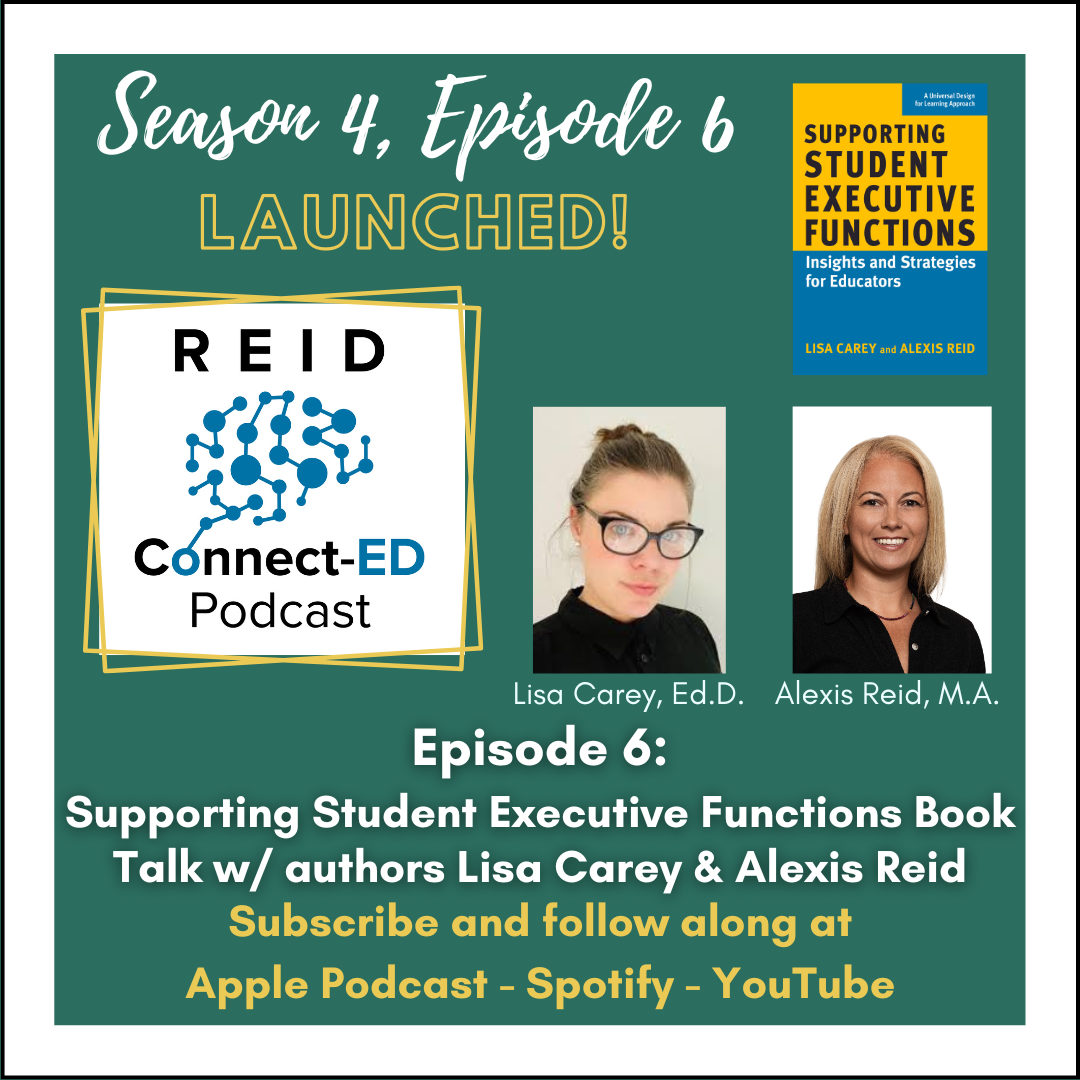
S4 E6: Supporting Student Executive Functions Book Talk
Listen Now!
-
Supporting Student Executive Functions: Insights & Strategies for Educators from CAST Publishing
Carey, L. & Reid, A. (2024). Supporting Student Executive Functions: Insights and Strategies for Educators.
-
Executive function (EF) skills are important to the process of learning and engaging in the learning process. EF skills help learners to learn, and utilize what they are learning, more effectively and efficiently.
Teacher education programs do not necessarily train teachers in how to identify, understand, and support executive function skills. Alexis had a vision for this book many years ago as a way for educators to fill this void.
EF skills are not easily identified but are most often recognized when they are lacking or not being utilized.
It is easy for educators to assume that what they are teaching is being readily and effectively digested, understood, and utilized by their students. However, this book helps to be more reflective and thoughtful that many students may need EF support in order for that to actually happen.
This book provides a contextual understanding of how executive function skills develop over time. This helps educators to connect their teaching practices to fit where the students may be at developmentally.
This book provides not only a thorough description of what EF skills are, including the neuroscience and practical nature of the skills; rather, this book also provides concrete examples that are translatable into the classroom.
This book is not only helpful for teachers, but could be helpful to anyone who is involved in teaching in learning, such as athletic coaches, musical instructors, apprentices, managers/bosses in the workplace, and even professors at the college level.
As educators become more fluent in understanding and communicating about EF, the better they can support their learner’s ability to activate and utilize EF skills. This book provides a larger framework and can be viewed as a stepping stone that can lead to this type of outcome.
-
00:14 Gerald Reid
Welcome back to the Reid Connect-ED Podcast. Season Four is all about connection. Connection with others, connection with something outside of ourselves, and the connections we make within ourselves. And today's topic is going to be about executive functioning skills taught and supported within the school system within the classroom. And school is for learning. To start this episode, I invite you to reflect on the past for a moment. And this may be easier or more challenging for you depending on how things went for you in school. But I invite you to think of your best class experience as a student. And that could have been in elementary school, middle school, high school, or even in higher education like in college, and make sure that it was an experience that really stood out to you and more specifically, make sure it was a very meaningful experience. So here are some examples you may be thinking. For example, think of a class where you did not just memorize facts to pass the test or to ace the test. Rather, you actually were invested in learning what you were learning. Maybe you did not listen passively to teacher lecture at you. However, you were curious as to what was about to be said, Perhaps when you were assigned a project, you were not scrambling to figure out what the teacher expected of you. But rather, you had clarity as to how to get started and how to proceed. And that felt really good. Another example could be you weren't begrudgingly walking into the classroom dreading the next 30, 40, 60, even 90 minutes. Rather, you felt really at least somewhat energized being in the classroom, and you really felt present moment by moment.
Another example, maybe you were not afraid to ask for help when you needed it. But rather you trusted that your teacher was there to guide you. Maybe you learned something new and you didn't feel completely overwhelmed. Rather, you had a process and your teacher really helped you with this process to better understand what you're trying to learn. Maybe you were stuck and how to move forward, and you didn't know how to feel because you felt embarrassed or ashamed to admit that you were confused or stuck. And instead, rather than feeling that way, you actually really respected your teacher and felt comfortable with the teacher enough to articulate how you got stuck. And the teacher helped you to understand it in terms of what was going through your mind in the first place.
So school is for learning. And to be human is to engage in learning nearly every single day we learn in every moment, every relationship, every situation that we're in, no matter what context we’re in we're always learning we need to learn in order to survive, we need to learn in order to thrive. To get along with people better we need to learn everything is about learning in life. And school is really the impetus for learning. That's the first context in which we really more formally at least learn and more specifically, as my sister always says, we learn how to learn. And my sister Alexis Reid here, my cohost for the podcast. She has always valued how important learning is. She has a plaque on her desk with a quote from Michelangelo that says I am still learning dot dot dot; ellipsis. And so many years ago, she manifested this vision for a book that could be for teachers and the book, the idea the vision behind the book is about how teachers can better understand and support the skills that help students to learn more efficiently more effectively. It's not necessarily the content that is being learned, but it is the process by which kids can, students can engage in the learning process to make it more engaging, more meaningful, and more effective and more efficient. And these skills are called executive functioning skills.
And they certainly make learning a more positive experience. And Alexis has been a teacher in the classroom for many years in the past. And since then, as she transitioned out of working in the classroom, she has worked with students and learners in her private practice every single day, where she is supporting these very skills that will be discussed today. They're called executive functioning skills. And along the way of manifesting this book, Alexis reached out to Dr. Lisa Carey, who's an educational specialist, and research scientist at the Kennedy Krieger Institute in Baltimore, Maryland, which is an affiliate of John’s Hopkins University. And Alexis invited Lisa to join her in coauthoring this book, and what an incredible collaboration what an incredible book this has become.
And today's episode, we're gonna dive into understanding what this book is about and more specifically, how teachers can utilize such a book that really speaks to these skills that are often overlooked. Even in the training that teachers receive in their schooling to become teachers. These executive function skills, which can be hard to identify it can be hard to understand how to support because, like I said before, it's the process of learning. It's not the content. It's not just saying here's two plus two equals four and memorizing it.
It's kind of the process by which kids and students and learners engage in the learning process overall as a whole. So it's really about the big picture about learning. I'm so excited to have Alexis and Lisa talk about the book today. It's about to be published in May 2024. They put so much work into it and just an incredible gift to the fields for educators, not only elementary school, middle school, high school, I would say even for college professors who are looking to better understand how to support their learners as well. So happy to have you both here today. Let me give a quick bio for Alexis and Lisa.
Lisa Beth Carey Ed.D. is a teacher, educator and researcher with a focus on improving educational experiences and outcomes for students with neurodevelopmental disabilities. And Dr. Carey was one of the inaugural fellows of the center for innovation and leadership in special education, where she received extensive training in the cognitive neuroscience of learning, behavioral science, school law, and research methods. So great experience great expertise to share. And before she was accepted as one of the inaugural fellows at the center for innovation and leadership in Special Education, Dr. Carey was a special educator in St. Mary's and Baltimore counties of Maryland specializing in inclusive practices for students with emotional behavioral and developmental disabilities. She taught as an adjunct Special Education faculty at St. Mary's College of Maryland and Towson University. Dr. Carey is a member of the CAST national faculty, and has facilitated a universal design for learning UDL professional learning projects nationwide. Dr. Carey holds a BA in history from St. Mary's College of Maryland, and MEd masters education in teaching from Gaucho College and an administrator one Advanced Certificate from Towson University as well as a doctorate in instructional technology from Towson University.
Great to have Lisa here today. Alexis Reid my sister and cohost for this podcast. She is an educator, adjunct professor, educational therapist and learning consultant who specializes in executive functioning, social emotional learning, teaching, learning and human development as well as designing flexible and accessible learning environments through Universal Design for Learning, UDL. A Montessori educator for nearly a decade, Alexis has integrated her research into practice from a UDL perspective, and her private practice which is called Reid Connect, LLC, which is located in Boston and Cape Cod as well as virtually, Alexis supports individuals and the systems in which they exist at the intersections of learning and well-being. Furthermore, Alexis has been a cast UDL national faculty and Cadre member for over a decade. She feels facilitates online and in person professional development courses, and trainings around the globe on UDL, as well as workshops, focusing on executive functioning and social emotional learning.
And of course, Alexis, and I host this podcast. And she holds a BA in education from Loyola University in Baltimore. And she also received a master's degree in applied developmental and educational psychology from Boston College.
So here we are today with Alexis and Lisa, and I'm going to try to facilitate this conversation about their book.
08:30 Alexis Reid:
Thanks, Jer. Thanks for the introduction, it was pretty neat to be able to put the audience and listeners into that mindset to think about what their experience was as learners. And Lisa, we're so glad to have you here. (Lisa: Thanks. Thanks for having me.) Can I just say real quick chair. It's so funny going through our bios. And I know it's a lot of words, and we cut them short, Lisa and I could probably go on forever. I think both of our CVs are multiple pages at this stage of our, of our work and our profession. But it's ironic that she and I connected together not in Baltimore, but in Boston.
You know, even though our paths probably crossed and we didn't even know it back when we were doing our undergraduate work and teacher training down in Baltimore County.
I was down at Loyola College. And I will say least I don't know if you've know this. My first teaching placement down there and Loyola as you know, from the minute you declare as an education major, they put you in the classroom in some way. And my my first teaching placement was at Sheppard Pratt in one of the schools that they have there on campus, and it was probably one of the most challenging experiences I've ever had. But it's also the thing that made me fall in love with the profession, and really working with you know, I like to say, learners who are misunderstood. And I think it was the impetus for a lot of the work that I've done from that point on and I don't know if you know that least but it's a it's pretty amazing to think about how our paths have intertwined even though we probably didn't know it. Yeah.
Lisa: I feel like they've been purely parallel. And then it every once in a while just syncs up.
It's really nice. And Jer, I don't know if you know this specifically, but it really, it really synced up at one of the UDL conferences, I want to say like 2017, 2018, maybe Lisa? (Lisa: definitely before 2018. Because, yeah, I have, I have a very clear idea of when we started writing the book, because I was pregnant. I know we started writing in 2017.)
We started that process back there. Time is elusive, especially after post COVID times; ‘PC’.
But we were at this conference together, and I'll never forget, we're sitting on tables like next to each other, I think. And I think you were sitting next to Mindy, our friend, our UDL Ambassador, we're very close with. And I remember, you know, having these conversations and being adjacent to some of the conversations you were having about neuroscience and executive functions, and we were speaking the same language, and all of a sudden, like all of the energy in the universe just intertwined was like zoom. Yep, this is this is gonna happen. And we've been collaborators and friends ever since.
11:22 Gerald Reid
Well, something I know about my sister is that when she has a vision for something, there's certainly times when it just happens. So this is really cool to see this come to fruition. So I want to start with a general, broad question about, you know, this book. And again, the name of the book, just to be clear for everybody is: “Supporting students executive functions, insight and strategies for educators.” So it's really geared towards teachers and those in the classroom where those I would argue anybody who's teaching anything. I would say even coaches and athletics can actually, you know, or even those teaching music, right, any type of learning that takes place, this is useful.
So my first question for both of you would be, you know, what are the challenges that come with being a teacher as it relates to attending to childs’ needs, and you can relate this to executive function and kind of sprinkle in what executive functions are and look like. But, you know, what are the challenges? Because, you know, as a therapist, I always want to understand, you know, the person who's going to make the changes, you know, what makes it hard to make a change? Or what, what is the challenge in of itself? How do you understand the challenge first, before you try to make changes? So what are the challenges that teachers really kind of run into when they're trying to attend to the needs of each child, each student that they're, they're trying to educate?
12:41 Alexis Reid:
Lisa, like, I'll let you take this one, because some of the research that you've done in the classroom has been really pivotal in thinking about this.
12:50 Lisa Carey:
Okay, so there's, there's a lot of challenges. But I think one of the things that that really stuck with me throughout while I was a classroom teacher, and then why I actually went and pursued learning more about cognitive neuroscience, and that's because our job is to help kids learn, but then we never define what learning is, in a way that that made sense to me at least and that, like, why, why everyone was learning differently. I wanted to unpack more. And that was part of why I was interested in Universal Design for Learning too.
So just kind of getting into what's going on with this particular student or learner or kid? And where are the points that we're getting stuck in? And what are the strengths? So I feel like understanding that in a way where you can kind of, then think about it robustly enough to change your learning environment and make things flexible enough and change your instruction is the piece that for me was the stickiest of how am I going to figure this out.
13:55 Alexis Reid:
You currently work with a lot of children and families who are undergoing cancer treatment and experiencing cancer. And there are a lot of barriers in helping to, you know, transform and translate the experiences that these children are having. And, you know, I mentioned before Sheppard Pratt and thinking about children who are undergoing behavioral and mental health therapy. And they are learning how to learn often at different level in a different way than most of their peers would typically be learning at that stage of development. And sometimes we learn the most from the students who are struggling or misunderstood the most.
And Jer, I hope you can chime in here too, a little bit from your background and neuropsychological assessments in thinking about how key and how important the translation is. I don't know about you Lisa, but I've had so many families who come to me and we're like, I think we need a neuropsych to better help the educators that are working with my child, understand what is happening for my kid, what they need, how to best support them in the classroom, for those who have had a neuropsych, and they're like, we went through the feedback process with school. And, you know, my kid still isn't getting what they need. They don't understand what the complexity of what they're experiencing really is and how to support them.
And both of us, I think, being being well versed in understanding universal design for learning and understanding how what one support that a child may absolutely need benefits the rest of the classroom, I think helps us to better have these conversations with schools and especially with teachers to be able to say: hey, look, there are going to be students that you're interacting with and working with, who absolutely need, you know, focusing on executive functions, they're going to absolutely need previews, they're going to absolutely need, you know, some assistance in making time more visible, they're going to absolutely need some structure and flexibility. But if we put those pieces in place proactively from the beginning, not only are you supporting the child that we know absolutely needs these supports, but we're really supporting all of the children in the classroom.
And speaking of neuropsych evaluations, I'll just read really quickly what Dr. Jason Fogler from (Boston) Children's (Hospital) wrote about the book, which I think is; I’m going to come to tears reading it because I'm so grateful for his support and understanding of the work that we're doing. He said: whether you're a veteran training or newly minted teacher, supporting student executive functions, insights and strategies for educators, is the best curbside consult you can ever have; maybe you didn't even know you needed. Lisa Carey and Alexis Reid make complicated neurocognitive processes and how they manifest and learners behavior accessible and actionable. After reading this volume, educators will be able to approach even the most confounding lapses of motivation and organization with empathy and effective skill building.
Which I think just so beautifully encapsulates the intent of this book and why we went into doing this work.
17:12 Gerald Reid:
Yeah, that that's a beautiful quote. (Alexis: Thank you, Jason.) Thank you, Jason. So I'm going to provide some, I guess, scaffolding to bring it back to the original question: what are the challenges that teachers experience when it comes to attending to each child's needs? And Lisa and Alexis both gave really good examples that fit into that question, which is, you know, you can start in this as exactly we said, like, Universal Design for Learning came from this idea that there are kids who are struggling, that we need to understand them better. But in fact, if you help one kid who is struggling to learn or to engage in learning, you can use what you're helping that kid with, or that student with; everybody else can use those same strategies and supports. So as Lisa is talking about, you know, supporting children undergoing cancer treatment. And what a beautiful thing that you know, you're taking a complex problem like that and trying to work collaboratively with a lot of people to solve that problem so that those children can get what they need in the classroom. And Alexis is saying kids with mental health challenges, right? There's different versions of it; could be a kid, a student with dyslexia could be a student with ADHD. It could be a student you know, for whatever reason that just maybe he's having a hard time at home and they come to school and they're just their mind is disorganized, right?
You can't look inside of a child's mind. So teaching is communication. You're trying to communicate something for a child to learn. And it's not apparent what's going through the kid's mind, what's going through the student's mind. You can't read a child's mind. And a lot of times when we communicate, whether we're a teacher, or in any relationship, we make a lot of assumptions about what's happening. And in the role of the educator, it can be easy to assume that what you're teaching is being learned. It's an aspirational idea, right? You want to think that everything you're communicating is going to be digested, understood and utilized by the students.
And this book really is about trying to identify what are the barriers, what could be those barriers, that could get in the way of that and so. So, number one, I think what you're, we're all kind of getting at is, it's important for teachers and educators to step back and to not make those assumptions that everything is just going smoothly. And to actually, to check in thoughtfully and creatively to understand, you know, what might those barriers be in this book really provides those executive functioning skills to look at that might be not developed, not being utilized. And then by understanding what those challenges might be, here are some strategies and supports that teachers can use.
So maybe you can talk a little bit more about that, in terms of what that looks like, you know, for the person listening to this, who really wants to understand what this looks like in the classroom.
19:52 Alexis Reid:
Thanks for bringing all the back together, Jer. You know, Dr. Jason Fogler who is a friend and colleague of mine likes to say, if we could have fMRI machines in every classroom, to be able to understand what stimuli and different environmental factors and characteristics are actually activating the student and the learners brain in the way that we need to, maybe it would give us a clearer picture as to what to do.
And I also want to caution in this conversation that Lisa and I have extensive training in both neurocognitive skills and understanding complex issues for students and learners. But, I always say, at least when I work with educators and school systems, by no means am I asking you to become a psychologist or neuroscientist in talking about executive functions. But we really need to better understand what these cognitive processes are. Because often what we see in the classroom is educators will say, you know, this student just doesn't, right. And we focus on the behaviors and the patterns of behaviors that might get in the way of learning, where we make it very student-centric instead of understanding development. And it's so crucial to be able to better understand the cognitive development. And put it back into understanding how the brain is working versus just saying there's something going on that's going wrong for the student, or for the learner.
Because I think that actually is one of the biggest barriers to teaching and learning is that we make a lot of assumptions like you say that students just can't, or they just won't, or they don't want to, or they are getting it but maybe they're just coping and they're getting through, they're using other strengths of theirs to get through the day, that looks like learning looks like competency, but it might not be.
So I think it's really crucial. And I think, you know, all of part one of the book is all about understanding how executive function skills develop. And I've said this a million times on the podcast in so many different contexts that executive function skills are a set of cognitive skills that are so vulnerable to so many different factors. So you can have complexity in your learning profile that includes a learning difference, a learning disability, some kind of chronic illness, mental health or trauma, that can get in the way of the development or activation of these skills. But really, anybody, even with fully developed executive functions, we can think of adults as like when we get stressed or busy or tired, that sometimes we're not as planful, organized, or efficient.
22:22 Lisa Carey:
Yeah, I'm glad that you brought up the developmental lens of that, because I think that that's, that's a key piece that we need to really pull into the teaching profession a lot more is understanding how kids develop. Right, that we, we are… and it's extremely variable when they develop, you know, we put kids in the classroom, about at about the same age and are just kind of like, okay, well, they should all be about the same place. And that's just not how development works. So just kind of having a better feel for that. And that's something I'm proud that we were able to put into the book. It's just kind of take time for this one set of skills, we're just going to really break down how it develops over time and it develops over a long amount of time.To try and give some of that foundation because the book is chock full of things that you can try out in the classroom and I'm gonna give Alexis most of the credit for so many of those great ideas that, I mean, there were so many ideas that she came up with that we had to cut some. So there'll be more coming out after this book. But just kind of like thinking about it, if you can understand the concept, then you can start to tailor those things to better fit your learning environment, or even come up with brand new ideas. Because you can just see what's going on. It's kind of like looking under the hood, you kind of get a I don't know if that metaphor works. Actually, I don't know anything about cars. But we do get a picture of like, right, that expectation didn't match where you were, like, there was a whole field of work for a while in the 90s that was called stage environment fit. And it's still kind of out there. But it's this idea of where you are developmentally needs to fit your environment.
And I think the time in my life that I most clearly saw that as an educator was when I moved from teaching high school to teaching, sixth grade and a middle school and just was like, wow, none of these 10 an 11 year olds were ready for this first week of school like this is; we gave them lockers, we were like, move around with your really hard to read schedule. And, you know, maybe maybe shout at them, you're in sixth grade now get it together. And it was just like, that is not; there's a mismatch here. That's pretty intense.
24:50 Gerald Reid:
Do you feel like do you both feel like when when students are really engaged in the learning that by nature emotionally and behaviorally things get better? Maybe that's not a silver bullet. But do you feel like the more engaged a student is and actually understanding clarity learning, that their emotions and behaviors could actually be it could be improved.
25:10 Lisa Carey
I think it definitely helps. If you're excited about what you're learning, and you're passionate about it, you're more willing to persevere when things are difficult, which is a great time to practice your skills too. But if things are kind of outside of that, even if you're super engaged, if it's just so beyond where you are, developmentally, it's just going to create frustration, and maybe even hinder how much you were engaged with that topic. You know, you could be super passionate about something and then put it in a place where developmentally, you can't do something, and then be really frustrated and have a bad experience with something you really cared about before.
25:50 Gerald Reid:
So I would say probably like having clarity, and also being emotionally invested are probably equally important. I'm thinking of just experience of students, right? If you're confused or not, digesting or really understanding something emotionally evokes frustration. Like nobody wants to feel confused, or like they're not getting something or understanding something. But when you can get it and understand it. That certainly can make a difference emotionally, for sure.
26:15 Alexis Reid:
I think that's so related to, you know, understanding the connection between the limbic system and the prefrontal cortex, where the executive functions primarily reside, that like when we feel like there's too much of a challenge, when we perceive there's too much of a challenge, even if it's something that you know, myself, or you or Lisa or a child or student has already done before, if we're anticipating that it's going to be more challenging than it actually is, you know, that can already shift and change how we show up to approach that situation.
You know, you and I talk a lot on the podcast about anticipatory anxiety. And I think that's definitely a factor that plays into how we activate the set of skills that for young people are still developing. So if we're anticipating I don't have the skills to do this, it's gonna be really hard, it's gonna be more difficult to get started. We see this a lot with kids and homework, right, or a challenging test or writing a paper that requires organizing your thoughts, planning things out and putting all the pieces together. We see this a lot come up, that we we lose his piece of task initiation. And we also lose what you're referring to is a piece of frustration tolerance, where we see this, especially in the classrooms, where we hear from educators all the time, that you know, these kids are just giving up before they even get started. Or they get started, and they peter out and they start to get distracted. We think that they just have focus issues. And really what is happening is and we'll talk more about this when we talk more about attention in future episodes that, you know, our focus and attention goes on what we prioritize. And when we anticipate something to be too difficult. Obviously, we're going to prioritize the thing that's more comfortable. And then we actually aren't building the skills that we're referring to call the executive function.
28:08 Gerald Reid:
Well something I appreciate about you know, I hear a lot about your work Lex and the executive function skills that you and Lisa talked about in the book. Working in therapy right I work with kids who have attentional challenges or, or just any challenges mental health related, right. And I find that the problems that they run into, like, let's say they get distracted, or let's say they're confused, or let's say that they have some problem that they run into, because life is full of problems. And in the classroom, you're gonna run into problems, you don't know what to do, or you're trying to understand something better, you're trying to figure out how to, let's say, use what you're learning in some actionable way. Whatever the task is for learning, right, there's always problems that are gonna come up. And for me, I always tell, you know, this is kind of a formulation that I tell my patients and the parents and whoever is working with them is, that is not the actual problem that that is getting in the way of things getting better in their life. The problem is how you react to it. Right? It's like, you can run into problems all the time. But if you react to it, and you feel overwhelmed and confused, and you just don't know what to do, right? Nobody likes that. And there's no GPS that you can pull up your phone and be like, alright, GPS, tell me what to do next, right? Because life is too complex, or like, you know, the situation and everything's contextual. There's no, there's no clear way to do that. But the executive functioning skills, right? That you're teaching, helping, that teachers can instill in their students can help to buffer against that kind of downward spiral that can happen, when a kid's not getting something when the kids are distracted, or a kid, whatever the problem might be. Again, my message here is that that problem in itself is not the core problem. The core problem could be what do you do after that happens? How do you problem solve? How do you navigate things? And that's exactly what executive functioning skills are; is how do you both proactively and reactively deal with that problem?
30:00 Alexis Reid:
I mean the answer really is what we always talked about here is: Can you slow things down? And to actually like, start with what makes sense to support because you can't always do it all right? Especially educators in the classroom, we're not going to be able to target and support every single thing that every single child needs at every single moment. But when that problem does come up, and we need to figure out what is the solution, how do we support and repair, or like bolster, whatever's going to happen, I always like to say my favorite quote to say is, there's no such thing as a failure, right, it's just an opportunity to learn. If we can reflect on that moment to be able to figure out what to do next, how to problem solve in that situation, how to be more strategic, that's where the learning happens. I think that's the most like valuable thing that we can ever do.
But instead, what we end up falling back on is, if we make a mistake, it's bad. So a lot of the book is really talking about how there are going to be different learners that are going to be presenting in different ways, for various reasons. But at the core of it, the thing that we have some control over as educators is focusing on supporting these executive function skills by getting really clear, by helping to scaffold and support, you know, sometimes the smallest things.
30:20 Gerald Reid:
Can you both give some examples, kind of as we're kind of moving towards the later stage of the episode. Like, let's say, the teachers can identify that there's a problem with the students learning or engagement and learning. And, you know, what would be kind of the process by which the teacher can notice what an example of an executive function skill that can get in the way, and also a way that they can navigate that based on you know, what the book is suggesting, just, you know, you don't think give away the whole book, but just an idea that kind of what this looks like, this specific example.
31:50 Alexis Reid:
I'll just list a couple of things and then Lisa, you can jump into too. You know, we talk a little bit about perfectionistic tendencies, we talk a little bit about rigidity, because as we've talked many times on the podcast, one of the core executive function skills is cognitive flexibility. And, you know, rigidity comes up a lot in black or white thinking all or nothing, in or out, right, like we can see this a lot in the classroom and how learners are engaging, like you mentioned in the learning and in the process of being a student.
And we talk a little bit about how, you know, on the other end, we have some students who will be reassurance seeking, who will constantly be checking and asking and making sure they're doing the right thing. And oftentimes, all of these at the core of the presentations of learners is that students are still developing these executive function skills to be more strategic to think about other options to be able to know how to navigate different situations and even being clear on their goals.
32:53 Gerald Reid:
So an example there would be like a kid who is getting started on a project and they're just confused about how to get started. And maybe they keep asking reassurance. Like is this the right way? Is this the perfect way? Because they have anxiety, right? And so what would be, you know, something that teacher can do in that type of situation that you know, first of all, what how would they talk to a student about that to you know, speak in a way that almost like speak the language of executive executive functioning, you know, to the student and to the parents to understand what's happening rather than than just saying, Oh, they're not getting it, or they're, you know, they're nagging me about it, or they're doing it right or wrong. And it's, you know, we're not making any progress.
33:34 Alexis Reid:
I think that the whole purpose of the book is to better understand that it's just not the kid not wanting to do something is to be super clear from the adult in the room to understand that, like, these are real challenges in the moment, and to validate that for the child so that they don't feel like they're good or bad that they're, you know, right or wrong. This is something that we need to be better at, I think, as a society, in the way we have these narratives around teaching, learning, growing and developing. (Gerald: And it's not going to get better unless it's talked about between the student and the teacher; if the kid’s hiding, and that's just gonna make it worse.)
Totally. Yeah. And when I was in the classroom, I used to actually make mistakes on purpose, and have the children check them and gracefully accept feedback. Right, because oftentimes, in our busy lives as adults and teachers, we, we need to get to the next thing we have to keep going. And we don't often give that time to kind of marinate in the mistake to be able to say, like, Oh, what did you notice? What could I have done differently? And me, as the educator who's supposed to know it all, being, you know, humble enough to say I made a mistake, actually open up an opportunity for that student who thinks they need to get it all right away, to be able to slow themselves down and to think through the steps and to problem solve, and to articulate, which is often the hardest part, what actually is happening or what could be different.
34:57 Gerald Reid:
So in this example, it could be that and perhaps the student needs kind of a bigger picture to; maybe the child is kind of scattered in terms of how they're approaching the task. And they’re deep too detail oriented and kind of can't see the big picture. And there's a lot of students who do struggle with that, right? So it's hard to get started on a big project that doesn't have smaller steps, smaller framework, which is kind of like what a graphic organizer does for learning, right, you kind of kind of categorize how to think about things, how to get started, and kind of make a visual for the students, instead of just talking sometimes talking is too abstract.
35:32 Alexis Reid:
Most definitely, well said, Gerald. (Gerald, I learned from the best.)
I think too, really understanding that, especially in this day and age, at least, you can, you can chime in on this, especially thinking about living in this digital world. And Jer, we've talked about this on the podcast a lot, that oftentimes we just see the end product, we just see like the finale or, you know, the goal that's achieved, because oftentimes, a lot of exposure to things is just, you know, the best parts instead of understanding this productive struggle that really is a big part of learning.
So students often will kind of just shut down when they don't feel like things come automatic. And for some learners developmentally, these executive function skills will come online and become more automatic, at different stages of their lives. But for a lot of kids that we're talking about here, in particular, who might have ADHD, or learning challenges or mental health challenges, they're going to be a little delayed in the development of these skills. So they might not just come online as quickly as we might want them to be, like, like Lisa was saying about this environmental stage fit.
I worked in a Montessori classroom for many years. And we have a full range of development that we can anticipate, because we know that there's three different age groups of learners in one classroom. And rather than having the expectation that first graders or second graders, third graders in one classroom are fourth, fifth, and sixth and another classroom are going to only develop based on what grade they're in. I mean, the point of doing it and putting students into this classroom where they have varied developmental levels is to be able to actually use that collectively, to better understand and to learn from each other.
37:30 Gerald Reid:
And something that you often suggest is teaching kids to students to reflect on themselves. So in this example, and what you're sharing now, instead of the teacher just saying, like, just go do this, actually, to understand them developmentally: oh, how are you thinking about this? You know, it doesn't have to be that perfectionistic, this student example, it could be any student. How are you thinking about this gives you so much insight again, because you may be making assumptions about what the child is capable of what the students capable what they already know, maybe they don't have even background knowledge about what you're teaching them and they're coming from a whole different point of view that you'd never expect, right? So I love how you always suggest to invite the student to express what is going through their mind; how are they thinking about that? It's such a simple thing, but so important and so insightful for understanding their processes of learning. It can open up a lot of doors to understanding what's getting in the way in terms of executive functioning. And kind of, as Lisa said, if you understand what executive functioning skills are, you can ask questions around it to better identify what exactly is getting in the way of using those skills? Or, or what does it look like for that particular student? And so kind of tying those things together there.
So Lisa, and Alexis, can you share a little bit about how you envision this book being used by educators, and not only educators who are currently teaching, but also those in training? Yeah, um, one of the reasons I was so excited when Alexis approached me with the idea of creating this book was that our vision was really in sync in terms of: let's explain what executive function is, and really break down this complex concept for people who are not psychologists for people who are classroom teachers, and have expertise in other areas. But then also give examples of how you can support these things in a learning environment, a more formal learning environment, like a classroom. And just kind of giving them the toolkit to be able to do something about it about the one of the one of the skill sets that I think is the hardest, is harder to define. And then also difficult to figure out how to support and something that we haven't traditionally talked about in teacher education. So making it really focused in on what would resonate with teachers, and giving them the understanding and the tools to then kind of put it in application.
40:00 Alexis Reid:
So instead of just learning how to teach content, again, you're kind of helping them to understand what these executive functioning skills are to identify them. Because it's not just being an expert in content, like you can be the best athlete in the world. But it doesn't mean that you're going to be able to be a good coach.
40:18 Lisa Carey:
I think also just kind of thinking about, like, teachers have all this experience of being around kids. And for a lot of people when they learn about and this is the same for both of us, when you learn about executive function, you're like, oh, that's what that is. Right? So you're, you're kind of seeing it, you're maybe not labeling it in a way, that's the most productive way. Or even not kind of giving it a label, but just kind of or name, you know, just kind of feeling like this kid is having trouble with organization or not, you know, this isn't, he's not getting started. And just being able to put it all together and think about it developmentally, is just really powerful in terms of amplifying the things that teachers come up with all the time. You know, teachers are very creative problem solvers. And so they're trying to come up with strategies. But if they have a deep understanding of what executive functions are, and how they develop, they'll be able to magnify what they've been doing and probably do it with less frustration on their part. So we really wanted to give teachers the ability to understand this way more deeply, and build on what they already know and what they're already doing and honor that.
But then also give them the ability to keep learning about it, right, so unpacking a lot of terminology from other fields, like neuropsychology, so that teachers can go and look at literature and books from other fields as well. So we're hoping that this is a stepping stone for people to be able to investigate and do more as well.
41:48 Gerald Reid:
Yeah, there's kind of a metaphor I'm thinking of, as you're saying this, it's kind of like learning a different language. So it is kind of what you're seeing with teachers they may already know, or see or kind of feel what it's like for executive functioning skills to be used or not used or challenged, or something. But this book is kind of almost like learning the language of executive functioning is to help them to think clearly and communicate clearly. And to perhaps even use what they already know, just do it in a more efficient way with this book kind of guiding as a framework to do that more fluidly.
42:40 Alexis Reid:
Yeah, well said I was thinking about what Lisa said before about looking under the hood. It's like you can see the cars driving. But unless you are an engineer or a mechanic like you might not know about all the functions that are happening underneath the hood, you might not know about all the different parts of the process that like makes the car go. And it's the same thing with learning, and especially these skills related to executive function that we do learn a lot about in teacher education and preparation, you know, to be planful, to organize, to manage and prioritize time. But you know, what allows for the student to be able to do that it’s these executive function skills. It's almost like all these different parts of a vehicle that allows for the behavior action to come to life.
43:05 Gerald Reid:
So excited for this book to be coming out. It's a long time coming but it's a long time coming because you put so much thought to it and it comes from your experiences. It comes from your thinking so deeply about this and talking so much about it. And there's a reason why it took the time it took is because you really put so much work into it. And that's the way it should be, things should be a process, things should evolve and get better and, and grow as you're doing. Right. If you're going to start a big project, it could evolve as time goes on, because that's how things naturally happen. So really glad and appreciative that you did put all the work into it and continue to see it through to the end.
And this is going to be a great benefit to a lot of educators. And like I said, anybody who's teaching anything, it doesn't have to be just in the classroom, it could be any type of learning, and teaching that's happening. You know, even parents could read this and say, Oh, that also relates to how we kind of function in the household, we can kind of translate this. And also, by the way, if the parent can understand it better, Lisa, to your point earlier, they can communicate to the teachers and with the teachers better. So no harm and parents reading this to to be able to say, Oh, now I can kind of talk to the school staff more fluently about what this looks like in the classroom and how to how to work through it in the process.
44:20 Alexis Reid:
I would say also therapists and medical professionals, right, a lot of what Lisa and I do is translate the educational experience to other professionals who are working with individuals and children especially. But you know, I love I really appreciate that you said evolution because that really is the impetus for this book, and probably the amount of time it took because Lisa and I wanted to focus on this because we didn't get a really clear understanding of executive function when we were trained to be teachers. And it really took a while for us to wrap our head around and really dive deep into the literature and even doing research and work in the field ourselves to be able to better understand it and translate it in an accessible way.
And we really hope that this book functions in that way. Because how we understand executive function, even in the field of education and neuropsychology, in psychology, and cognitive neuroscience has evolved and changed. We know the core capacities of it for a very long time. Right, going back to Phineas Gage and understanding the role of the frontal lobes. But really, you know, the way we describe and talk about it, instead of getting too neuroscience-y, it has taken a long time to feel comfortable for a lot of people to understand. So really, we really hope that this book serves that function to help especially teachers in training to go into the field, not with the narrative of there's these can, there are going to be these behaviors that are going to get in the way of kids learning, but how can we proactively plan to build in functions in the learning environment to support the development of executive function skills?
45:56 Gerald Reid:
Well, thank you both for being here today. In talking about this book, again, the book is called Supporting student executive functions: Insights and strategies for educators, Lisa Carey and Alexis Reid, look that up now and go get your copy and share with your school district if you know whoever your teachers are, you know, if you're a parent, share with other parents, teachers share with other teachers, therapists, everybody out there definitely will be a great read.
Alexis Reid:
Thank you, Jerry. I just want to say thank you to you for you know, summarizing and bringing all the pieces together so beautifully. And Lisa, thank you for your collaboration and friendship as always.
Lisa: right back atcha.
Gerald Reid
Thanks for tuning in to the Reid Connect-ED podcast. Please remember that this is a podcast intended to educate and share ideas, but it is not a substitute for professional care that may be beneficial to you at different points of your life. If you are needed support, please contact your primary care physician, local hospital, educational institution, or support staff at your place of employment to seek out referrals for what may be most helpful for you. ideas shared here have been shaped by many years of training, incredible mentors research theory, evidence based practices and our work with individuals over the years, but it's not intended to represent the opinions of those we work with or who we are affiliated with. The reconnected podcast is hosted by siblings Alexis Reid and Dr. Gerald Reid. Original music is written and recorded by Gerald Reid (www.Jerapy.com) recording was done by Cyber Sound Studios. If you want to follow along on this journey with us the Reid Connect-ED podcast. we'll be releasing new episodes every two weeks each season so please subscribe for updates and notifications. Feel free to also follow us on Instagram @ReidConnectEdPodcast that's @ReidconnectEdPodcast and Twitter @ReidconnectEd. We are grateful for you joining us and we look forward to future episodes. In the meanwhile be curious, be open, and be well.
Executive function skills are commonly known as the skills that allow us to get things done… and are also often misunderstood. In their new book, Supporting Student Executive Functions: Insights and Strategies for Students, Lisa Carey & Alexis Reid break down this complex set of cognitive skills in an accessible and meaningful way for educators, or anyone who works (or lives) with learners, to better understand how to support the development of executive function skills. Part one discusses the neurodevelopment of executive functions and part two provides actionable suggestions to tweak or intentionally build supports into any learning environment.
In this episode Gerald interviews his sister and co-host Alexis Reid along with her co-author, Dr. Lisa Carey about their intention for writing and getting this book out into the world and the benefits of reading this book. We all hope it reaches, teaches, and supports many!
Be curious. Be Open. Be well.
The ReidConnect-Ed Podcast is hosted by Siblings Alexis Reid and Dr. Gerald Reid, produced by and original music is written and recorded by www.Jerapy.com
*Please note that different practitioners may have different opinions- this is our perspective and is intended to educate you on what may be possible.