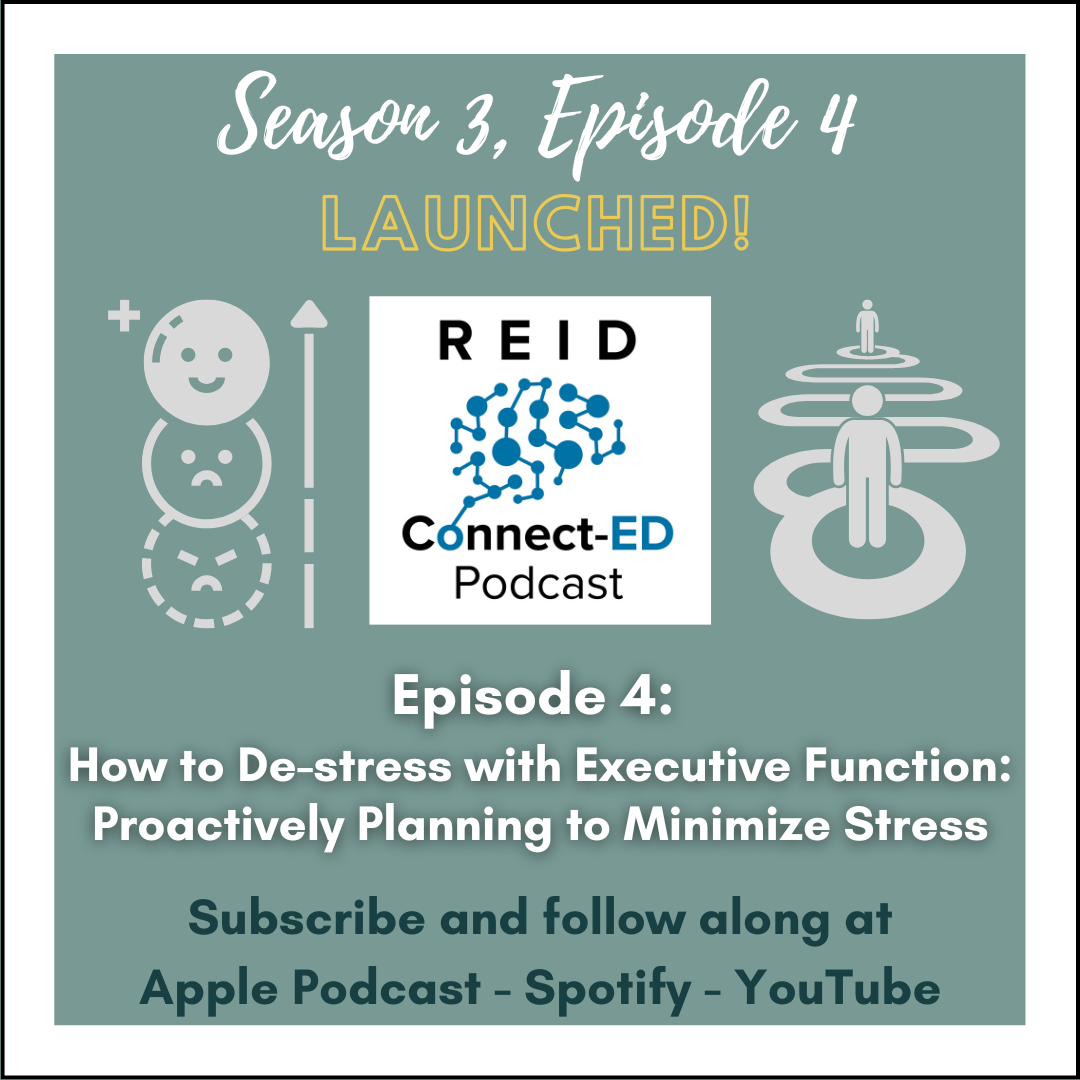
S3 E4: How to De-Stress with Executive Function - Proactively Planning to Minimize Stress
Listen Now!
-
-
Executive functions are a set of cognitive skills required to achieve a goal by way of aspects like time management, cognitive flexibility, prioritization, inhibiting impulses/reactions, holding and manipulating information in your mind at one time, etc.
As was mentioned in the Anxiety episode of Season 3, having a lot of stress (activation of the nervous system to address a demand/task) can bleed into experiencing anxiety (fear of a ‘negative’ consequence). Utilizing executive functioning skills can reduce stress to manage anxiety in a proactive manner.
The front part of the brain develops last, and this is where executive functions are activated. That means that it can be challenging for younger people, and even individuals through their 20’s to complete and navigate complex tasks that require more fully developed executive functioning.
Executive function skills may take longer to develop or be impacted, especially when there are influences of stressors, traumas, and emotional distress/mental health traumas.
Executive function challenges are often seen in individuals with ADHD, although individuals with ADHD can certainly experience challenges with these skills. In fact, the more society becomes complex and overloaded with information, the more our executive functions are going to be taxed and perhaps exhausted beyond our limits.
Difficulty utilizing executive function skills can contribute to increased stress.
When individuals become anxious (perhaps by way of being overly stressed), the mind can become very simplistic, inflexible, and narrow-minded. Anxiety helps to identify and hyper-focus on a perceived ‘threat’, which is why this happens. It can also lead us to become less patient and chaotic; as well as less present and therefore less comfort and security.
Executive function skills can increase order and structure to reduce this ‘chaos’.
You cannot actually ‘manage/manipulate’ time, but you can change your relationship with time and how we prioritize time in terms of what is important across points in time.
You can look at what might not be going well (e.g., difficulty getting out of the home efficiently in the morning) and then work backward to identify the executive function skills that would help improve whatever happens in these moments. This is like identifying the ‘antecedent’ to a behavior where you can figure out what challenges came before the unwanted behavior rather than only addressing the behavior itself. This is very much like the Collaborative Problem Solving or Cooperative and Proactive Solutions therapy approach that you can look into, which is based on the premise that individuals can do better when ‘unsolved problems’ and ‘lagging skills’ are addressed in a collaborative and proactive way to improve behavioral challenges rather than just focusing on punishments or consequences.
This approach can take the guilt, shame, and anger/resentment out of the challenges and frustrations an individual and their family faces when it comes to day to day functioning.
Exploring and coming up with different systems to put in place can help reduce stress and disorganization. This can prevent the issues and challenges that can arise when the same problem continues without being resolved.
Make everyday decisions and tasks easier on yourself so when you are confronted with a decision or task, it feels more seamless and you can find less excuses to avoid the decision or task. For example, Exercise for Mood book suggests putting all your exercise equipment and apparel in a specific place ready to go the day before so that when you consider going to the gym tomorrow, it can feel more seamless or get out of the door. The same goes for students and their materials when transitioning from place/space to another.
When shame and blame is activated, it’s possible for individuals to shut down rather than problem-solve and think more reasonably through a situation. This is especially possible when emotions are difficult to express and work through in a constructive and effective manner. This can contribute to interpersonal conflict and lead a person(people) further away from actually addressing the problem in the first place.
What works for you (and your family) to get through a day efficiently and effectively one day, one moment, in one context, etc. may not be the same at another time. This requires us to reflect and be collaborative.
Sometimes you gotta just “take the ‘L’”. Maybe not call it a “loss” but a “lesson” or a “learning” opportunity to re-frame ‘failure’ as a chance for growth and reflection.
The upsetting emotions that come from a perceived ‘failure’ is to give us information of what is working and not working for us. Rather than being overwhelmed by the emotions, being extremely hard/negative on oneself, and/or treating it like a catastrophe that spirals us downward, we can use the emotions as information to guide us on what is happening and what we might need or could try going forward.
Just because you are struggling to accomplish something may not mean you are incapable of completing the task, it may mean that you just need to address the executive function skills that will help you achieve the task. Taking this perspective can reduce shame and guilt or negative self-images for struggling.
Teachers can treat their job as facilitating learning and identifying executive function supports that can help their students learn better. The same is true for coaches, instructors, etc. whoever are trying to teach something to others. Not everyone is going to learn effectively and efficiently in the same way; they may need different approaches and supports to digest, organize, and learn in a way that works for them. This can also help master new learning so it can be used more effectively (e.g., helping an athlete learn and master the strategies/plays so they can execute the plays more easily in the moment).
Teachers can think in a way that acknowledges the variability across learners, such that not everyone is going to learn exactly in the same way. An individual may not even learn in the same way across time, context, and circumstances. This is from the Universal Design for Learning framework of teaching.
It can help to consider if an individual is lacking a skill, or if there is something interfering with the skill being utilized (e.g., stress, anxiety, confusion, lack of clarity, distractions).
We can find ways to practice executive function skills rather than just expect that we will be good at using them without practice and reflection of how we can utilize them.
Perspective-taking (of others, and of other ideas) requires being flexible in your thinking, inhibiting impulses, etc. and can reduce interpersonal conflict.
All or nothing thinking can contribute to anxiety and interpersonal challenges.
Gaining life experience and gaining perspective (including seeing the big-picture) can help you to prioritize what to worry about and to what degree; rather than just worrying about everything equally all of the time. This can help us to be more adaptive.
Mindfulness and Cognitive Behavioral Therapy (CBT) can help individuals to label where different worries can fit into different categories of priority and so forth in what context and in which situation, rather than obsessing over a particular worry all of the time. Prioritization can help reduce anxiety for this reason.
We can prioritize where we put our energy across a given week in order to achieve more balance in what is important to us, but we need to first identify what aspects of life are important to us. This does not have to be all or nothing; rather, we can find little ways of integrating aspects of life that we may be neglecting (e.g., fun, playfulness, connection, movement, etc.).
Everyone has fears. We all have our insecurities. It is important to note that when you hold beliefs about yourself as being ‘never good enough’, your motivation can come from fear leading to over-compensation (over-doing one thing) and not prioritizing other things. It can help to reconsider these beliefs and over-compensating patterns so you can act out of proactivity rather than acting out of fear.
Just getting ideas, thoughts, and concepts onto paper (or visualized somehow) can reduce the overwhelmed feelings that come with trying to hold onto too much information in your mind at one time. It can also help you to more accurately recognize how long a task can take by breaking tasks into smaller steps and chunks.
You can add positive and enjoyable aspects to tasks that may be less motivating (e.g., listening to music or a podcast ;) while doing the dishes or simple chores; watching tv while working out; going on a walk with a friend to chat).
Tools like Microsoft OneNote can help organize ideas and thoughts.
Changing the context can help improve how you feel about initiating a task and staying on task. For example, your bedroom is often associated with rest/sleep; so it may be better to do work in an environment that is associated with being activated to work. Or, you may be more productive in a coffee shop that feels more energizing rather than being alone; or maybe in a quiet library that is less stimulating.
Listen to what you need and try out different options.
Sometimes the demands may be beyond your abilities and this would require trying something different or self-advocating for a way forward, or even just getting more information on how to take steps forward… rather than just shutting down or expecting something of yourself that is beyond your true capacity (for now).
So much of life is learning how to more gracefully and effectively deal with things ‘not going well’ - disappointment, challenges, and roadblocks. It may not feel good and we can get down on ourselves, but we can learn how to navigate it more effectively and efficiently with practice, reflection, and collaboration. This re-frame can reduce perfectionism. So many ‘successful’ individuals (in whatever way ‘success’ is defined) so often follows this philosophy (see Season 2 for examples)...
…to feel secure within yourself and your relationships can help you to do this. So take time to nurture your relationships and connection where we give each other a safety net to recover from setbacks. We can learn acceptance and to be where we are and feel okay about it.
Find ways to calm your nervous system so you can recover each day. Make it a routine that is consistent and always there for you.
-
Alexis Reid 00:20
Welcome back to the Reid connected Podcast. I'm here with Gerald today. And we're going to talk about a topic that's near and dear to our hearts. I feel like we say that all the time. But for sure this one, as we're going to talk a little bit about how to reduce stressors by proactively planning to support executive functions. And this is a really hot topic, especially right now. I'm seeing this all the time with the clients I work with. But especially in the schools that I consult with and work with. Not only are the educators and teachers kind of asking, What can we do to better support executive functions to reduce some of the stressors and help with the flow of the academic day, but also from parents and caregivers where they're asking, you know, how do we help with these transitions in my child's day? How do I help to build and develop these skills? And what can I do to help kind of mediate or decrease some of the stressors that might trigger behaviors related to executive function skill development, that maybe these skills just aren't developed yet?
Gerald Reid 01:32
Yeah, this is going to be a great topic. You know, we talked about anxiety Two episodes ago. And, you know, something I mentioned is that the more stress you have in your life, the more likely it's going to bleed into feeling anxious, you're more vulnerable to turning stress into anxiety. As I said, stress is not necessarily anxiety stresses, you know, activating yourself, your cortisol levels and activating your brain in your mind to do something of anxiety really is fear of something going bad or something going wrong. And so we want this episode to be kind of an add on to that episodes, how you can manage anxiety and stress by using executive functioning skills. Because, you know, life is so fast. Now, there's so many things we have to do. And as technology has grown, there's actually more that we have to do. You know, a lot of people do talk about this life is more complicated now, because everything's at our fingertips. And there's just more tasks that we have to do that maybe, you know, decades earlier, we didn't actually have to do everything. And everything kind of falls on us. Because we have technology that you know, hopefully that technology can make things easier and simpler. But there's also more things to do that maybe we didn't have to do in the past. So the executive function skills certainly helped with that. And I think we're all we anyone can really benefit from that nowadays. For sure. Yeah.
Alexis Reid 02:50
So this episode, we're going to talk all about kind of bringing the pieces together, we've done episodes on anxiety episodes on executive function separately. Now we're bringing this all together to talk about how do we de stress with EF,
Gerald Reid 03:03
let's go.
Alexis Reid 03:07
So before we get started, we really kind of have to set the foundation, hopefully, you've listened to some episodes before about executive function. So the cognitive set of skills, which is often misunderstood, those primarily reside in the prefrontal cortex, which is the very front part of our brains. So if you were to put your hand on your forehead, that's typically where the prefrontal cortex is. So you'll be able to notice and recognize that that's the part of the brain we're describing and talking about when we talk about executive function skills. It's primarily where they reside. Again, not any one set of cognitive skills, functions in isolation. So there's a lot of different systems and circuitry that's going on, that we're not going to dive too deeply into here today. But just understand that this is the last part of the brain to fully come online and get developed. And there's research that shows that typically, these skills will start to come align around, you know that your late 20s to 25, 26. And I would imagine new neuroscience research is going to continue to come out to show us that it's going to be taking a little bit longer for these skills to fully come online closer to when you're 30. And there is some some research that says that, but I want us to just be mindful that these skills aren't fully solidified until much later in life. However, you know, we do ask young people, especially young children to do some pretty complex tasks, when maybe their brains aren't ready to take that on independently yet, right. So when we're thinking about executive function skills, which we know neural developmentally, might take a little bit longer to develop, especially when there's influences of additional stressors, trauma, and different kinds of mental health challenges that might arise anxiety, depression. And most especially when there are learning disabilities. And I have to just be clear about this. And Gerald, you can speak more to this from your, your neuro psych background. But you know, executive function isn't necessarily a disorder that is described medically, it is most closely related to the diagnosis of ADD and ADHD, which many people in the ADHD world in fields will talk about ADHD as a diagnosis more as like an executive dysfunction. Because really, what we're talking about is an inability to be able to inhibit, to be able to use working memory, take in new information and do something with it. And also be cognitively flexible, to be able to shift even though there are other options might be available as you're navigating through different situations. So when we think about executive function skills as a whole, we really want to think about how they're basically cognitive skills that allow for us to do things and get things done especially efficiently. But we also want to recognize that, you know, we're not just talking about a disorder here, when you and I are discussing this, and especially when I talk about this in my work, too, I don't really focus on a label or diagnosis. But I would be remiss, we would be remiss to not mention that, when we talk about executive function, skill, challenges, deficits, or as the skills are developing, we're not really saying that this is a disability specifically, though, it can potentially be tied to specific learning disabilities, or mental health challenges, which are under the realm of disability. So we're going to be talking about a globally about how everybody benefits from support around executive functions. And we'll talk more about why that's important in a few minutes. But we do want to make mention, especially through a UDL lens, that there are some individuals who absolutely need and benefit from supports around executive function, but really everybody benefits from them.
Gerald Reid 07:14
Definitely, you know, as you're talking, first of all, a great primer about you know, what executive functioning is, it's a, it's a complex to explain it all, he does a nice job of explaining it as to set up the episode. As you're talking, I was imagining, you know, you said the brain in the way the brain develops, and in you said, you know, put your hand on your forehead, that's where the prefrontal cortex is where the executive functioning skills lie, you know, that's where they're activated in the, in the front of the brain. I was imagining, like, you know, when someone makes a mistake, and they they're like, they regret what they did, which the executive functioning skill they were being, maybe they didn't inhibit themselves, and they did something that they regret, and they didn't stop themselves. I'm imagining that like emoji, where like, the palm is on the forehead, and I like or like Homer Simpson, like "Dot!"
Alexis Reid 08:01
say, it's such a great connection. I've never thought about that before. Yeah. And
Gerald Reid 08:05
literally, that's the part of the brain that that didn't, you know, work the way you wanted to? Oh, good. Yeah. You know, that's, that's the irony of that is, it's pretty funny. But anyway, so, you know, I want to say this about, you know, executive functioning and stress. So, let's kind of set the stage here. So if your life is kind of disorganized, and you're having a hard time using all these executive executive functioning skills, you're going to be more stressed, right. And, you know, with mental health, and in general, you know, the more that you can control what you can control, you know, sometimes your mental health can get better. So the idea behind this whole episode is how can use these executive function skills to reduce stress in your life, because we all stress and these skills can certainly help and you do a great job working with your clients to help with that. And as I said, the more stress the more anxiety and the more anxiety, as you said, the less that you're going to use your executive functioning skills. Because when we get anxious, let's talk about what happens when you get anxious. Your mind gets very simplistic, right? Like if you have if you're anxious, and you're tense and you're afraid, your mind becomes very narrow minded, right? That's the way anxiety because we're looking at a threat, we're focused on the threat that's why our anxiety is trying to help us is to help us to avoid a threat. So it actually narrows our mind, which
Alexis Reid 09:27
is like you lose track of everything else that's happening. And it's just you focusing on just what feels so scary and fearful.
Gerald Reid 09:33
Exactly. It narrows your mind and makes you less flexible, less seeing the big picture. It also makes us less patient right? We're rushing around and you know, like, oh, I can't find something. I'm rushing around to get out the door. Or you know, we're trying to get your kid ready for school or this or that or bouncing around from one place to the other or you have a bunch of different tasks to get done. And you know, you're trying to rush through everything because you feel like there's not enough time. It can make you you know, less patient with other people and more short more irritable, which certainly is not great and less president, right? When you're more stressed and anxious, you're less present to actually enjoy life, the moments that you can enjoy and feel less comfort and less security. So, you know, a lot of ways, you know, developing these executive function skills can help us to feel more at ease, more present more grounded, because we feel like there's an order now, because the opposite of order is chaos, right? It's kind of like things are disordered things are chaotic, in which could create stress and anxiety. And the whole point of your work with individuals is to reduce that. So there's not unnecessary stress and anxiety is to create a little bit more order. And we'll talk about, you know, ways to do that, for
Alexis Reid 10:42
sure. Yeah. And, you know, you describe a lot of the behaviors that are related to that cognitive set of skills that I was mentioning, and we'll talk more about these fancy words that we're using to inhibit working memory and cognitive flexibility. Those are like the cognitive skills that are coming online that allow for us to do these behaviors that we might more readily Associate Executive function with, right? So being able to plan to organize in the fields and education and psychology, we hear a lot about time management, and I made a joke. I was working with parents at a school this morning. And I made a joke that I don't actually think is funny. I'm like it, could anybody actually manage and manipulate time? I wish that was the thing that I do. Because I would redistribute how time is happening, right? But we it's really difficult for us to manage time,
Gerald Reid 11:39
I actually wrote a song about that it's called time you can bend it or stretch it, ya know? Exactly.
Alexis Reid 11:43
But I always talked about it in terms of how do we prioritize our time, right. So going back to being able to prioritize, which actually is a higher level skill to understand what's important across different points in time. So I want us to keep in mind the behaviors related to executive function skills. And my colleague, Lisa Carey down at Kennedy Krieger in Baltimore and I are finalizing a book right now, where we talk about it, what are the ways in which we see executive function showing up. And often the best way to think about it is to think about the things that don't always go well, that we want to improve upon to be able to recognize how we can actually support it. So it's a little bit of backwards planning, if you think about it, it's like, Oh, if we know that children's students, individuals, partners, whatever the case might be, or having a different, having difficulty getting ready and getting started in the morning, these are some of the things that are getting in the way we can identify some of those barriers and behaviors that might not be super adaptive and helpful. And we can say, okay, what are the supports that we need to put in place to be able to allow for that to happen to go a little bit more smoothly, to be a little bit more efficient? So when we think about we look at these behaviors that maybe don't work so well. It helps us to better understand what we can do, because it's like, where are the stress? Where's the stress coming from? And in my parenting talk this morning, actually, Jerry, you saw my slide deck where I actually took a lot of time focusing on understanding behaviors, what's the antecedent to the behavior that we're seeing? What was happening contextually, right was an individual, or especially a child, given a demand that was a little bit outside of their reach. Was there a time constraint? Were there other social or interactional forces that were in like, actually leading to them being triggered or frustrated by something else, that they weren't able to carry out a task? what actually was happening around the behavior that was being exhibited? And then what was the consequence that actually came from it? So you know, we talked about this both in education and psychology as the ABCs of behavior, we have the antecedent, the behavior and the consequence. And I was mentioning to the parents that, you know, the consequence sometimes can reinforce the behaviors. So sometimes if the consequence is the parent or the adult, or the friend swoops in and pays attention to the big behavior, that might actually reinforce the behavior to happen over and over again. So if we're thinking about a skill that's not yet developed, that we can actually intervene and support proactively, right? If we can actually set up the environment, the circumstances, the expectations in a way that supports the development of executive function skills, to be able to pause and say, Hey, what do I actually need right now, instead of jumping to a big behavior, which often is emotional and stressful, we can actually shape and change those behaviors by understanding how a consequence might be reinforcing the behavior or consequence can become a point of learning that we can actually go back to think about okay, what can we do differently next time? How can we better serve for you in this moment where we were running out of time, as we were trying to get out of the house in the morning, or you forgot to do a part of your homework assignment, or you were feeling disorganized, and you know, your lunchbox was in one place, your backpack was nether and your sneakers were all the way across the house, and you couldn't find one of them, you know, how do we help to actually support and shape those experiences, that we're really reinforcing and strengthening our executive function skills to be able to carry out these behaviors that are going to be adaptive, and helpful in navigating through your day or a child's day, rather than just kind of trying to problem solve or diffuse? A big emotional response? In a moment?
Gerald Reid 15:48
Yeah, so and that can take the guilt and the shame and the anger out of when things are going downhill or when things are spiraling, right. This is a line and families right? Like if there's kind of a meltdown, because whatever, for whatever reason, or even just for yourself, right? You can go backwards, as you said, Let's go backwards and say, What was the skill that was needed to prevent this meltdown from happening? And what was the challenge? And what was the skill and, and this is actually perfectly in line with what's called collaborative problem solving, or cooperative and proactive solutions, which are very similar approaches clinically, and there's therapies developed around this whole framework. And the idea behind is that kids are going to do well if they can, and you have to find the problem that preceded the behavior issues. So and the emotional challenges, right, there's Oh, in the framework, the theory behind it is, there's a skill that's not developed or wasn't being used to deal with some sort of challenge. And you have to identify that. So as you know, your examples, right? If the kid is arguing with the parent to get out of the house, because they're so disorganized, then maybe the parents are rushing, and there's no kind of support to find what they need. And they're arguing with each other. And they didn't have breakfast, because there was no time. And all this stuff kind of spirals, you want to be like, Okay, let's take the guilt and the shame, the anger out of this, let's regroup, come together and collaboratively problem solve, what was the challenge? And what is the skill that's needed, in this case, it could be, well, we have to have a better system in place. You know, maybe the night before we put everything where it needs to be, so that when we leave the house, we know exactly where everything's going to be. And we just grab it and go, you know, lunch is already made, it's in the fridge, it's already made, we don't have to worry about making lunch, there's an easier system from getting breakfast ready. You know, so So things are clearer and more expected and more organized. And that would help prevent, it's very preventative, right, it prevents that emotional, and behavioral meltdown that could happen. And this is not just for kids and families. This is for, you know, adults, right? systems in place, right. There's a book called exercise for mood, which is a great book, and it talks about, like, if you want to get to the gym, you know, make it easier for yourself to actually get to the gym, you don't want to have little barriers in the way like, oh, you can't find your sneakers. And all of a sudden, you're looking for your sneakers, you can't find like I forget, I'm not gonna go because I can't find my sneakers, you want to have everything in place, and ready in a system that's going to make it seamless so that when you finally have the motivation to go to the gym, you're not going to you're just going to go because things are in order. And it's going to be a smooth transition. Because you know, as everyone knows, you can lose motivation quickly and find excuses for not going. So that's kind of an example of that.
18:37
That's a great example, what another little Alexis ism that I like to share is everything should have a space in place, right? So that there's a go to you don't have to think too much. And you meet you brought up a great point about simplification, right? Oftentimes to be able to support executive function skills, especially during stressful situations, or when there's a time crunch or a quick transition. You want to know exactly where something is, if you need it, right. And if everything has a space in place, you can just go right there and have it ready to go. You know, there's there's a reason why there's often a lot of stuff in people's hallways are right by their door that they often use the most going in and out, because that's where a lot of stuff collects. But if you can actually come up with a system that makes sense for you and your family, to be able to organize Oh, this is where all the shoes go. This is where the jackets go. This is where in colder weather areas like New England where we are, this is where the hats and gloves go. This is where the water bottles are. Right? This is where your backpack goes thinking this is where your gym stuff goes. Thinking about what makes sense to be able to put things in a specific space in place can totally distress a lot of really intense situations when you're trying to make it somewhere and and once we activate that, that shame and blame it's very easy For us to justify not doing a thing, or to deflect whatever's going wrong, instead of investigating, what can we do differently to be able to support this, and you brought up problem solving. And I want to just circle back to that for a moment. Because oftentimes, in these moments, we can't problem solve, whether it's a child, a young child who can't articulate what they're experiencing in a moment, when they're might have, you know, a tantrum or a meltdown, or just simply having a big emotion in a moment. They can't articulate in words, what's happening, especially in those moments that are behavior are telling such big stories. They're saying, there's something going on here that I can't do right now. And oftentimes, we as adults in the room, will swoop in and try to like either say, Well, what are you doing? You've been able to do this before? Why can't you do this? Now we're rushing really, now you're gonna make me late. Whatever the case may be our brains, even the best intention and visuals in humans might go to a place that is saying and sharing those things versus saying, what do we need right now, so that we can get to the next step. And then the problem solving needs to happen in lower stakes situations. This is like, you know, maybe after dinner, maybe as you're setting up for the next day, maybe over a weekend, you're gonna say, hey, look, it was really hard for us to start our mornings and get out the door for school or work or whatever the case might be. Let's take a little bit of time to strategize together, and problem solve together, what are some options we can do in our home in our space, to set up our environment, to support us to better get going and get out there. And one of the things I want to just be very clear about and I said this, this morning to the group of parents is that I have a million strategies that might be helpful. But the thing that's going to work best, most consistently, is what you feel comfortable with, and what's going to work for you and your family. Because what's gonna work for you and your family one day might be different than another day, and different than another family different than another child. So you got to really have these conversations, because even things that work well and have worked well over time might need to be adjusted also, because different things come up different needs have to be tended to, and this is, you know, happening in the classroom all the time, where there's certain, you know, fundamental rules and expectations in a classroom for the role of the teacher, the role of the student, and the role of the student and teacher in different contexts. But even across the scope of the school year, you might need to shift and adjust what needs to happen and what needs to be supported or not. So same goes at home too. And even in our adult lives, sometimes we need different things at different points in our lives, and we make those adjustments, but how powerful is it, to have that conversation to articulate that, to be able to think about our own thinking outside of our own brains, with the people that we interact with the most? To try to see what makes sense.
Gerald Reid 23:00
Yeah, and the word use together, that's the word right? Together, we're gonna do this together, it's collaborative, we're gonna, you know, we're gonna do together because we're a team, you know, and I like I like sometimes the young people I work with, they'll say, You got to just take the L, which means take the loss, which essentially means like, Jesus, except like, this moment is not going well. It just like, Okay, take, take the loss, take the pill and move on. And we'll come together and we'll regroup just like a coach, right, let's take a timeout. Or, you know, during practice, tomorrow, we'll come together, and we'll figure out a better solution to whatever happened, we'll learn from it. Just like our emotions tell us when something's not going well, that's the same thing. Don't cheat your emotions as bad if you're frustrated, if you're disappointed, be like, alright, well, that's telling me something is off. And maybe I just need to make a change. And to be humble and open, and compassionate about that is sometimes the best way to get through life, take the L and be like, Well, my emotions are telling me something, let's regroup because I gotta respond to what my emotions are telling me instead of feeling like it's bad to feel these emotions, and then you start to get depressed and anxious. And that's not the point of our emotions. Our emotions are, you know, telling us to giving us information that could be useful to us, it's not to just, you know, fall into despair, because we're not feeling well, you know, I
Alexis Reid 24:18
wish we had a better maybe you or I, or those of you who are listening can get in touch with us and let us know, can we come up with a better term than take the l take the loss because I don't see that as a loss. We can use it as L because it's like, it's a learning opportunity for me, right? Even when it doesn't go well, if a plan doesn't go the way we expect it to. And we need to pivot and shift like that. Those are the greatest opportunities to learn and adults in the lives of young people. I think we could do better at sharing what happens when things don't go well. And to be able to say like, oh, that didn't work. When I was in the classroom. I literally would make mistakes on purpose, and have the kids call me out and be like, Oh, History. That's not right, you did that wrong. And I'd be like, Oh man, and I would show them how to gracefully Yeah, make a mistake, and be able to, like learn from it instead of getting shut down from it.
Gerald Reid 25:10
Yeah, my students say, in the supervision class, they said when or when or learn, do it. Now learn,
Alexis Reid 25:22
I love that take the eyelets let's have it as learning opportunity. But you bring up a really good point that, you know, sometimes in the shame, the guilt the avoidance comes up when things don't go well. It can, it can really spiral into something more, and I appreciate. Well, I'm excited about the book that Lisa and I have been working on for a while because we talk a lot about understanding what other behaviors might actually be signifying that there's an executive function skill deficit, right, like their skill hasn't been developed yet. That's why we're seeing some of these responses to challenge or two demands that students are facing in the classroom or, you know, humans are facing in their worlds in their lives. And, you know, some of the things that, you know, Jerry, you and I can kind of extrapolate a little bit more is like, we see a lot of procrastination, where, you know, especially in the learning environment, students are waiting till the last minute to do something. And we talked a lot about this in the perfectionism episode, too. There's some self hatred, negative self talk, you know, we will see some anxiety, often depression, a lot of conflictual thinking, like, how can I be so good at one thing, and not another? How can I be so verbally astute and sophisticated, but not be able to write a paper? You know, what are these things that are getting in the way because another thing to remember is that executive function is not necessarily correlated to like IQ and intelligence. Just because you have a difficult time, getting things done efficiently doesn't mean that you're not capable of getting things done or doing things at a really high level. Just there's other barriers and other skills that need to be developed to support you to be able to fully complete a task or to take on a greater, more complex challenge. Definitely,
Gerald Reid 27:20
yeah, and by the way, big plug for your book coming out very excited, long time coming, oh, my God, it's gonna be it's gonna be fantastic. When it comes out. Yeah, definitely publicized as
Alexis Reid 27:29
publishing, we're really excited for the collaboration for the work. So
Gerald Reid 27:32
here's a concrete example, right, when in my class that I'm teaching for the grad students, they have to kind of work on a imaginary case, in terms of counseling and therapy, and kind of go through all the phases of what therapy would look like. And it's a lot like I'm really challenging them on, like, there's a lot here that you guys have to accomplish by the end of the semester, and you got the whole semester to work on it. And one of the students raise their hand and they said, I have so many ideas, but you know, this is new to me, do you almost have like a template, you know, or kind of an organizer to kind of org Help me to organize my thoughts. And first of all, great self awareness, love that great advocacy. And as a teacher, I always tell them, like, my job is to help you to learn, it's not to, like, prove what you do, or do not know all the time, like my job is reach doctor. Like, if you're not learning, I'm not doing my job. And I have to help you to facilitate that learning, you know, I'm not there to be like some authority figure to say, like, you know, like, obviously, they have to learn material. It's not, you know, it's not all on me, they have to read, they have to do the work to learn the facts and the concepts and ideas, but certainly in the classroom, my job is to help them to learn, and to utilize that learning in an effective way. And then to find out best ways to do that. So they can, because that that student, and many of the students, they're probably capable of amazing things. And sometimes maybe they just need a little bit of a tweak in terms of how they're approaching it. And that's exactly what you're saying, you know, potential is there. And sometimes you got to find alternative ways of doing that. That's also in sports, by the way, right? Yeah, I think this is a very underrated aspect of coaching, is that the your athletes as a coach, they're not all the same? Yeah. And this could go for music, this could go for other, you know, perform performing arts, like people are going to, you know, learn in different ways. And so just telling someone, you know, this is where you need to go, you need to cut at the elbow and, and look right for the past and then, you know, drive to the basket, right, just verbally saying that may not be enough for certain people maybe, you know, they have to slow things down in practice themselves. Maybe they have to even write it down or kind of watch it on video or something to really learn in different ways to kind of activate that planning and organization to take in the information to organize in their brain, because we're always taking in tons of inflammation and one of the executive function skills is actually organizing it in our brain, and on paper or wherever externally, so that we can really digest it. Because we can't expect people to just take all this information and integrate it in an effective or efficient way. It's sometimes the information just scattered in their brain. And it's stressful, right? It's like, oh, man, I'm trying to like juggle all this stuff. And my main make sense of it, and not only make sense of it, but figure out how to use it. You know, certainly when I was playing basketball early on, I wish I had that as a scaffold actually, is to have something to organize all the information, I think it would have been a much better basketball player. Because things happen so fast on the court, I think if it was more clear in my head about how the plays worked, and the concept of the plays, and why we did each play, and the theory behind like, Okay, well, why would you? Why would we use this play, and so forth. And it would really help me to respond more quickly and stuff like that. It's why, you know, in my field, I learned so much and I conceptualize the stuff of my field, the material in my field, so much so that it's just second hand, it's second nature, I understand it on a deeper level. So it's easier to use this information that I've used in my field, because I've tried to master it in that way.
Alexis Reid 31:12
Yeah, you know, this is kind of why I gravitated to Universal Design for Learning. There's so many pedagogical frameworks, and so many different theorists who think and believe different things, but at the core of understanding UDL, is to really think about variability in the way we learn, do things right, very simply put, and I gravitated towards that, for so many reasons. Not only were you and I, you know, we went to the children's house for Montessori Preschool, which I think allowed for us to develop some of these skills in a really beautiful, independent way, which, you know, in the Montessori environment, we can have a whole episode on this too. We can talk about all this stuff for weeks, actually. But, you know, in the Montessori environment, there's a lot of predictability. There's a lot of very simple designs in the materials that are used, the actual learning environment is very simple and age appropriate. Right? There's a lot of very intentional design aspects that are built in there. And you know, when I learned about Universal Design for Learning, I was going through my graduate work from a more neuro developmental, psychological perspective. You know, it all made sense, right? How do we understand how there's going to be variability in how people learn and do things? How do we support that proactively by setting up the environment? And how do we recognize that contextually speaking, like one person might be very skilled in one context, and then actually look disabled? And another? Is it actually a disability in the person? Or is it like an interaction with the environment, or a lack of skills in a certain environment that's presenting that way that can actually create more of a performance deficit? Even when you have the skills? Or, you know, what we talk about a lot in developmental psychology is, is this a lack of skill? Or is this another barrier that's occurring that leads to something that's impacting performance, and that's a lot of the realm of what you do from the mental health perspective is understanding anxiety, motivations and engagement. And like you said, this happens on the field on the court happens in the classroom and happens in the boardroom, it happens across so many different situations, that this is why I love the work I do, you know, executive function, it cuts across all barriers, right? It really applies to any human being, who has a thinking brain, right. And that's every all of us, we all can benefit from understanding how our brains are working, how we interact with the environment, and what we can proactively do to reduce some of the stressors that tax those systems that allow for us to do things efficiently. You know, Dr. Jason Fogler, who we have an a couple episodes, where he's come on and talked about things and he talks about how, you know, in the, when we think about the brain, really, we are one of the only living beings on the planet who has this prefrontal cortex, executive function capability, you know, outside of maybe the similarity sort of endorphins, but really, that's all there is like, our, our brains, as humans are so complex and allow for us to do so many things, that we need to start to learn how to train support and develop these skills. So we're, we're really providing opportunities for individuals to become critical thinkers, to be able to be good problem solvers. And in fact, I would also argue to be good social community members, who are both navigating in a respectful, mindful, open minded way to be able to support a little bit more of like, peace and efficiency in the world, really, because if we can Be open minded and think about different perspectives, understanding variability and how people do and think differently, we can actually be able to integrate that information with what we care about as individuals to be able to, you know, work towards the greater good, okay, when I went down a little bit of a rabbit hole there, but I think it's so important, because these skills are related to pretty much everything we see and do in our day to day, I'll
Gerald Reid 35:24
pull out some pieces of that, then some of the younger, some of the younger patients I work with, I'm blown away that this is kind of their instinct, and maybe maybe they've been influenced to kind of do this have more empathy, but I hear them say things like, you know, if I have a disagreement with someone, maybe it's even a deep disagreement, I'm trying to like understand that other person, well, maybe if I was them, and I grew up the way they grew up, or had these experiences, maybe I would think the same thing as they are, even though I disagree with them. I'm like, blown away,
Alexis Reid 35:59
that's working memory, holding on to these rules, these understanding of other people's perspectives in relation to your own, and then being able to think differently about a situation it's, oh, it's brilliant.
Gerald Reid 36:09
It's being flexible, it's inhibiting right your impulses to just argue and just turn it into a fight with someone. It's a lot of skills. And that's, you know, amazing. I also, I also want to say you know, how it relates to anxiety. So, prioritization is a really important executive functioning skill prioritization is what's important and to what degree is something important versus something else. And when we can't do that, we can really fall into extreme all or nothing thinking, somebody brought this up, yeah, like this is completely important. And something else is not important at all, and there's no middle ground, there's no in between. And that could certainly lead to conflict with other people, it can lead to anxiety within yourself. And it can even relate to the things we worry about. So you know, in part of what we always talk about in the podcast is the more life experience you get, the more perspective, you have to kind of get a sense of, okay, you know, what holds more weight than something else in terms of how you can function in your life and be adaptive in your life. Because if you're worrying about everything equally, in a house that can impact you, right. And that's not to say, You shouldn't worry about things like if you're not worrying about things, you're not paying attention to things that you need to pay attention to, to realize, you know, the things that need to be addressed in life and in your life in the world in general. But that's not to say that, you know, you should always worry about this one thing. And so, you know, part of even, you know, therapy and even mindfulness, right, it's the kind of label in categories, categories of things you might think about and worry about, and say, Okay, this kind of fits within, let's say, worries that are more existential worries, right? And I'll have, you know, patients come talk about these big existential worries, okay, well, if you worry about these existential worries, all day, every day, what's going to happen? It's going to consume your life, it's going to cripple you with anxiety, because these don't have solutions right now. They're way too complex. And so is it is it more effective and efficient and adaptive to categories that is a more big, bigger, larger, huger existential worry, and you can postpone worrying about that for a particular context. Maybe you have conversations with someone, certain times of the week or the month, or you can process it on a deeper level. But to think be thinking about this, when you gotta do your homework, or when you're talking with you, you just want to hang out with your friend and have fun because you want to also prioritize other things in your life. You know, it's important, as we're saying, to prioritize, so that you can function in a more well rounded way throughout your day, because your day is not only one thing your days, a lot of different things.
Alexis Reid 38:51
Well, my brain just went into like 12 different directions from saying that of things I want to share. And one of them is that
38:59
a friend of mine just sent me a video, you know, in social media, people just sending little quick reminders of things. And it was talking about how, you know, thinking about 100 years from now, where we'll actually be, right, are, uh, personally our lives will no longer be continued. Right? I would be 100 in my 141 at that point, right. So I wouldn't exist, the things that I've been collecting over my lifetime probably won't exist. I might only exist in hopefully the book that I've created or a picture in a family's album. But when we think about the amount of time that we have here together to be able to make change to be able to support and enjoy life in general. It's like such a really small amount of time. Yeah. And the amount of time that we spend stressed or worried is so insignificant in the grand scheme of things. And how do we prioritize where our energies and our focus go is so important. And it's interesting when you talk about, you know, prioritizing friendships and doing work. And in my work, I think a lot of times the clients I work with, regardless of how old they are, they're kind of surprised when I say, I don't want you to just focus on schoolwork all the time. Because in fact, that will burn you out. Oh, yeah. If I were to work with an adult who's like, Oh, I'm trying to be better, organized, more efficient with my work. So I don't feel so burned out, I wouldn't say, Oh, you have to spend more time on your work, I would say how do we balance out to prioritize where your energies go? But the thing to remember, especially with individuals who are developing executive function skills is that third priorities might be how do I feel better in this moment, versus how do I get the thing done that has a deadline, which is really a tricky nuance that we need to be clear about, and help to build some awareness for young people as they're developing these skills and better understanding themselves. Because that is the thing that can get in the way. And this is where procrastination pops up. A lot of all, or nothing, thinking over doing something over doing something overcompensating or this, you know, we see this turns into perfectionism a lot of times, but I want us to be really clear about that. I mentioned social media in a video. And there's some really beautiful things that can be shared there. But there's also some messages that are very black and white there too. Right? That we want to make sure we're we're teaching, supporting and having conversations not just with young people, but with each other about like, where the variability lies, how these messages, these images is information, it we need to prioritize it and filter it for ourselves too. So we don't fall into black and white thinking, we need to always remember that often the truth, the reality, the efficiency lies somewhere in the middle.
Gerald Reid 41:54
So, let's you know, let's think about the executive functioning skills as really to anxiety. So if you feel like you're never good enough, and no matter what you do, you're never enough, which is, well, always perfectionism, your motivation to do things is that a fear, and you may may do things, you may do things you don't need to do, because you're overdoing it, because you don't realize, doing your best is enough. And so the executive functioning skill would be to prioritize, you know, what is enough, and to prioritize that. And also, to be proactive around your time in any city can't manage time, but you can certainly allocate your time, yes. And to say, well, you know, this is the best I can do for this project, and I got to spend time with my family, or I got to make time, my friends to just have fun. And that's a proactive thing. And you got to realize when you're acting out of fear, or when you're acting out of proactivity, about what's going to help your well being, and that takes some reflection and some thought, but it's an executive functioning skill, you know, and we get consumed by everyone gets consumed by fears, right? You got insecurities, you got, you know, relationship stuff, or maybe you're worried about something that happened in a group and a friendship group. But, you know, our fears can as, as we said before, narrow our attention on one thing, and prevent us from prioritizing other things that could be useful. And also, you know, stop us from planning time in different ways. And that's why even using the schedule, so it's there in visual, right, like get a schedule going and say like, you know, like 9am on Saturday, or maybe something that maybe people are not doing things at 9am on Saturday, but you know, picking my clients are, some are, some are not as fun. But yeah, pick a time to do something fun, you know, and just putting your calendar, so it's there, you know, so you don't have to think too much about it. But
Alexis Reid 43:46
you know, I'm going to just bring it back. Because that point alone is probably one of the most powerful things that resonates for my clients who realize, oh, once I get it out of my head and onto paper, once I can visualize it, I can see it, it becomes more concrete versus this thing I'm thinking about doing. It makes it a little bit more concrete for me to say, Okay, I gotta get this done. And from there, actually, let's let's dive a little bit into some of these strategies to support the development of these skills. We mentioned a ton of things over the course of our talk so far. But you know, once you see and you can visualize what needs to get done, you can make some approximations, like it will probably take me about, you know, 20 minutes to start this part of a project. And then you could break it down even further and be like, Okay, if I need 20 minutes to start this project, what are the resources that I need? How am I going to set up my environment to minimize distractions and to be able to focus in on this one task at a time? Or maybe you need to even break that 20 minutes into 210 minute segments, and reassess what you need to be able to shift and stay focused to carry out the task You know, the same thing goes with simple chores at home, whether you're a child or an adult, you know, I always say, can you make a playlist like three or four songs, that you know, you have a designated amount of time that you know you're doing something enjoyable, you've got some music going in the background, hopefully, that'll keep you motivated and engaged while you're doing something else I call it you know, we're grouping these tasks together, can you maybe pick an enjoyable preferred thing to group with something that maybe is less enticing or interesting or preferred?
Gerald Reid 45:31
Yeah, I think I think that people who live next door are probably not too happy that I'm blasting music while I'm doing stuff in the morning, pretty the dishes away making my smoothie. Friday, though, it makes it enjoyable, it makes
Alexis Reid 45:43
it more enjoyable. And then it makes it more engaging. And in fact, he like wakes up the different systems in your body in your mind, to help you get started. So you know, think about how we can actually group things together. I always say, especially when you're studying or taking notes or doing homework, within reason, right? Be mindful of who you choose for this, because you want to make sure you have the same goals. If you're studying with somebody else, that becomes both a social interaction that's reinforcing, you know, learning, or studying or preparing or consolidating where you have somebody you can bounce ideas back and forth off of I mean, that's the beauty of you and I working together and some other colleagues where we touch base and say, Hey, what do you think about this, and sometimes it's both making a connection, which we know is so powerful, and builds up your, your mental health capacities to be able to feel good about yourself, but also that you're, you're problem solving, you're working through something, you're organizing your ideas a little bit better. And this The other thing to think about is sometimes when we feel really disorganized, we can make it concrete and clear by writing it down. That doesn't work for everybody. Right? Sometimes we do need to talk through it. Sometimes we need to use visuals in different ways to be able to construct an idea to think about what the next move is, or the move forward from there, or to even consider different options.
Gerald Reid 47:04
Yeah, like when I was in grad school, I use Microsoft OneNote, which is like a additional journal nine journal is like a digital notebook with a was five star notebook. So it's a bit more complicated than that. But it's so it helped me so much, right? So if I had an idea, or if I read an article, I'd be like, alright, this is going to fit in this tab in this area of the one no subject so that I can go back and all these ideas that revolve around this topic, or this category are going to fit in here. And it was it was, it was a life changer for me, because I had so many things going through my mind that I had to organize. Another point you made to you know, we talked about this in the emotions episode, change the context, change the context, and you know, so many people that we work with, do work in homework, in, let's say, their bedroom, because that's their space, right? Whether it's their dorm for a college student, or, you know, just your bedroom, wherever you are. And, you know, maybe that works for some people, but you got to realize your bedroom is associated with rest and sleep, oh my gosh, or other things, right? But it's, you know, relaxing, whatever. And so your brain is going to be triggered to not be in the state of mind to like, get up and go and, and, and get those cortisol levels up to, to do your work and to feel motivated. So you know, it maybe you're in the same room for the whole day, you know, she got to realize how your environment in the context could affect you know, the way you're able to get things done and sometimes changing it right go go to a coffee shop, maybe that works for you put on some classical music while you're doing work or change it up. But try different things. If you're stuck as you always say, what do you need, maybe you just need to change in context and environment that can make a huge difference. You know, when I was in grad school, going to a coffee shop was great for me, I just had to get out. I like moving you know, and going for that walk there was important for me, just being around people and zoning into what I was doing put on some nice classical music that that worked for me. It's not gonna work for everybody but gotta realize how your environment could affect you.
Alexis Reid 49:09
This is another great piece of advice. Actually, I was talking to Jelani and a client yesterday and he shared a really great piece of advice. Jelani who was in season two episode one we interviewed him he's a Broadway performer and an incredible person just human being but he was talking about you know, the question was posed to him how do you keep your your energy level going for singing so many songs and going through so many performances every night when you're on Broadway? And he said you know, what I actually do is I train my body and I practice and it was really cool because he said you know, sometimes they get on the treadmill and I'll start walking up a hill or go for a jog and I sing the songs they need to be ready for Wow. And I just thought that was so brilliant and in fact Jelani I'm gonna start doing that for myself because when I'm doing workshops on something I was talking for hours, you know, engaging with people as I do every day in my work one on one or in groups with people. But you know, keeping that momentum going, building up your capacity to even be able to like move your body and make those neural connections. There's such a strong mind body connection. So if you're studying, you're trying to remember something, sometimes just like getting out in listening, you know, I'm a big audio book fan, or I can, you know, drive or walk or jog and in listen to the book. And that's often so amazing to be able to reinforce some of that information doesn't work for everybody, sometimes just get outside and do nothing, but just be outside and go for that walk, because that's also calming your nervous system down to lead to more mental cognitive clarity. And again, like you're saying, Jared, you know, just listen to what you need, understand and test out different options, we don't want to fall into the trap of all or nothing black and white thinking, this is the way I always did things, this is the way I have to do things. You know, we need different things at different points in our life, depending on what the demands are. And oftentimes, especially for young learners, the demands might be greater than their perceived ability, right. So when the demands feel like too much, even if they have the skill set to be able to meet them, if they perceive them to not be accessible, or, you know, within their their reach, they might shut down before they even get started. Right. This is again, that limbic system pre frontal connection that we described at the beginning of the episode, that if we are perceiving or get nervous or stressed about something, or especially if we are anxious about it, or depressed, that we can't even face it, you know, we're not going to be able to activate those executive function skills to be able to do whatever it is or even attempt it. So this is the other piece too is like we want to be able to build in opportunities, especially for young people, to be able to test out little challenges, often in lower stakes situations where they can, you know, figure out what works best for them, they can have these experiences, when things don't go well. What do you do? What can you do? So that when we're faced with a challenge that is actually higher stakes, or is timed or has social components of other people around you, that's influencing how you're gonna perform and do that you you have a toolbox of skills and experiences to draw from that helps you to move forward. Yeah,
Gerald Reid 52:32
you know, the more I think about what is quote, unquote, success in life, and let's, let's just say in your career or something, right, let's just use this as an example. I feel like success, quote, unquote, whatever he wanted, whatever he wants success to mean to you, is so much of how well do you deal with things not going? Well? Yeah. And that, to me is, one of the biggest fundamentals of being successful in whatever you're doing is how well you handle things not going well, it is essential to be able to do that gracefully, and with these executive functioning skills, and you know, you're not going to be able to do that perfectly well, that that's unrealistic. But I feel like it's a good thing to aspire to, is to think about success in a different way, flip it on its head, it's like you don't have to be perfect at everything, you have to do it. And I really think it's the reality of life, how well you handle with things not going well is is is, in my opinion, is always going to help people to keep growing and evolving and get better at something, it's just, you're always gonna find challenges, you're always gonna plateau. And you're always gonna, you know, be the peace to be the full one a lot of ways and, and how you handle that, like, you know, without getting overly anxious, overly perfectionist that overly stuck overly rigid, overly resentful, overly, whatever you want to call it, I think there's so many ways we can get stuck. And it's not that you can't do it, it's that you just are stuck and you haven't broken out of whatever is holding you down and the chains that are holding you back from from from moving forward in a way that makes sense. And sometimes it's not even moving forward. Sometimes it's moving as you say, to the side, or stepping back, and then proceeding in a different way. You know, whatever that is, but I really, the more I think about it, and this was I was thinking about this last week, it's like, I really think that you know, you're not gonna get better at anything if you can't do that.
Alexis Reid 54:36
Yeah, I'm gonna make two quick points. To what you're just saying is that number one, I mentioned here before on the podcast that I have, I often will tell the people I work with, I care less about the plan going exactly as you plan. I care more about how you recover if it doesn't go well. Yeah, right. How do you how do you respond in the face of something that doesn't go as you expect it? Because that's where As the learning happens, right, that's the take the l take that learning opportunity. But then to your other point to want us to also consider that real quick.
Gerald Reid 55:10
I'm sorry to interrupt. Yeah, please do. It's like a grieving process, though. You know, like in, you're not going to be a Buddha here where it's like, okay, wow, that went horrible. Everything's fine. Look at the clouds.
Alexis Reid 55:26
And that's not a bad thing to try and see if it works for you.
Gerald Reid 55:31
But it's agreement, sometimes you're gonna be angry, sometimes you'd be upset at times, you're gonna resist, sometimes you're gonna be in denial, right? And, like, it's frustrating that moments like that. But the point is like, how can you still, as you say, recover eventually, or work more quickly as time goes on. Because you learn how to how to do that in a different way. Next time it gets you get a little bit more graceful as time goes on. But that's a process in of itself. Sorry to interrupt.
55:55
No, totally. It's such a great point. And that, you know, those emotions are real. And that's okay, when that stuff comes up. But it's again, it's like, how is it impacting you, like we talked about the on the anxiety episode, anxiety is not bad. It's just when it takes over your world and it prevents you from doing anything else you want to do or a goal you want to work towards is where it gets complicated, and we have to do something and look at it a little differently. And
Gerald Reid 56:20
real quick, keep interrupting you know, your younger brother. You know, in part of doing this, we keep coming back to this because you know, it's a more of a kind of a fundamental way of looking about life, to feel secure with your relationships is going to help you to do that better. So so keep nurturing your important relationships. And if you feel like you don't have it, you know, try to expand yourself to open yourself up to it, whether it's a mentor, or an extended family member, or a really good friend, right? We got to feel secure enough that we can take the L that we can pull back in go to our safety nets and, and to feel like okay, life is still okay. Yeah, life is okay, I feel connected to this person. They believe in me, they're gonna be patient with me, they're gonna still love me, right? That is underrated.
57:18
But you actually, you weren't interrupting you were kind of sharing my second point I was about to make Oh, and that sometimes being okay is okay. Right. We don't always have to keep striving for more changing constantly. Sometimes it's like, let this percolate for a little while, let's just kind of be right where we are, practice feel more secure, which will build up our competence. And ultimately, the the bridges connection to the people you care most about. Because when you're showing up in a way that you feel comfortable and confident whether it goes well or it doesn't. And you're like, yeah, that's okay, I'm okay, where I am right now, that's actually a really nice place to be. And it's a great example, to show young people that we don't always have to be the goats, like we've discussed before. We don't have to be the greatest of all time. We don't have to be superhuman, we don't have to be able to do it all. And we also don't have to regress backwards and shut down either. Some sundresses a good word, sometimes just being in that space where you can show up and kind of get through a day in a day is okay, is okay. Okay, okay, so we talked about a ton of different things here. And again, like I said, we can talk about this for weeks. And in fact, you and I often do all the time. And I do in the workshops that I do with educators and parents alike. But there's a lot to unpack here, Jer, there's a lot to really dive deep into, there's a lot to explore. And as I say to everybody I work with, there's a million strategies and supports and skills I can tell you. But the most important thing we can do is try to reframe how we think about things. And really consider what's going to be most helpful in different situations that is going to expand the possibilities of who you are, how you engage with others and how you explore and navigate the world. So what I really want to emphasize here as we wrap up this episode is I want everybody who's listening to take a step back and pause right Can we inhibit what is happening in a moment any of the emotions, any other thinking? Any of the things that are coming up for us?
Alexis Reid 59:33
Can we press pause and assess? Like, hey, what's one thing maybe I can focus on and work on that might enhance my executive function skills? I keep calling them now my new thing is to call them executive function enhancers. Right EFPs what are the things that can help enhance our executive function skills? For me, I you know, without a doubt Every night at the end of my day, I have a nighttime routine where I brush my teeth, I wash my face, I do a little face lotion that kind of like relaxes and calms. A lot of the stressors that I hold on to in my face like that one thing I know, every single day is going to happen. And believe me, there's a lot of things that happen my day. But I know that that's one calming thing that I can do for myself that actually allows for me to reestablish and ground myself for whatever comes next. Yeah,
Gerald Reid 1:00:29
those routines are so important right? Now, for me, it's that calming playlist that I have that puts me to sleep having to at the end of the day, when when I know when this time happens. Work is over. Yeah. And it has to be over. I'm making that hard deadline, because I need to do that for myself. Yeah, you know, and there's different versions of this. And I really appreciate you Lex because you brought executive functioning into my life, you know, as the, you know, the expert in this area that you've really grown into, and it certainly helps, it certainly helps. It's important. I'm
Alexis Reid 1:01:01
grateful. And I'm also hearing listeners say, oh, Alexis, Jerry told me more things to do. Right? There are plenty of things to do. We're happy to share more tips as we go through future episodes and through more resources that we share and in our work, but and in the book, but also really thinking about how we can replenish ourselves. So we can lead to having a greater sense of organization, order and clarity in our worlds, because a little bit of proactive planning can oftentimes lead to peace. And how do we find a little bit more of that in our day, even if it's just for a few minutes to reset to reengage. So that's my offering for you all today? How do we de stress with EF but you can do some proactive planning to find a little
Gerald Reid
Thanks for tuning in to the Reid Connect-ED podcast. Please remember that this is a podcast intended to educate and share ideas, but it is not a substitute for professional care that may be beneficial to you at different points of your life. If you are needed support, please contact your primary care physician, local hospital, educational institution, or support staff at your place of employment to seek out referrals for what may be most helpful for you. ideas shared here have been shaped by many years of training, incredible mentors research theory, evidence based practices and our work with individuals over the years, but it's not intended to represent the opinions of those we work with or who we are affiliated with. The reconnected podcast is hosted by siblings Alexis Reid and Dr. Gerald Reid. Original music is written and recorded by Gerald Reid (www.Jerapy.com) recording was done by Cyber Sound Studios. If you want to follow along on this journey with us the Reid Connect-ED podcast. we'll be releasing new episodes every two weeks each season so please subscribe for updates and notifications. Feel free to also follow us on Instagram @ReidConnectEdPodcast that's @ReidconnectEdPodcast and Twitter @ReidconnectEd. We are grateful for you joining us and we look forward to future episodes. In the meanwhile be curious, be open, and be well.
Oftentimes we just deal with the stress that comes up as we notice it. However, there is more we can do to minimize stress that arises. Proactively planning to support executive functions can help us to de-stress with EF. Listen in as Alexis & Gerald share their expertise about Executive Function, Stress, Anxiety, and how to minimize emotional responses to everyday tasks or challenges that may arise. From performances to tests, High-stress, and potentially stress inducing moments of procrastination, we cover so many aspects of life related to what is possible to minimize stress.
Be curious. Be Open. Be well.
The ReidConnect-Ed Podcast is hosted by Siblings Alexis Reid and Dr. Gerald Reid, produced by and original music is written and recorded by www.Jerapy.com
*Please note that different practitioners may have different opinions- this is our perspective and is intended to educate you on what may be possible.