

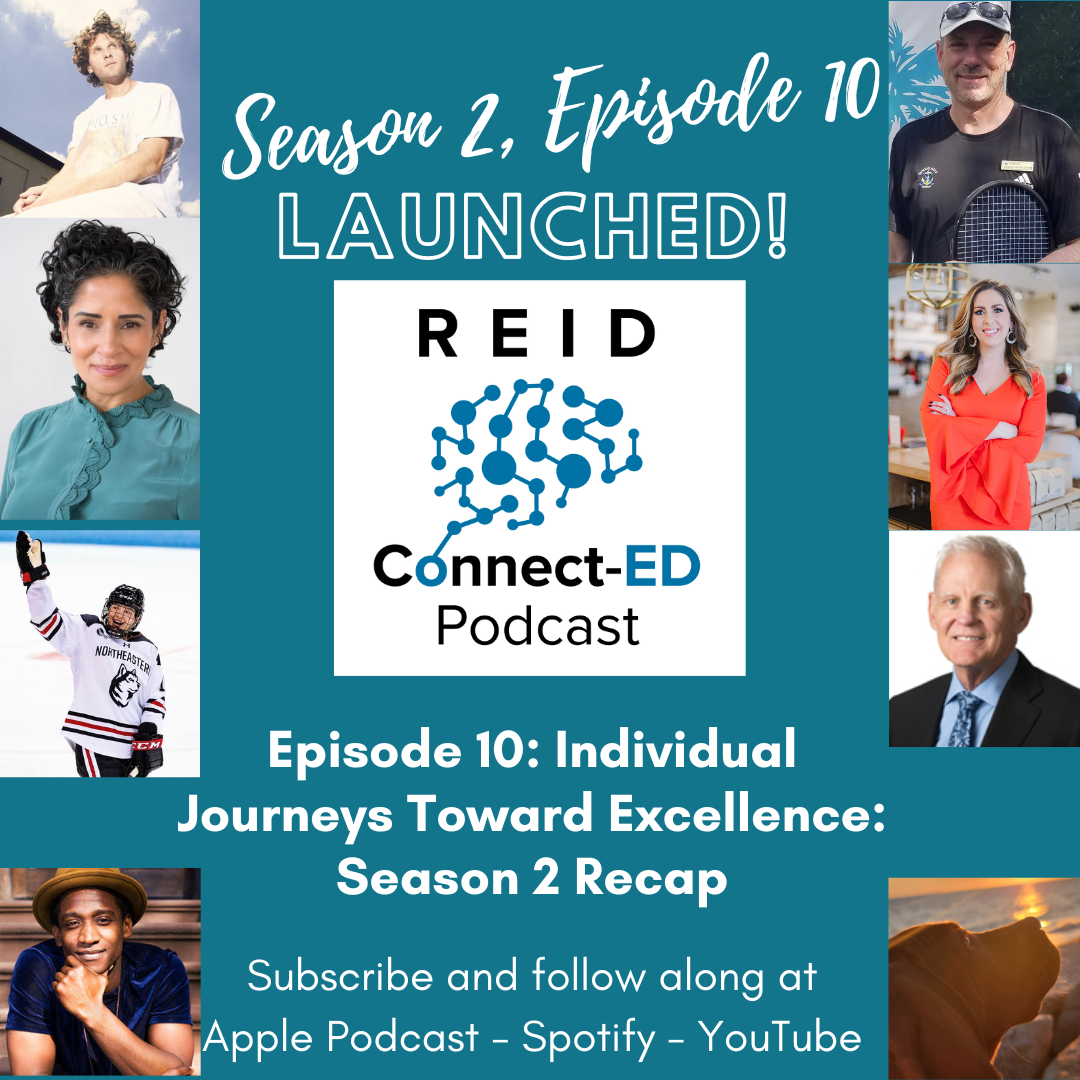
S2 E10: Individual Journeys Toward Excellence - Season 2 Recap
Listen Now!
-
-
Themes from Season 2 Interviews about Excellence
Lean into learning.
Leaning into learning your craft can shift feelings of anxiety to feelings of excitement and purpose.
This can be especially important during early stages when everything is new, scary, and even overwhelming.
Most of our guests highlighted learning as essential to their growth.
As the late, great, legendary sport psychologist Ken Ravizza once said in his book Heads Up Baseball, “A player who respects baseball recognizes that the game is difficult and is committed to improving his skills.”
Mia talked about being out there as a kid and during high school finding and creating drills to hone her hockey skills.
Jelani Remy talked about how he looked to others before him, those who were older and more experienced to learn from them. Throughout his journey he would always look to the best in his field so he could learn from them in any way he could. It was not only inspiring but helpful in becoming better and better along the way. It also inspired him to do the same for young aspiring actors and actresses.
Jelani Remy also talked about how his mother, someone who has continued to be very close with, often gives him very honest and direct feedback that came from a place of love and continues to be a foundation to stay grounded.
Marisa Brahney, who has been a television anchor at News 12 NJ and is a media expert and tv personality, shared her story when she first got behind a screen. She talked about creating her own experiences and opportunities in a college that was not known for the field she was getting into. Each step of the way, she always pursued learning as much as she could because she wanted to be her best and that was the way to do it.
Joe P talked about how when he dedicated himself to his love for the guitar, it was way more motivating to set his own ‘bar’ rather than feel like he was striving for ‘someone else’s bar’ to reach. Having meaning in your pursuit can create joy in learning.
Jelani and Joe P talked about how it was important for their parents to be okay with not knowing how to support their pursuits as a child, but to trust that there are others who could assist them in their learning and growth. Giving the child space to go out and dive into their passions, this can also be done while also being a guide and setting responsibilities. Controlling passions may be one thing that can get in the way.
Jelani, Joe P, and Mia all talked about how grateful they were for their parents to make sacrifices to support their dreams and enjoyment in their area of passion.
Humility is required to be a good learner.
Find people who connect with your passions.
When you have an interest in something it may even feel like a calling. However, you may not feel like others around you have that same passion or interest.
Many of our guests described how they sought out the people with whom they could connect around their newfound interests and passions.
Rosie Ramos, who owns a thriving esthetician practice, talked about the importance of one of her first bosses who owned a salon… he embraced her passion for learning, as she went off to conferences to learn from the best in her field. She also talked about how having other mentors support her along the way inspired her to do the same for those who work within her company.
Mia Brown, the elite hockey player, described how when she was young, she had to make difficult decisions to stay true to herself by seeking out peers with whom she felt she could connect more around the activities she enjoyed, which were sports and being active. She explained how you don’t need to completely leave behind certain friendships, but the people who you interact with can evolve and change over time in order to pursue your passions.
Joe P shared similar experiences in high school when he sought out others with a passion for music and being in a band when he felt like he was the oddball in his garage playing guitar while others were out partying. Mia also described making sacrifices to say ‘no’ to going out to parties because she was dedicated to what her big-picture hockey goals were.
We interviewed Jelani Remy, the broadway star who was featured as Simba in the Lion King, Eddie Kendricks in the Temptations show “Ain't too Proud,” and now Goldie Wilson & Marvin Berry in “Back to the Future”. He shared how he felt different from others around him in high school when he was experimenting with his passion for singing, choir, and ultimately theater. He had a push from his choir teacher and he had to be courageous to put himself out there and find others who were as interested in the activities he was interested in, which led him to give up on the sports and pursue acting.
Be adaptable and focus on building your strengths, even when disappointed.
Many of our guests talked about how they faced difficult realities that required them to make changes and adapt.
Peter Savas, CEO of LikeMinds, talked about how his desire to play a certain position on his football and swim team was met with big disappointment. However, he was guided to have a vision for a different way to be successful, in a way that fit his strengths. Peter described putting his focus into what he was good at, which ultimately led him to feel like he was improving and finding success in his own way and within a role that worked for him.
Kevin Pease described a similar experience where he was cut by his little league baseball team despite having a wicked lefty slider and although he was disappointed and crushed, he turned to tennis, which led to a passion and ultimately a calling to become a coach.
Kevin also described how there are only so many tennis players who make a career out of competing, and yet he found his passion in coaching, even at a young age despite coaching not being something others his age were pursuing.
Peter also described how one of the major ways to be a leader is to identify which role each individual would thrive in, and to support their growth within these areas of strength.
Jelani Remy and Marisa Brahney, who both entered into the world of entertainment which required auditioning, both talked about showing up as the most genuine version of yourself. Jelani talked about how he realized at one point that they want to see the fullest version of himself when auditioning, and to develop the relationship with those he may be working with, rather than assuming they want him to be someone else, like emulating one of his idols.
Find meaning in your journey.
Each person shared how their journey was not easy. There are times that are going to be very difficult and times that are going to be filled with joy and elation. Given the ups and downs of everyone’s journey, it can help to find or create a fundamental sense of meaning that will sustain you.
Mia Brown, the assistant captain of one of the top 5 college hockey teams in the country, described how important the team culture was not only to the team’s success but also to the overall experience of her time as a student-athlete. The way in which the players lift each other up, accept each others’ differences, and work together toward a common goal was inspiring to her and certainly helped her to put in the work while also enjoying the parts that could be enjoyed.
Mia Brown also talked about how important it was growing up to embrace her love for her sport and not feel forced to train or pursue her dream. She felt that it was chosen by her, which made it much more meaningful and motivating.
Rosie Ramos talked about how she found meaning in her career when she noticed that aspects of her business were pulling her away from what truly brought her joy… and how she brought herself closer to what it was that brought her joy and meaning.
Jelani Remy described how he vividly recalls his first experience with acting in front of an audience during high school and how sharing his full self and embracing the emotions of the acting was exhilarating and made him feel alive.
Jelani Remy also talked about how theater brings together all walks of life to tell a story and evoke feelings in the audience. Theater is more than just the actors and actresses, there are so many needed people to bring forth a production and they are all important.
Kevin Pease talked about how important it has been to realize the importance of the role he plays as a coach to create positive experiences for his students, and to not take that for granted.
Joe P and Jelani Remy talked about how their self-esteem really skyrocketed when finding their passion on which they placed their energy and concentration. Csikszentmihalyi discussed this in his book Flow. This is especially true when you can share your talent.
Have a foundation to keep you steady.
Many of our guests talked about how important it was to have a foundational support system.
Mia Brown talked about how athletes growing up should have access to sport psychologists/consultants proactively, instead of waiting until there’s a problem, which is usually how it turns out happening.
Mia Brown also discussed the importance of relationships on a team. She explained how teammates that strive to build a culture of respect, an appreciation for everyone's role, and buy into a team's mission and values can be some of the most important reasons for success. This was true for her teams.
Rosie Ramos talked about how her family is of the highest priority in her life and keeps her steady through the storms, as well as her faith and trust in her moral compass.
Jelani Remy talked about how his mother always encourages him to be his best self inside and out. He said how it can feel like a big responsibility to fill; however, he reminded us that the journey does not need to be direct. It can be a winding road, but at the end of the day, it is his journey and he has his whole life to fulfill the ideals he and his mother aspire to.
With Joe P, we discussed how it’s important for parents to understand their child and what they may need for their development. In the happiness episode, we also discussed how important it is to recognize that it’s not always evident and clear what will lead your child to be happy but rather it takes time to explore and gain understanding of the nuances that makes the child who they are and what will lead to feeling fulfilled.
Joe P talked about putting yourself out there. He described how holding onto your foundation in doing things that you love for love’s sake can keep you steady when putting yourself out there.
Jelani Remy talked about how when there is pressure and performance anxiety, you can “put on your big boy pants” and show up, while also remembering that you are sharing your talents and gifts with others. Joe P talked about this, too. Sharing your passions with others is like making a contribution to others around you when they appreciate what you are producing and putting out there.
Build self-awareness of your needs.
Something Alexis and I continue to come back to in our conversations and work with individuals is the importance of knowing yourself and identifying your needs along the way of your journey. This makes the journey sustainable.
In the perfectionism episode, we shared a lot of insight into the way in which perfectionism can be a positive and helpful trait, but it can also turn unhelpful and destructive in other ways, and so it is essential to learn about yourself and when those scales tip either way.
Emotions are a part of the journey and we will all have positive, uplifting emotions, as well as difficult, upsetting emotions regardless of who we are and where we are in our journey. And so, it helps to learn about your emotions and get acquainted with what the emotions are communicating to you, what beliefs are underlying those beliefs, and also how to respond to your emotions rather than being reactive.
Jelani Remy reminded us that sometimes we push through the hard times so the "show can go on" and sometimes when it's just too much, we can learn to advocate for a break to recover and return whole again.
Mia Brown also talked about how important it was to identify her approach to learning, homework, and being a student-athlete (not just an athlete). She shared how she reflected on herself in an honest way in order to identify what worked for her and what didn’t work for her to complete her responsibilities in the classroom while also playing on one of the best hockey teams in the country.
-
Gerald Reid 00:15
Welcome back to the Reid Connect-Ed Podcast. Throughout season two, Alexis and I have interviewed a diverse range of individuals who share their journeys towards excellence. We started with Broadway star and friend, Jelani Remy next we spoke with an elite college hockey player Mia Brown, followed by a discussion Alexis and I had about the topic of perfectionism. Later we spoke with Rosie Ramos, who has a thriving small business as an esthetician. And later we spoke with CEO of the brain health company like mines, Peter, Savas, Alexis, and I then pause to talk about the idea of happiness in life and how to expand what it means to be happy, especially in the pursuit towards excellence. And after that, we spoke with Marisa Brahney, whose career included TV news, casting, being a TV personality and also being a media expert consultant. Next, we spoke with Cape Cod tennis coach Kevin Pease. And last but not least, we spoke with our cousin Joe Parella known as Joe P. He's a rising star in the music scene, and he's been signed by Atlantic Records.
Alexis Reid 01:16
Okay, sure enough of the resumes of all these individuals, they're quite impressive. But as we know, and we've, as we've been talking about the resumes are more about the outcome, the things that happen with a broad range of persistence, effort, energy, resources, collaboration. And the purpose of interviewing all these individuals was because we wanted to go behind the scenes to really look into that, to see what goes into the process, not just focus on the outcomes, though, these people are incredibly impressive, and we have, we hold them in high esteem for so much of who they are and who they've become. But the process is at the heart of it all. The process is what we focus on every day in our work with individuals, you as a psychologist providing therapy and assessment as a professor providing supervision and sport psychologists working with athletes and me as an educational therapist, executive function coach, educator, Professor, we knew that these guests had meaningful and insightful aspects of their journey. And so we tried to ask curious and thoughtful questions about their experiences, their thoughts, their feelings, their relationships, what was meaningful to them in their life, and so much more. By doing so our goal was to really shine a light on how their individual journeys were unique in their own ways, as they are for every individual, especially those that we work with on a daily basis.
Alexis Reid 02:41
So there's really not a one size fits all approach, going back to the UDL concept we explored in season one, and something that is woven into everything I do in my work, and often my life. And when we think about it, not being a one size fits all approach to determining whatever success might mean to you, or how you figure out when you've achieved excellence, or what it takes to work towards it. It's such a subjective experience for each individual. And the purpose of the season especially. And pretty much overall in the podcast is for us to share some of the wisdom that we've gained in our work in our professional lives and personal lives, too, because it all plays a role in each other. It's all connected, but really thinking from the perspective of others, that these people that you might see their accolades, or their resumes and the things that they've accomplished, but really, pulling the onion back right, pulling the layers back to see what it took to get to this process. And like I said, in the episode with with Marisa, there really are like three main components, I think, that are a big part of getting to where you are and achieving excellence. It's about having, believing in fate, right? Sometimes things just happen the way they're supposed to, we really have no control over that. But knowing that somehow some way things come together, having faith both in yourself, knowing that others have faith in you, having faith in something outside of yourself. And this idea of agency, which I think is a big part of our work is helping the people helping people to feel like they have agency and they have some role in what happens in their lives where they can build skills, they can better understand themselves. They could understand their emotions and how that plays a role in their life. And really figure out what goals you want to work toward and what that process is going to be like.
Gerald Reid 04:38
We're going to really try to identify themes that cut across the stories shared by the guests, we do think that there are themes along the way and we're also going to highlight this the insights and wisdom that came from each individual guest and overall we want this episode to acknowledge our guests and what they brought to the Reid Connect-Ed podcast and also to relate it to the work that we do with individuals on our practice every day.
Gerald Reid 05:00
So Lex, you know, we're, you're an educator, right? In my own way, I'm an educator too. And, you know, education is huge, you know, they always say knowledge is power. And, you know, one of the themes I really felt came up a lot in all the guests in sharing their stories was, the importance of learning and your job, basically, is to help people to learn.
Alexis Reid 05:27
I had a client yesterday said, you literally teach people how they learn best. That's literally what you do. That's awesome. And it is awesome. And, you know, knowledge is power. But I think wisdom helps us to transcend that knowledge into more purposeful practice, which I think is really incredible, which is a lot of what our guests were so articulate and sharing on on this seasons episodes.
Gerald Reid 05:56
And, you know, what came up in their stories is that everybody had their own version of learning that was meaningful to them, you know, you can think of finding that passion really opens up this desire to learn, you know, not everybody's going to be in a classroom, and just absolutely love to learn what they're being taught, because math or history, or English, whatever social studies, whatever topic that may be discussed to them. But, you know, it's amazing when people can, you know, that's what you try to help your students to do is to engage in the material that's really, you know, fundamentally, what helps people to learn the best is when they're truly engaged in it. That's one of your UDL principles that you hold true to. And the research backs that up to so you know, one of the biggest themes that I really found really amazing and you know, this applies to us, too, in our own journeys is just, you know, when you're motivated by something, you really truly care about it, you're going to do everything you want everything you can to learn about that, because it's going to be inspiring, too. And it might be different from what other people may expect of you, like, maybe, you know, you're, you're not top of the class academically. But you know, like Joe P said, he picked up his guitar, he was an expert learner in the guitar. He wasn't necessarily that in the classroom. And I think, you know, he did say he has some regrets about like, not, you know, fully engaging in his academics like he could have, but he was finding more meaning in the guitar and learning about that. And that's that just a different type of learning. It's not like it's better or worse than other type of learning that could have in the classroom.
Alexis Reid 07:27
Yeah, I think, you know, like you're saying, leaning into the process of learning was such a big theme across all the episodes we recorded for season two. And, you know, it's also a theme in the work that we do every day, whether it's your clients learning about who they are my current clients, learning how to learn well, and navigate life with using skills in different ways in the classroom or outside of it. And I think that, you know, one of the big parts of this is, so many of our guests mentioned that they got in touch with what they were really good at, they recognize their strengths and skills and passions. But they needed to do more with it, than just show up with it. And I think this is a big piece that gets missed. And you know, this has been a common theme, also talking about what we see in the media at this day and age that we often see the outcome more than the process. And, you know, just having a natural skill set often isn't enough. And we need to deepen that understanding, again, going from just learning or using his skills to transcend it more into like, you know, the semantically, it's that thing I said before about wisdom, but the wisdom becomes the practice, it becomes the integration of whatever you are focusing on to be able to do, whether it is an instrument or you know, a sport, or in acting, or in business or in life in general, you know, our natural abilities and skills can only take us so far. So we really need to lean into learning and understand what that process is, to better integrate into whatever we choose to do. Because even us in our work, I have a quote on my desk still to this day, and I said it in season one, it says, you know, I'm still learning, we're also learning and one of the greatest Buddhist philosophies that I believe in, is that there's a sense of ignorance that we we don't know what we don't know, a lot of times, and we're always still learning. There's this beautiful curiosity in life. And I think it's what makes us human, to be able to explore and understand what's possible and talking to people and having the opportunity like we do every day in here on the podcast, to talk to people and hear their stories, I think is a great process for us in learning to.
Gerald Reid 09:49
Definitely, I mean, every moment is a different moment, right? And who you are now is going to be different in some ways than who you are a year from now, two years from now, a decade from now we're always evolving and growing and We have new experiences that you know, in some ways shaped us to be a little bit different as we go. So to be open to learning about ourselves, and what we're doing is great. And to be humble about that, right? That's, that's humility. And I did hear a lot of that humility, that there is always something more to learn and to seek that out. And like I said, when you're inspired, it's like, you want to seek that out Jelani talked about easily. He's a Broadway star, like, you know, do two amazing things. And,
Alexis Reid 10:29
by the way, just a little plug for Jelani right now in June 2023, he just stepped onto the set and stage Back to the Future in his new role there, which is really exciting.
Gerald Reid 10:38
And it seems like he's just loves, you know, stepping into these roles. But, you know, he talked about always looking to people above him from the beginning. And even now, you know, he doesn't have to do that. But he's always looking for people who have come before him who have more of an expertise in some area or have some wisdom to gain. And he sought that out. And he always felt like that was part of his growth, like, you know, find someone else who knows more than him. Or he will, he can kind of see or model from to get better. And he did that since high school. And he was a late bloomer, too, he was not the acting early on in his life, he was, uh, he was a very late bloomer, but he didn't let that hold them back. And Marissa, you know, talked about this too, in some way. She's a late bloomer, because college was there, you know, your your college was not focused on. It wasn't known for like media relations. It was like, she, you guys had a,
Alexis Reid 11:29
we had a broadcast program there at all. There's a communications program, which I started in, and, you know, it didn't exist, we had to create it, you create
Gerald Reid 11:37
it, you create your own TV station, you know, Mercer was you guys were agreeing with this. You both were agreeing to this. And you, you know, Marissa, I think what I found a theme for her too, is she leaned into just learning and being excited about taking opportunities to get better. And that excitement, you know, I'm gonna say this is when you're trying something new. It's scary. I've totally, and I think, you know, in sports psychology world, we try to sometimes reframe things being scary to things being exciting or being you know, changing the the interpretation of what you're feeling can help sometimes. And I felt that from Jelani from Merson, from others, when you're really inspired to learn and to grow, that make those nerves and those butterflies not get in the way of your process, because it's hard to to jump into something new.
Alexis Reid 12:22
Yeah, and as I frequently say, and listeners of the podcast know that, you know, oftentimes these frightening, uncertain times can bring about the greatest changes, even though it's really challenging to get into it. And in a lot of the work that I do, thinking about executive function skills, right to be able to inhibit, to pause and kind of check yourself and say, Okay, what's happening for me, in my environment around me with what I have available to me, but also inside, right, from an emotional aspect and perspective, and what's coming up for me that I need to pay attention to, because it might be a signal in some way to tell me something needs to shift or change or adapt. And then the working memory skills, you know, when you're learning new things, you're taking in so much information, and you need to do something with it right away. You know, think about everybody that we interviewed Jelani on the spot, you know, sometimes he has to learn a line or a song in a few minutes, and then practice it and audition it. The game about Marisa being out in the field, Mia, when she sets foot on the ice, you have to adapt to the new changes that are happening on a team within the team with the other team that you're performing against every single person here, you know, that we talked about and talked with in season two, it's about being open to what's happening and taking information in sometimes, especially from learning new information and learning how to adapt and change.
Alexis Reid 13:46
It's a process, it doesn't always just come online right away, especially as you say, if there is some anxiety or stress around it, because that's going to also weaken the critical executive function skills that allow for us to do deep, hard, complex tasks. Not to mention, you know, cognitive flexibility, which often comes online a little bit later in life. Because we need to have a lot of experiences and know that there's different paths we can take to even know to make a shift or change. You know, we can end up in a rigid place because all we know is what we've tried. And if it doesn't work, it might seem hopeless, like, oh, well, I guess I'm not good at that. I tried it I thought I was good. didn't go the way I plan so therefore I need to give up or change my path versus how can I adapt shift or pivot a little to see if we can make some improvements and find more purpose in that which we're doing
Gerald Reid 14:43
totally and that's a plug for therapy but that's therapy is a lot about just learning about yourself. You know, I just had a session with someone who you know was saying like, I never really knew why I was doing this or why I had this pattern. We got to such a good deep insight in the in the session that just He totally makes sense in a way that I didn't really totally understand in a deeper way. And to your point about adapting, that takes self awareness. And it's not just learning your craft. Like, I think, you know, one of the major themes of this podcast too is like learning, learning is not just about something a skill, it's also about learning about yourself. That's what you do in your work helping learners to understand how they learn best, it's in my work and helping people reflect on themselves. And I'm going to add a piece to this, that it's also the people around you, that was another theme from our interviewees, you know, they had people to support them, that either really believed in them, gave them autonomy, to take risks, and to try new things and to feel safe to do that. And, you know, because to have that, you know, if you're in the classroom, think back to when you're a kid, you have a teacher that you trust and you know that, you know, they care about you. And they're going to create an atmosphere conducive to learning. And this is also what, ideally, ideally, yeah, ideally, right. And this is also what therapy is, let me create a context in which you can be vulnerable and just open up to the honest truth of like yourself, and how things happen. By doing so you can learn, you can look and learn a lot of things in that type of context. So
Alexis Reid 16:16
I'm going to bring it back to learning for a minute before we go on to that next theme of connection and community. And I really want to double back into this because you, me and our friend and colleague, Luis Perez, we just did a conference presentation about trauma informed teaching and learning. And I want to bring this up, because for our listeners, who might have had a negative experience with learning in the past, or those who maybe have tried something and failed or felt like it was a failure to them in that moment, that it's, it's often not an all or nothing experience with learning, right. Oftentimes, there's creations and levels and steps. And parts of that is really the process of learning you learn what works and what doesn't. And, you know, thinking about experiences that could have been really detrimental, brought about a lot of stress and distress in a moment, especially if you're in a learning environment that is not set up or conducive to learning for what works best for you. That doesn't mean that they don't exist doesn't mean that we can also create or co-create these spaces, these opportunities these contexts for ourselves, or advocate for what we need in these different learning environments.
Alexis Reid 16:17
And I say learning environments broadly, it could be, you know, from preschool, all the way up to high school, in your, you know, college undergraduate, your workplace situations and workplace. Exactly, that was my point that I was getting to, even in our household, right? Sometimes different contexts and situations change that we need to change the way we do chores, right, maybe we need to redistribute the efforts in different ways, or come up with a different system or come up with a different plan or way that we balance our efforts for the people who contribute. You know, there's all different things that are constantly shifting and changing. And, again, going back to this advocacy agency piece, like we can play a role in what happens. And oftentimes, when it feels difficult, when it feels challenging when it feels scary. It's really easy to shut down and be like, Nope, I don't want to do this. And all the people we brought on this season to interview, every single one of them had at least one situation that they shared with us where they could have said, No, this is too hard. This is too scary. I don't want to put myself out there be vulnerable, try to jump without a net, and maybe fall flat on my face. And oftentimes, most of them have shared or they've shared with us personally off air. That there there were times where you know, it was really difficult. And they they did get stuck for a little while and they had to adapt and shift and change to get back on a path or create a new path to lead them towards where they were heading and what they were able to share with us and what that process looks like.
Gerald Reid 19:14
Yeah, and if you get if you get too fixated on the outcome, or the future, or some ideal, this is the perfectionism episode, then you can lose touch with trusting in the process of what's happening. And it could feel like it's a catastrophe. You know, that's kind of the CBT term catastrophizing. Yeah. And that's, that can create anxiety and anxiety is an emotion that can make people narrow minded. It's just the way that anxiety does because anxiety, you see a threat. Like you know, back in the day you see like a lion, you want your focus to only focus on the lion and narrow your focus on one thing and we know different threats happen in different ways to different people, depending on what they perceive a threat is so you can get really fixated in that way. And, you know,
Alexis Reid 19:57
And, I was gonna say and you know, a lion in these days. An age might be a really difficult test or a job interview, or, you know, somebody that you had an argument with who you name now need to confront and talk to in a reasonable way like, or it could be, you know, just somebody makes a comment on your social media posts that feels uncomfortable, those can all feel like threats, it can be a lot of different things. It's not, you know, we don't live most of us in a, in a bucolic and wilderness way, where we're facing really big, scary animals every day, that that's the only threat we need to protect ourselves from, there's so many threats, that can trigger a response that can be stressful or sometimes traumatic.
Gerald Reid 20:44
And so that and part of the process is, you know, learning from the experience and trying to figure out how to be flexible to, to adjust and to make adjustments. So let's take Jelani's example. He talked about when he was on auditions, and he's like, could you believe, you know, you have like, like, fifteen minutes, I don't know how long it was, like, very short period of time to just sing something or to perform or to act. And they're, they're judging you, they want to know if they want to hire you or not for the role and the cast you. And so, you know, he said, very bluntly, that he had to learn, it's not personal as much as that feels it is and so many words, he said, you know, they may not be looking for you now, but they may be looking for you in the future. And it may be something you don't even know that they're looking for. And the key this is his reframe that really was great. And you know, a lot of therapy sometimes is reframing, reinterpreting, to be to be resilient. And as he said, you know, the most important thing is they don't want me to be something I'm not they want to see the full me. And my job is to, to to be the full Jelani that I can be when I'm showing up, and whatever happens happens, you know, I'll find the right role for myself as time goes on.
Alexis Reid 21:55
Yeah. And, you know, Kevin talked about this when he was in a youth baseball pitcher, and got cut from the team and 11/12 years old, and had to figure out what else to do with this spring. And he didn't even know that he was going to become a tennis player until he had that opportunity. Because the thing he expected didn't work out the way he wanted to, to. And one of my favorite new things to say to clients now in my sessions is comes from Ted Lasso actually says in an early season where he says, you know, be a goldfish, right, you know, be a goldfish and, and forget the things that don't always work out the way you want them to. Because we overly like you're saying we overly fixate, and remember the things that don't work. And in fact, that's not often, for some people, it is motivating. But for many people it's not. And it gets us so stuck in the hardness in the difficulties and the challenges, instead of being like, Oh, I'm still floating, swimming, what am I going to do now? Right? Be that goldfish and have that like, you know, quick opportunity to forget the stuff that doesn't go? Well? Because if we keep harping on it, it's gonna get in our way, every time.
Gerald Reid 23:05
Yeah, you know, I remember talking to someone in therapy, and someone is very hard on himself, and would really kind of brace himself and say such negative things, when things were not going well, when he made a mistake, or did something he regretted. And you know, what came out of me in this in this moment was, you know, wait, like, reflection has a purpose, there's a function to reflecting on the past, it's to learn from it. So I said, did you learn from it? And he said, Yeah, I definitely have learned from it. Now I'm going to try to, you know, use what I've learned in the future. Okay, your reflection has done its job. Sure, you're going to need reminders along the way, we all need reminders, in some ways, this is what the podcast is about. Like, sometimes we just need reminders about things, you know, we're not, we may not be saying things that other people haven't said before, but this is, you know, a way to kind of create a create a context to have reminders for what we all need. And I said to him, Okay, your reflection has done its job. You don't want to overdo something, if you're gonna keep reflecting on this and braiding yourself. It's lost its purpose.
Alexis Reid 24:05
Great point.
Gerald Reid 24:07
Now it's time to move on.
Alexis Reid 24:08
Yeah. It's a goldfish mindset. You know, and I could talk about learning, as you know, for forever, I'm going to share one more story, it's personal story about my path in learning. And then we'll, we'll pivot to the next theme that came up. But, you know, I think this is an important point to make. And I share this often with clients that I work with it, you know, oftentimes they'll look at me and be like, Oh, you're so intelligent and smart, and this and that. I can't believe all that you're doing. And I have to remind them about my journey too. Right? Because when I was growing up, there were a lot of things that came naturally, but I didn't always put my fullest effort into everything I do, did either. You know, I said in one of the last episodes that I really didn't feel inspired to read for reading sake until I was much older I would read a lot, but I didn't And, you know, choose that path for myself until I was a little bit older. And when I did, people who know me know, I have this huge library now of books that I love to dive into and enjoy.
Gerald Reid 25:12
I didn't start reading really into, like, really passionately reading until college when I was coaching. It was because of coaching that was like, wow, like, I really am interested in this, let me read as much as I can about it,
Alexis Reid 25:23
right. And sometimes when you, you choose something you want to learn more about, that's when you dive deeper into it, versus somebody else telling you to do it. And we totally get that. And a lot of the younger people we work with are like, well, I don't want to do this, because I was told to do it. But there's skills that get developed and doing things that maybe you don't love to do. But you have to do, right, there's, there's a balance there that needs to be achieved, and
Gerald Reid 25:46
adults are in our lives for a reason. Well, they have perspective to remind us, sometimes
Alexis Reid 25:51
absolutely true, because our prefrontal cortexes are not fully developed until much later in life. But you know, Joe really did a nice job reflecting on that experience, too. And he even said, you know, if I could go back to school and do it differently, I probably would. But, you know, for me, I took a little different path, there were so many things that happened to me when I was in high school, when I was a teenager, you know, we lost a lot of people that were very close to us, there's a lot of mourning and change that happened at a very critical point in my life, that I know definitely impacted my academic portion of my life. And I see it every day in the kids I work with, right, that are young people that are going through a lot of stuff. And often, that's why they need me at that point in their life to help support them to bring them up and teach them about, you know, when my emotions get high, when stuff is going on, I can control, how do I how do I zero in on these skills that are going to help carry me forward. And, you know, I want to just point this out, because a lot of my clients, they see the schools I graduated from right the the end results, but they might not know that my first year out of high school. And by the way, when I was in high school, when when the academic stuff, maybe wasn't the best that it could be. And I'm going to say that because my mom and dad will hold me to that. That I didn't always do my best during those tough times, that other stuff was going on that I couldn't control. But I really leaned into the stuff I was good at that time, right, I was a big part of student government, a lot of volunteer organizations, a lot of helping helping the community. You know, I was fortunate to to write for the newspaper and the sports section to, to really explore the passions and the things I loved a lot. So like Joe was saying, you know, even if you're not learning what you're being told to learn in the way people are telling you to learn it, there's still opportunities to learn and develop your skills. And I think that's what I did. And I want to share that. For people who might be going through things they don't have control over, you know, especially young people because they don't have the experiences over the course of life, like we talked about with Marisa that we don't, they might not have as many data points that there's going to be ups and downs. So when the things feel difficult and challenging that there's other ways to channel your energies to be able to get you through while still building skills that translate into the academic areas, if that's what you choose. But with that, you know, my first year out of high school, I ended up going to it was a State University in New Jersey, it was close by to where we lived. And I lived home for a year until I figured out really what I wanted to do. And I would say it's probably the best thing I ever did. So I'm a huge advocate of students taking a gap year or maybe going to community college or more local university to figure out really who they are and what they want to do. You know, I was so fortunate I had the opportunity to literally study everything. I think I took Intro to law classes, accounting classes, I dove deeply into broadcast journalism, because that was my passion then. And I got to explore and visit a lot of my friends who are at different schools too. And then I got study abroad that summer afterwards. And it was on a, you know, much cheaper opportunity than it would have been if I pursued that through where I ended up at Loyola College in Maryland Loyola University. But I just want to share that because sometimes the path isn't laid out exactly the way others might be experiencing it, or what you what you think you're supposed to be doing. There's always going to be a different path, a different option that might fit you better. And it really is not about thinking one size fits all. This is the way the trajectory of people's lives in general go whether you're in the US or you're in a country in Europe, or Africa, or Australia, or Asia, wherever you are. It's not about just thinking I have to do what everybody else is doing. It's really about doing that deep work and reflection and who am I as a learner? Is this the right time for me to be pursuing this? Is this a passion and purpose that I feel committed to and engage to And how do I figure out? How do I map that out. And sometimes you need the support of somebody like you and I, or a close mentor, or coach or friend, or an another adult, that's a positive influence in your life or a family member. But you know, there's really no shame in that is my point in saying all this.
Gerald Reid 30:17
Yeah, it's not linear, it's not linear and, and all those experiences, you know, eventually lead you to be who you are, as you get older. And, you know, they don't have to be considered something bad. Like, we're always making judgments, what's good, what's bad, and sometimes things just are what they are, you know, it's part of your journey. So, you know, embrace it, make meaning out of it the way you want to, you know, after high school, you know, I started, I went to the same university, talked about local, State University and started coaching, I had great opportunity. I was very blessed to have that coaching in the inner city, and like, I had these experiences that I think I just needed to have at that time of my life. thankful for my family and for the opportunity, and also like, mom to like, she always, like, encouraged boldness in us. You know, like, who was I, like, I showed up with the team, and we would go to different schools. And I looked so young, like, I was always short, like, look, the young when I was younger, and I remember another coach, like, I introduced myself to the other coach, at one of the schools I'm like, Hey, Dylan, Coach, you know, nice to see you. And you excited for the game today. And, coach, he was so much older than me, it looks to me, he goes, How you doing? where's your coach? Like, that's me. That's right. But I think I needed experiences like this to grow and develop and I had to be vulnerable, I had to really believe in myself. And I think, you know, we call her Momma Dukes who really inspired us to believe and to be courageous and to be bold in that.
Gerald Reid 30:17
I mentioned this, when we talked to Kevin about coaching, but stuff I was doing then informs what I do now, as a psychologist like I was experiencing, stuff was coming out of me about leadership about getting to know people building really good relationships. I remember at the end of the season, like writing up a whole, like, you know, feedback to the players individually about like, Hey, here's what I learned about you, here's things you can work on. And like I'm doing stuff now, I'm doing the same thing. Now, when I do assessments with people, I'm trying to learn about them and give them feedback in a positive and encouraging way. You know, Joe P. said this too sometimes, in our interview with Joe P. said, like, you know, stuff I was doing back then when I was younger, I'm still doing now. So you know, all this is to say, you know, when you're parenting, it's hard to really understand what a child needs when you're parenting, we talked about that, too. So if you see glimpses of who your child is, you know, it's good to to understand what what might that mean, about them and their personality about what they might do as they get older. And embrace that rather than feeling like, you know, they have to go do this, because, you know, that's an expectation of society, or some other cultural norm or something that like, hey, you know, try to understand who they are.
Alexis Reid 33:05
Yeah, I'm gonna add a caveat there that just because somebody picks up a guitar or violin or piano and says, Oh, this is cool, doesn't mean they need to be committed to like two years of lessons intensely. But I think like you're saying that it's about having that conversation, right and showing up for them. If, if you have a student who says, you know, I think I really love music, bring them to a concert, introduce them to somebody that's been doing this for a long time. Play them Joe P's episode, right, and hear about what it takes to commit to becoming the best at what you do or that level to work at a higher level, because it does take a lot of commitment and sacrifice. And it's not always an easy path, because there's gonna be ups and downs.
Alexis Reid 33:50
I was just talking to one of our 20 something year old cousins the other day about, you know, she's year out of college and working a couple of different jobs trying to find her path. And she said, Lexi, you know, I have not really saving any money right now, this is really difficult. And I had to remind her, I'm like, Yeah, I'm like, I know that feeling. And like, we used to joke when we were in grad school, we I skipped a whole bunch of years, we'll come back to it, I'm sure. But when we were in grad school, we had to share a really small space to get there first year to live in Boston, because it was very expensive. And we joked it was like camp grad school, because it's almost like we were on bunk beds, trying to just make it work. And sometimes you got to get scrappy, and you got to figure out what it's going to take to make it work. But, you know, to your point, Jer, you might have been doing a lot of the same things back then as you're doing now. And like I said, that's like the natural talent and gift and who you are. But by no means does that mean you're at the same skill level then then you're the as you are now because you put so much effort and so much training into building and honing those skills. Right and Huge dedication, lots of sacrifice on every aspect of your life probably, to be able to improve that which came naturally to you that it had to be something that was developed over time to get to a point that now, you know, new you and I feel comfortable having these conversations on the podcast to share with others in this way.
Gerald Reid 35:22
Yeah, I mean, I remember me saying this, we echoed this a few times, sent me like, who are the athletes that really go far? you know, they're the ones that are kind of just going through the motions or feel like they're forced to be there, or they're the ones that really are excited about the sport, and they just love it, and they're gonna go out and play it, because they love it, you know, they would be out there, like she was doing drills playing the sport, they want the sport, without even if they weren't told to because they are so immersed in engaging and Joe P, he said the same thing is like, even now he's, you know, he's got a big following. And he's like, I wouldn't be doing this if there was no following. Yeah, you know, like, if I was the only person left on Earth, I would be doing the same thing. So, you know, to your point. And I felt this way, like, you know, I didn't, when I jumped into this career, I was just so excited to learn and to to grow in like I was doing it because I wanted to do, I didn't feel forced to do it. I felt like it was a passion. And I felt like it like you said it clicked with my strengths. And to know that, like there's, there's at least something there. That's a good foundation. I think, number one, it's the support people in your life, you know, having the support people but also knowing that your strengths, you know, Peter Savas said this, you know, he's very successful in running companies. And he's trying to do a lot of good right now and trying to address Parkinson's disease in his company. And it's very meaningful thing to him and really drives him. But he was saying, you know, back when he was younger, that like, he had to get feedback about things he may not have been naturally good at. And he was told to shift in a different direction. And that really helped him It doesn't mean that you did someone tells you exactly how to do this, like, you know, sometimes I've gotten advice sometimes that didn't fit exactly what I needed for myself. And that's okay.
Alexis Reid 37:05
Or like Jelani's mom said, "just not feeling it"
Gerald Reid 37:07
is not. No, yeah, that's it, though, you know, you need honest feedback, but it's but it's compassionate, inspiring feedback. It's not just, you know, shooting your dreams down. It's like, let's try to navigate this together. So and when you have that, and you really care, like, you know, you're all in but it's, it's an engaging thing doesn't mean it's easy. Like, it's definitely not easy. But but that element, and remember, I asked Mia, I said that she said, Yep, those are the ones who really, really, you know, get much further, otherwise, you can really get burnt out.
Alexis Reid 37:39
Yeah. And, you know, I hear people using the term ego in a kind of negative way. But ego is really just like your identity, your self that you put forth. And I think that sometimes we get really like stuck on an ego, which could make it a negative connotation, and how we show up in a way. But I think that there needs to be like a little stripped down version of ego to tap into humility to be open and vulnerable to taking feedback and making changes, and adapting and adjusting to whatever the context might be. I was talking to a parent earlier, who, you know, is going through a tough time trying to adapt to a child who was adopted. And, you know, they're working so hard and doing so much through so much love that she's sharing for her daughter. And I said, you know, parenting is so difficult, because even when you figure out the formula that works well, in a moment, the next day or the next week, you might need to come up with something different, just because the context changes, something might come up from the past that you don't even recognize or know or can anticipate. And all of this is just is constantly shifting and changing as it is in life in general. And I think we need to be open to the process of, you know, taking in information, reaching out for support, tapping into resources that are available, and really honestly recognizing that we're all human just doing the best that we can. But to your point of the second theme, that really was a resounding theme across everybody we talked to this season, was thinking about this idea of community and connection and support. And we touched upon this a little bit already, so we won't go too far into it. But you know, we mentioned mom, you know, Dad, our cousins, aunts, uncles, friends and family across the board, you know, we might not see or talk to them all the time. But we feel the love and support and we know that they're out there cheering in some way in their own way. And it might not look the same every single time might not feel the same. And it might be very distant, but it's there. And the fact that we can trust in the fact There are people that believe in us. And in you and I both, especially here in Boston, I feel so grateful that we've developed a community here. Since we started grad school here in Boston, we're not from Boston, originally, we're from New Jersey, as you've heard over the episodes. But, you know, I feel so lucky to have found a community of colleagues, mentors and friends who have just embraced me in the work that I do in such a beautiful way. And I'm so grateful for that. And that's what inspires me and keeps me going, especially in the work that we do that we're able to enter people's lives, usually, when it's a really tough time for them, and to be able to support them in the way that fulfills an aspect of their life and empowers them to do something different and be better. And to that point, you know, when I was in college, I shifted from communications to education, as most of you probably can imagine, as I'm an educator by trade. And I will never forget sitting in a class one day, and one of my very good friends to this day, Julia looked at me and said, Lex, you're gonna be a great teacher. But that's not all you're gonna do, there's something else that you're gonna do in your life, something that has to do with like psychology, or mental health, and also education at the same time. And I looked at her like, I don't know what that's going to be. But I feel that too. And I'll never forget going home from that class that day. And I wrote out like a five year plan of what I thought I wanted to do what I wanted it to look like. And to be quite honest, I had never seen anything like it before. Like I didn't know of a person who did the work that I currently do now, back then. And somehow I just drew up all the characteristics of it. It's almost like you know, what we do and in our, in our work in a therapeutic capacity of like journaling, putting it out there getting clear about what you're looking to be in looking to do, and, and mapping that out. So, you know, for anybody out there listening, trying to think of how they want to show up next, take that opportunity to press pause and just write down, you know, what do you want it to look like, and if you even approximate that, it's amazing, because I pinch myself all the time. Because I feel so grateful and blessed to be able to do the work that I do every day, and to be able to do so many different facets and aspects of the work I do in the educational realm and to be able to blend it with the work you do in the mental health realm and to help people on all these different levels. It's absolutely miraculous, and it's nothing I could have ever dreamed of. Again, I was wanted to be a sportscaster when I was in high school. Who would have known?
Gerald Reid 42:46
Yeah, we need you never know how things are going to progress. Like you said like he just kind of feel like this makes sense right now and you get some inspiration like your friend gave you some inspiration because he she saw something inside of you. Jelani said that to like his choir teachers like No, no, you got to get into theater. And he said very specifically, like she pushed him in that direction. And he was uncertain about it. But she saw something in him that led him there. You know, when I was in grad school, there's the kind of a joint program between the School of Education School of Medicine and one of the professors at the School of Medicine, there's actually two of them. At the time, I was so interested in the brain. Like there was brain science was like blowing up it was like 2008 2009 like all the 2000s like this brain science was like all over the place on why this stuff is so cool, interesting. And I actually applied to go into the field of just becoming a neuroscientist Yeah, neuroscientist and actually got accepted to the program. And I'll never forget this two of the professors. They essentially in so many words said, you know, you're such a people person, you're, you're, you're a therapist's therapist. Like they saw something in me that when when you're growing and you're going through training and stuff, you just you have no context you have no you don't have like people who you've talked to before in the field, like you have no idea what to expect. Everything's brand new. And for them to have that perspective and share that with me. I changed my course. I mean, it came with a lot of reflection and talking with people close to me as well. But that definitely helped you know, someone who's been through the field who knows the fields like No, like you have something natural like this is you know, they didn't tell me I had to choose it. But I definitely ended up choosing this direction rather than becoming a neuroscientist kind of a brain sceintist because you know, like you said, like someone can see something inside of you that you don't you don't realize it yourself because sometimes we got to rely on other people's perspective.
Alexis Reid 44:48
Yeah, and I think naturally curious people which you know, you and I definitely are but so are so many of the people we work with. I think that actually causes a lot of confusion for them that makes things feel uncomfortable because they like so many different things. and they are not sure what to do with it. But you know, you didn't formally, properly get trained to be a neuroscientist. But, you know, you and I both have incorporated so much neuroscience in our own way of learning you through doing your postdoctoral work at MGH to do neuro psychological evaluations. And me by really diving deeply into the neuroscience side of, of education and learning. You know, it's it wasn't something we, I least formally trained in, but it's something that I've really developed an expertise in, because it's something I cared about. And that's the other part of this too, going back to learning, I was going to do it. Going back to learning, again, as a theme that, you know, you don't have to just do a formal program to learn a lot about something that, you know, is going to benefit you or the work you do in the future. And that's another theme to you know, even thinking about Peter are talking about, I really loved, thought it was going to become a scientist, but it was really good at the business side of it. And I was able to blend those pieces together. You know, it's a really beautiful thing.
Gerald Reid 46:08
And in Rosie Right, yeah, so Rosie, what a great story, right. And she was talking about her journey of, you know, that led her to get back to her roots of what she really loved. You know, she kind of went into the business world of things, and kind of the corporate route of doing different things. But she's like, you know, I really love the face to face with people. And she opened up her own business, and she had a few goals that go into great with it each time, but in her later stages, she's like, you know, it's all gonna be back to the basics of what really brings me joy and fulfillment. And she got back to that. And that was very meaningful to her. Because she was being true to herself, you know, so much of life is like, you know, what's most true to me, and it takes time to figure that out. And we got to go through experiences to make sense of it. But the stories are powerful.
Alexis Reid 46:57
Yeah, for sure, and more to come. And, you know, we touched upon this a little bit, but I just want to dive deeply because I know that so many people we talked to in season two brought up this adaptability and flexibility piece of things. And like I said, from a neuro developmental perspective of at all, this is something that does take time to come online. And you can think about it this way that, you know, young kids might not be able to recognize all the different breeds in dogs, right, but they might not, they might know that when they see a dog, it's a dog, but they might not know all the different names and characteristics of them. It's the same thing as we get older in life that sometimes we don't have as many experiences to know all the possibilities of what might happen, that it makes it more difficult to be cognitively flexible, to see more than just the path that's right in front of you. So to be adaptable, to be able to be flexible, to pivot and shift psychologically, cognitively, it takes a lot of effort sometimes as those cognitive skills are coming online. And again, as I constantly am saying, All of this is so vulnerable, and influenced by our emotion, that if we get dysregulated, or overly emotional in one direction or another, it can also hinder our ability to flex and change. I mean, even thinking about like, if you have a plan of you're really excited about doing something and then all of a sudden, it doesn't work out the way you want to, it might be really difficult for you to shift your your plan or your approach.
Gerald Reid 48:34
You know, life is life is so interesting, because you know, we all we all want control and you know, control reduces anxiety. But sometimes we have to learn how to let go of meaning control in some certain ways and also learn how we can gain control in other ways. And that's like a dynamic thing. That's what a lot of therapy is about. It's like how do you find things that are you can control or, you know, make sense to control and lick pullback on the things that you can or maybe not need to and, and that's all about the process. And it takes time to certainly to understand that.
Alexis Reid 49:04
Yeah, and and it was really cool to hear people's stories in reflecting on you know, maybe I was a little more rigid when I was younger, but I'm glad I gave myself the space, the time the opportunity to sit with it. Or to make a change because it actually ultimately brought me to where I am today that feels more fulfilling than it would have been before. Yeah.
Gerald Reid 49:31
And it's good to have those foundations that keep us steady. You know, you talked about the boat metaphor from Scott Barry Kaufman and like there's you know, we talked about this in the happiness episode is having that foundation, whatever it is, it could be one person that you can kind of lean on emotionally could be family, you know, Rosie talked a lot about family and how meaningful family was to her is to her and you know, to have that to keep you steady when the waves are crashing and when the storms come and it could be anything could be that you just kind of Stick to your routines, it could be that, you know, you have meaning in your life or you have sort of some rituals that kind of keep you grounded. Because life is going to you know, it's scary when things are confusing or uncertain. And, you know, we all need something to hold on to. And the hope is that it's a healthy thing, right? You know, we talked about this in the past, you know, people can develop unhealthy coping mechanisms to deal with things like this. And the hope is that you learn that, Oh, those are just coping mechanisms, those don't don't, these things don't define who I am, whether it's substance use, or different kinds of maladaptive habits, that people can fall into that, that those are, you know, if you can understand them as coping mechanisms, you don't have to identify with them as much, and you can replace them with something healthier. And so, you know, the main point here is, you know, finding healthy versions of your foundation is, is, is a great part of growing and getting through life. And it takes time to figure out what that will be for you.
Alexis Reid 50:49
You know, I was reflecting on this recently, I don't know if I even said this out loud. But I was reflecting on how a lot of people think, you know, looks or monetary successes or fame or achievement is really what's like, the most sexy and attractive in a person. I actually think having those routines that ground you is like the most attractive thing that anybody can have or do is like, you know who you are, you know what you need, you know, it's helpful. And you do it not because somebody tells you to, but because it makes you feel good.
Gerald Reid 51:23
Totally Lex and anybody I work with who has social anxiety, I asked him this one question. Do you admire the person who's extremely popular? And people just fallen over them? Because they're like a celebrity? Or because they're so cool? Or do you admire someone who is comfortable in their own skin. And more times than not, they'll say, I admire the person that come through bones. And that takes time to develop in all ourselves, we're all striving for that that takes time. But what a great ideal to strive for doesn't mean you always have to be that way. But I think, you know, when you can get to that you feel more grounded, for sure. And that takes time to understand. It also helps you understand who truly appreciates as a person, right? If people like you, because some sort of act that you're putting on or that you're trying to impress them, how do you know that you have a real relationship, or they're just like you for some version of yourself that you're presenting to them. So you know that that's grounding to know they, you really have relationships, that's what that happiness episode was about. And a lot of ways is now cultivating, you know, genuine relationships, a big part of happiness.
Alexis Reid 52:23
And reminding yourself that there is no such thing as perfect, right the trajectory in life. And if we're thinking about some outcome as being excellent for whatever we're aiming to excel at, you know, it's always going to be an up and down, it's more like rolling hills, versus like steep peaks that we go up and down. And that actually helps us from, you know, more of a hormonal aspect to if we were to get into the biology of it, that it helps to keep our cortisol levels a little bit more steady. And it helps us to feel good, not necessarily just be happy, but feel content feel good feel like we're doing what we're supposed to be doing, which I think is where we can find excellence in life.
Gerald Reid 53:11
Totally. So all this to say, Lex, we had a great season too. I mean, like we did, the individuals we brought on, they're just wonderful people, first and foremost, as Mia said, the the elite hockey player, she said, at the very end, remember all the athletes out there, you're human, you're also human. And you're not just an athlete, we always talk about that. Because, you know, that's what life is, you know, we see people for who they are not just some outward outcome that we're talking about. So it's been such a great season to and again, I thank you, Alexis, because you convinced me to do this. I did not want to do this in the beginning. I was like, what?, we're gonna do a podcast. Oh my god, no. As you do you pull me out of my comfort zone. But most importantly, we're doing this for the right reasons. We're doing this because we truly care about, you know, sharing stuff, you know, we enjoy sharing, that's part of our personality, you know, and we feel like we have so much experience and training and knowledge that, you know, maybe one or two people who are a lot of people benefit from this in some ways. Sometimes we just need reminders. Sometimes you can be inspired by something, you can learn something new, but, you know, it's like when I write songs, like I have to always remind myself, I'm doing this for myself if one person likes the song, cool. That's, that's great. That's enough for me. You know, I'm doing that I try to do things for the right reasons. And I appreciate you bringing me on to this. It's been so fun. It's been cool for us to have this experience together.
Alexis Reid 54:39
Yeah, it's very cool. How lucky are we to be able to do this together and to have this great studio now that we found to help us in this process, but
Gerald Reid 54:47
cyber Sound Studios, Boston Newbury Street, there we go. Amazing studio, amazing people
Alexis Reid 54:52
incredible. It's It feels very comfortable, and it's so wonderful, and they're so helpful and professional in every level.
Alexis Reid 54:58
But I have to also say that...? Well, two things. One, I'm gonna say is a little bit of a caution, because I think in all the stories we heard, we heard both the high points and low points of everybody who shared what it took to get to where they are today. And one of the things I just want to share to the audience and the world at large, I hope is that whatever you see people presenting in a moment, there might be, you know, an ocean, of other experiences, and other struggles that might be going on behind the scenes, that you might have no idea what these people are experiencing. You know, it's never just one thing, there's so many things that are often connected. And there's so much that goes into the complexity of humanity and life. And I just want to share that if we can all just be a little more empathetic to the fact that we are all going through a lot, even when it doesn't look that way, even when we are experiencing joy and purpose and happiness. But there might be so much more going on. And if we can even share one ounce of empathy with other people that we pass by that we interact with, that we have the opportunity to teach mentor guide or, you know, have a therapeutic alliance in relationship with whatever it might be whatever the context is, just just remember that there's usually something more going on in the background.
Gerald Reid 56:20
Yeah. And then we can reflect on our own stuff that we've been through and helps you empathize more with other people. And like we said, with Joe P food, and music brings people together, people are different than each other. You know, I'm talking to a high school student the other day, and just the wisdom of a high school student sometimes just amazes me, you know, talking about how you can have differences with people, but you can also remind yourself that you have a relationship with them. And sometimes the relationships supersedes the differences that you have with each other. Whether it's opinions or you know, different things that you disagree on, and also that you might agree on other things that you may dismiss, in the midst of an argument about who's right or wrong. So, you know, as much as we can, you know, arguments and debates are good and all that, because they can move towards some evolution of something positive, but as same time, you know, bring people together who are different, could be a beautiful thing as well, this bit of a tangent here, but
Alexis Reid 57:16
no, I think it's good. And, you know, we brought up this idea of expansion. And I think that's it, we expand and grow ourselves in our souls, our wisdom, by having these conversations with people of diverse backgrounds and experiences and interests and passions, because, and perspectives. And that's how we grow ourselves. And this is, you know, one of the biggest reasons I wanted to do this podcast is because we get to have these conversations offline with these really interesting people, both in our work and from colleagues that we meet over our time and training and in the work that we do. It's incredible. And I think the more we can open, open ourselves up to being open, being curious being well, the more we can evolve as humanity. And you know, I'm grateful for for Momma Dukes, who sent us an email last week and said, Guys, I'm so proud of you for doing this podcast. It's almost like you're doing preventative therapy for people to kind of think about things that maybe they've never thought about before your different experiences that others haven't heard about, and get a little glimpse into the work that you both do to know that there might be other options to help support them if they need it. And I thought that really encapsulates what we're doing here and glad you got out of your comfort zone took a lot of convincing. But I think it's a beautiful thing. And we're looking forward to the next season. We've got incredible guests lined up already and some really important topics we can't wait to dive into. So thanks. Thanks for following along. Thanks for being a part of our family. If you're listening, we you're in our hearts and in our worlds and we're really grateful for that.
Gerald Reid
Thanks for tuning in to the Reid Connect-ED podcast. Please remember that this is a podcast intended to educate and share ideas, but it is not a substitute for professional care that may be beneficial to you at different points of your life. If you are needed support, please contact your primary care physician, local hospital, educational institution, or support staff at your place of employment to seek out referrals for what may be most helpful for you. ideas shared here have been shaped by many years of training, incredible mentors research theory, evidence based practices and our work with individuals over the years, but it's not intended to represent the opinions of those we work with or who we are affiliated with. The reconnected podcast is hosted by siblings Alexis Reid and Dr. Gerald Reid. Original music is written and recorded by Gerald Reid (www.Jerapy.com) recording was done by Cyber Sound Studios. If you want to follow along on this journey with us the Reid Connect-ED podcast. we'll be releasing new episodes every two weeks each season so please subscribe for updates and notifications. Feel free to also follow us on Instagram @ReidConnectEdPodcast that's @ReidconnectEdPodcast and Twitter @ReidconnectEd. We are grateful for you joining us and we look forward to future episodes. In the meanwhile be curious, be open, and be well.
In Episode 10 of Season 2, Gerald and Alexis discuss the stories shared by their guests in Season 2 and about their individual journeys toward excellence. We are grateful to have such interesting, engaging, and respectable guests join the podcast to share their experiences and wisdom.
In this episode, we discuss themes that cut across each episode to elucidate themes that could be useful in your own journey toward excellence.
We are looking forward to Season 3 starting in September 2023 where we will dive into many new topics around the areas of mental health, education/learning, and performance. We are grateful to have you join us and the ReidConnect-ED podcast!
Be curious. Be Open. Be well.
The ReidConnect-Ed Podcast is hosted by Siblings Alexis Reid and Dr. Gerald Reid, produced by and original music is written and recorded by www.Jerapy.com
*Please note that different practitioners may have different opinions- this is our perspective and is intended to educate you on what may be possible.