

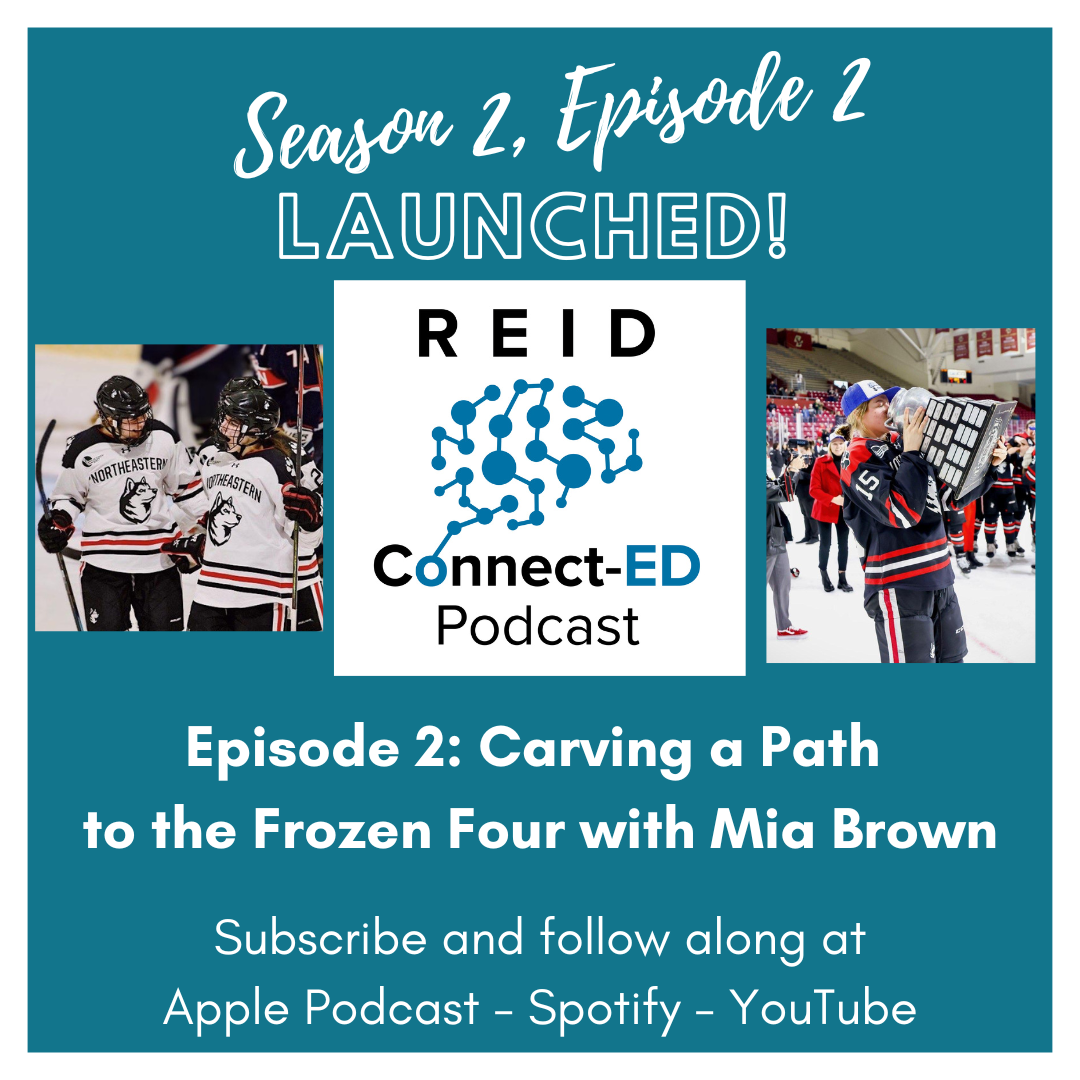
S2 E2: Carving a Path to the Frozen Four with Mia Brown
Listen Now!
-
-
Sometimes making sacrifices (e.g., not going to parties or hanging with friends from time to time) don’t even register as being part of the pursuit of becoming the best you can be.
The pressure that can be put on youth athletes can get in the way of improving your skills and can take away from the internal motivation and joy that comes from becoming the best version of yourself as an athlete.
As a student athlete who utilizes so much energy, it is so important to be self-aware in order to find the best time to dedicate focus and energy toward school work.
Mapping out a plan in an agenda.
As a higher level college athlete, you need to find a way to set a structure and schedule to get through your work and do it well otherwise it's easy to fall behind.
Online learning could work to some people’s advantage to be able to do work at the times that work best for them.
Setting boundaries to quiet any external noise can help to establish a better focus and concentration with school work and training.
Teammates that strive to build a culture of respect, an appreciation for everyone's role, and buy into a team's mission and values can be some of the most important reasons for success.
You are more than an athlete, which can be easy to forget.
-
Gerald Reid 00:11
Welcome back to Season Two of the Reid Connect-Ed podcast. This is episode two. Today we have a special local guest. And in the city of Boston, it seems like there's more colleges and universities than there are restaurants. And in the heart of the city is a school called Northeastern University if you haven't heard of it, they're known as the Huskies. And don't get them confused with the other Huskies of UConn who just won the national championship, but they are the northeastern Huskies. And over the past five years or so there's been a sports theme at Northeastern that's become one of the most prominent and consistent programs in the country. And this team is the Northeastern women's hockey team led by coach Dave Flint. And over the past few years, I've had the privilege honor and joy of getting to know one of their players. And in doing so I made it a point to go watch this team in action whenever I could, because their ice rink, which is the oldest in the country, Matthews ice rink, is only a 10 minute walk from my office. So it's been pretty convenient. And despite being an alum and a professor of Boston University, one of their rivals, I came and I supported their team and watch their journey unfold over the past couple of years. And it's been amazing. And so without further ado, our guest today is a fifth year graduate student of northeastern women's hockey program, she has been the assistant captain of the team and genuinely just a great human being in her name is Mia Brown. Welcome. Mia.
Mia Brown 01:34
thank you for having me.
Gerald Reid 01:35
Yeah, super excited to have you here. So we're hoping that today you can share a little bit of an insight into first of all, your journey, you know, as an individual, as a hockey player over the years since childhood up until this point in time, and also some insight about what it's really like to be a college athlete. You know, I know many people out there people listening, they may be part of it, or they may be spectators, and they don't really see what goes into the process behind the scenes. And I know that you're part of it every day, and your peers are a part of it every day. But not everybody really gets a look behind the scenes about what it's really like and you know, everything that you go through and the process behind and that's what this podcast really is about. It's about the process behind people's lives and people's journeys in their life. And this season is about excellence. So we're excited. So I'm gonna I'm gonna leave the floor to you, Mia, you know, just to tell us a little bit about your journey, you know, growing up and, and getting to this point where you are you really start from the beginning if you like
Mia Brown 02:32
yeah, absolutely.
Mia Brown 02:32
Well, I'm from Vermont, small little town actually come from a ski family. Not sure how I ended up playing hockey. But I did. And we I started playing hockey because we moved towns when I was about six. And then the town we moved to I had a had a nice little ice rink and I went and visited one day with my mom and saw the other kids skating all around, and I immediately wanted to give it a try. So we found some pads and some skates and I don't know, I guess they just put me out there and I skated around figured it out. And then next thing I know is I'm on the team with all my friends from school. And we're going to state so pretty much started there. Eventually you have to kind of I guess gender your sport and I just start playing with with the girls which is great. moved my way through. youth tens to twelves eventually started realizing I I guess I didn't realize my parents and the coaches realized they might have had something special and started nudging me to go try other teams maybe come down here to the Boston area where there is a bit better hockey and and really like throw myself into the sport if I wanted to get recruited. And that's kind of what led me here I started playing for the East Coast wizards in Bedford mass and which was a two and a half hour commute from my house and Woodstock. Thank you parents for making that drive every weekend. But went from there, got in contact with the coaches here. visited and then I knew that Northeastern was the place for me. Wow. It's funny because you work at BU and actually what drew me to Hockey was because my cousin played there. So she was like my role model and person I looked up to the most because we shared a sport she was relatively close in age to me. So actually my goal used to be BU. Funnily enough,
Gerald Reid 04:35
what's your cousin's name by the way?
Mia Brown 04:37
Dakota Woodworth.
Gerald Reid 04:39
Give her a shout out for sure. So me, let me ask you kind of going backwards a little bit. You know, it sounds like you kind of got plopped onto the ice when you were when you were young. Is there any type of memory you have about what that felt like? Because I mean, here you are, and I know knowing you that you love the sport of hockey genuinely. I know there's some You know, pains that go through being a college athletes a lot of work, but you genuinely love the sport. Did you get any, like, initial kind of intuition or just feelings of being on ice when you're really young that you know that you can remember?
05:11
Yeah, for me, I would say, I mean, I'm very lucky to have come from very athletic family. So I was able to pick things up rather quickly, whether it be lacrosse, soccer, hockey, skiing, what have you. So soon as I started, giving it a shot, I had already been a skier, even before I stepped on the ice, so I kind of had that muscle memory of having things on your feet that aren't shoes, and finding a way to make them work. So I'd say that was useful, but just like the feeling of being good, and like, I'm not sure if you guys have done a whole lot of skating, but I mean, it's cold out there. But you you have your pads on. So probably like the air and the wind just kind of like flowing through there. And like kind of can feel your power like each stride has. And then once you start getting better and better, like you, you get a stick, you get a puck, you're doing all this stuff while, skating on ice and having all those feelings. And then to put it like Together with a team. Like the whole whole thing. Why I chose hockey to be my sport over ski racing was because it's a team sport, and I got to have my friends, I got to go to school with them, I got to go to practice with them to have sleepovers with them. Like it was just so great. Bring it all together. It was there wasn't just one thing, it was a little bit of everything.
Alexis Reid 06:35
I will share that in our family. Every holiday season around Christmas time, we would bring our four younger cousins to go ice skating. So that was our thing when we're younger growing up. So we had we never played hockey, I will say, but we do know what it feels like to be on the ice. But you're right, there's something about like gliding on the ice and feeling the power from even just like one small push when to find your balance, you find your footing. So I can't even imagine how amazing that must have been. To put all those pieces together and play as a part of a team with your friends and the people that you love. Pursuing a sport that just felt natural to you. That's so cool.
Mia Brown 07:13
Yeah, back when there was no pressure, no stress. Just fun.
Alexis Reid 07:20
It's so interesting as we get older, how the things we love sometimes take on a different role and serve a different purpose in our lives.
Mia Brown 07:27
Definitely college athletics is
Gerald Reid 07:30
when did you start to see that shift where it like, like when things started to change from just inherent joy in the moment, just enjoying it for the sake of it versus like it becomes more of a discipline and that type of thing. Can you tell us about that shift and maybe milestones for that shift?
Mia Brown 07:46
I would say that starts to occur. Once whatever recruiting starts for you, like some people that's freshman year of high school, depending on your sport, some it's later, but really throughout high school. But I was I definitely had to deal with some of that my freshman year of high school, but it really didn't sink in until junior and senior year of high school before like when it really became real, that it's no longer. Hey, guys, let's go work out and then like, go shoot some pucks. It's now like, Hey, guys, I have to go work out sorry, I can't come hang out. I got too much to do. And then by the time you're done, you're too tired, or it's too late, or people are done with whatever they were doing.
Mia Brown 08:34
So that kind of, but then it wasn't an option. It wasn't like I mean, for some people it was but for me, it wasn't an option. If they wanted to be the best I could be like I understood what I was gonna have to do to kind of do that and the pressures it was going to what it was going to take. And that was definitely a realization that I feel like most elite athletes have. But some milestones for kind of that progression would probably be at a young age when you had to go from like mites and squirts where you're playing with all your friends, both girls and boys, to switching to a girls team to then trying to find a girls team that was up to my caliber, which I had to start traveling more for.
Mia Brown 09:24
My parents had to have a bigger commitment. I said I had to start training harder. Luckily with my family's athletic background, and my mom was pretty much able to give me all the tips and tricks on how to do at home workouts. If you saw me running around my driveway doing ladders jumping over stuff stick handling. Yeah, that was that was my childhood. That was me and sometimes my friends have I could convince them to do to do that with me. But you're just like you have to want to do it. It can't be forced like your parents. can force you to do a lot of things. But at the end of the day, it won't be sustainable. Unless you're choosing to miss the hang out, you're choosing to miss the party, because you have a game because you have practice or what have you. And then once you commit to that, it gets a lot easier and the stresses and the pressure still there, but at least you know, you're doing everything you can to, you know, reach your goal. And if you come short, like, that's okay, you did everything you could, but at least looking back, you don't, you're not like, damn, I wish I didn't go to that party. Damn, I wish I worked a little harder. But then once the pressures become real, you have to, you gotta ride with it. I mean, they're, they're not going away. The most elite athletes somehow have been able to train themselves to, I don't know, trick themselves into thinking there is no pressure. But I mean, everyone feels it, and it's just part of the game. You just can't let it break you.
Gerald Reid 10:57
Well said, Mia, you don't have to, you know, disclose particularly people. But over the course of your journey growing up, did you notice other athletes who maybe didn't have that choice? And kind of how did that turn out? Or it sounds like you really enjoyed the team atmosphere, it was inherently intrinsically motivating for you. But did you see kind of the opposite of, you know, within the sport that you're in?
Mia Brown 11:21
Yeah, I've definitely seen people either crumble under their parents pressure crumble under the coach's pressure, not want to be there at all. And they're there because their parents or someone's telling them they have to be, I've definitely seen it all. And you just don't make it that far, if your head is not in it, or if you're doing it for the wrong reasons. Because you kind of had a point that if you if you're not in the headspace to be there, obviously, like nonverbal communication is like a huge part of communication in general, and how humans like interact. And if your nonverbals aren't portraying that you want to be somewhere, everyone around you is going to know it. And being on a team. And like playing a team sport, like you can't act like that. It won't work, you'll make other people miserable, which is the opposite of what you want within a team sport. So I've seen people like that either lose the motivation and drop out, because it just wasn't the path for them, which is fine. I've seen coaches, obviously playing time is a big part of sports, they have to make those decisions. If someone isn't showing that they want to be there, they're putting in the extra effort that's on them. And I've seen people kind of crumble with that pressure. You see that a lot in college sports, just people losing the their edge, and then kind of facing that consequence, and which sadly enough, affects the way they view their sport.
Alexis Reid 12:58
I really appreciate your perspective on just being a player and trying to figure out what your path is, and how to hone your skills and get to the next level. But at the end of the day, this entire career that you've had as a hockey player, you've also been a student at the same time. And I I'd be remiss not to jump in and ask a little bit about, like, what was that like to be able to balance out the academics along with the athletic side of things, because it does require such a commitment on both sides of it. I wonder if you could share a little bit about your experience?
13:32
Yeah, definitely. It definitely does require a commitment. Really, the way that I was seeing it was I couldn't I couldn't play hockey, if like, my score wasn't done, like you can't play on your school team if you're not in school, and you know, doing the work and succeeding also in the classroom. So the way I tried to tackle it, and not sure when I learned this, it was probably high school where I really got real in school really kind of took that next step. And I went to prep school. So it was rather rigorous my course load. So I just kind of had to find a way and teach myself to be rigid with my own schedule and my own habits and learning how much time I need to set aside for homework or what times of the day are the best for me to focus because I found out that after practice is it's a no go for me after practice my mind and my body is just need some food and then need to go to bed. So I learned that so I realized that the mornings and the afternoons might kind of be more where I need to devote some time to getting my work done and balancing it like that. And then as soon as I got to college, they give us a little student athlete like agenda planner. What just great because it's free, and it's perfect. So I learned how to really utilize that and kind of live by that. And then the good feeling of you know, checking stuff off a to do list. But then once you get to that higher level to college athletics, it's it's just go go go, you don't really have a choice, you can't fall behind. Because if you do, you're not playing. And the whole reason you're there is to play. So I feel like myself and most student athletes just kind of find a way, you just have to be rigid and ready for it. And you just have to do it. Even if you don't want to, you just have to do it, you got to find a way.
Alexis Reid 15:39
Yeah, it's really great to hear that the the tool of the agenda planner was really helpful for you. I know some people who really benefit from being able to check things off and feel really good about it. It's like almost like a release of like, I did that. It's some people that actually doesn't work for so it's so interesting to hear that it was helpful for you. And I imagine like the same mindset that you had, as an athlete trying to, you know, have a discipline to have a routine for workouts and conditioning and practice, probably translated to schools, too. And I love to hear you reflect in your reflection process on, like, how to figure out when the best time is going to be, I often bring like a little bit of sports psychology into the work I do with students and talking about, we really need to find our sweet spot for learning. Because if you're too tired, if you're not focused, if you're preoccupied with other things can be so hard to dive into the work, especially when it gets more challenging. So I appreciate you sharing that. And you and I were talking about before, you know, the benefit of online learning has actually worked to your advantage that the college shifted a little bit during COVID and has still remained online and in a lot of ways. And that's been beneficial to you. Do you mind sharing a little bit about that, too?
16:56
Yeah, absolutely. I found through my college career, that online class and online work benefits me and works really well for me, and I'm able to absorb much more knowledge through an online class than I am in person. I'm not sure if that's because lecture learning isn't for me, or attention span issues or what have you. But I'm just so self aware and the way that like, I know what I need, and I know how I need to do it, for it to be done in the way it should be. And to the standard it should be. Which obviously takes time to learn, you have to learn yourself, and you have to be like, critically self aware. But kind of what I found is that, for me to give my best work, gonna need to be either alone or somehow able to be in my own world. I'm so extroverted and social in the way that I can't have other people running around me, gossiping, chit chatting, trying to make jokes, stuff like that. If I'm around other people, I'm trying to do work, I have my headphones in most of the time, nothing's playing, but just makes it so people won't talk to me. Or I'm playing music with no words, I found that like, go on YouTube and look up Cafe jazz, and play that for hours and just crank out work. But on the other hand, I found that if it's a time of day, or it's just a week, where it's been hard to focus that, okay, I understand it like being understanding with myself that right now, my mind isn't in it, there's no point in trying to do this work. Because it won't be it won't be good. So saving that till I have a time where I am focused, and I can put in the correct effort to get it done. That being said, you can't be a procrastinator with this type of Outlook. Because if you do, and it comes time where you have to get something done and you're not in the mindset for it. That's not good. So that's why I also like to know what the week expects of me what the month expects of me so I can get stuff done early and at my own pace. Without being rushed without being stressed and only working when my body tells me it's time to work. ,
Alexis Reid 19:32
Yeah, that's so great. And you know, your self awareness is such a beautiful thing. And I I could hear it in your voice and in the way you're explaining things that you've done a lot of really great reflection and been honest and open about, you know, what's going to work and what's not going to work and I think that's all part of the process. And I imagine and I could I could see and Jerry's thoughts percolating at the moment to that I could imagine a lot of that translates into your work and conditioning and preparing for games. and getting back on the ice to.
20:02
I mean, it's the same, like, I don't actually know the saying well enough to really bring it up right now. But it's like, it might be like, the 1/3 rule, or something, where like, 1/3 of the time, you're gonna be feeling great, you're gonna be loving exactly what you're doing, everything's gonna be perfect 1/3 of the time, you're going to be like, Meh, but like, still still got to do it. And then 1/3 time, life's gonna suck. And it's going to be really hard, and you're not going to want to do it at all. But the most important thing is that you keep showing up and you keep doing it. Because if you're in that 1/3, where it's pretty awful, just know that. The other third, where it's really great, it's gonna come back around. So just kind of staying the course and staying consistent. No matter what phase you're in
Alexis Reid 20:50
such a good way of thinking about it. And you're right, it's like, things aren't always gonna feel super motivating, and exciting and engaging. But sometimes the most challenging moments are the ones that teach us the most either about whatever the discipline or content is, or just about ourselves in the moment, right? Sometimes things are gonna feel challenging, and how we react and respond to it often makes all the difference.
Mia Brown 21:14
Yeah, exactly.
Gerald Reid 21:15
Yeah, Mia, you have an incredible, you have an incredible ability to accept reality, I think, you know, like the awareness, but also the acceptance, like, okay, it is what it is, and I have to work with it. And, you know, that's really respectable. And I do have a follow up question about that. So just knowing your team a little bit by observing and watching and hearing about a little bit, can you tell me, what are the aspects of the team that allow you to kind of enhance that positive energy, that positive feeling that the sustain you through that 1/3? That's so you know, hard and challenging and rigorous, you know, what are some of those aspects of your team in particular, that you really have, have cherished that have got you through those moments.
22:00
Like, if you're on a team, and it's great culture, and you love being there, which you should, team should be a place where you feel happy, if you're in that 1/3, and your body hurts, and you have so much schoolwork, and everything sucks in your mind, but you get to show up at still hanging out with your friends and like, yeah, maybe you're you're lifting or you're on the ice, but at least you're with your friends, and they're cracking jokes and keeping it light. And it's fun. And you kind of just got to know that like, even on your worst days, when you go to the rink, our whole thing is like pick each other up. Obviously, you're responsible for the energy that you bring into the locker room and the rink every day. But people have bad days, and you got to you got to pick each other up and help each other out if they're down. And even if even if you can't visibly see someone down as a teammate, your job is to always bring the energy and the happiness and the heart because we are practiced enough to be able to hide our emotions, even on the bad days, which is great, but kind of just treating everyone with love and respect every day, because you never know what's going on outside the rink. And they showed up for you even though they're not feeling great, you got to show up for them. Especially if you're feeling great.
Gerald Reid 23:27
Yeah, Mia, you know, as a psychologist and therapists, I do meet with a lot of people who, who have depression, they experience depression, because life gets really hard and you can get knocked down and, and kind of get into despair. And something I have learned over the years is that depression makes some people not want to open up to be supported, it kind of shuts you down. It's kind of like a let me go into my cave and hide from everybody. And what you're pointing out is, I think really meaningful, because when you have relationships that are proactive, and you have people that you trust in a deeper way, and you know, they have your best intentions to support you. And that's part of the expectation. I think those are the moments when you could actually get pulled out of that despair. Because, you know, like I said, I think, you know, working with people who become depressed, it's like, you have to really trust and really have a genuine relationship with someone to want to open yourself up to them. Otherwise, you know, you can kind of harbor you know, whatever you're harboring inside you resentment or anger and it just gets all blocked out and you never you never come out of it. So that seems like seems like an important part of what you're saying is the foundation of the culture. Probably allows for that to happen to me not only speak for you, but it sounds like something like the
Mia Brown 24:46
no definitely and my team is so special and has been the last five years because our culture has been so incredible. Like I hear stories of friends on other teams or go in different schools and It's not like we are like, that's probably 90% of why we're so successful, because we actually like each other and respect each other and work together rather than separately. And we have great coaching staff and everything kind of just falls in line to create this, like, perfect culture, where we can thrive in whatever way that looks for each person within their different role in the team.
Gerald Reid 25:29
And you're all probably different to just to kind of tap into the reality of how this stuff gets built. Like I imagine all the different personalities, and I've got to watch you all on the ice, and I'm just mesmerized by what you're able to do. But I imagine everybody's got a different personality and wave being that I'm sure it took, it takes work to build that. It's
Mia Brown 25:49
definitely, definitely a lot of different personalities. And I feel like without the like, difference, we wouldn't be as strong like as we are, because we can't have all the same personality type. And that would just clash completely. So we have X amount of introverts x about of extroverts, half the team is likes to make jokes, the other half likes to laugh at them, like stuff like that, just as like a give and take. Each person gives what they have to offer. And then the people that need that that day, take it and then you're taking something you're giving something else. And it's just kind of like this web or for system that works.
Gerald Reid 26:37
We were just talking to a good friend about, you know, what makes marriages work. Better a bit of a tangent here, but I think it's related. And you know, what we came down to is both people need to truly want to make it work and have that underlying foundation, where those differences can be worked out, like you said, and those differences could actually become something beautiful on both sides, when there is that foundation of wanting it to work and embracing each other's differences
Mia Brown 27:04
totally makes perfect sense.
Alexis Reid 27:06
I wonder too, what's the role of your coaches, they must be pretty special people to be able to be the glue the magnets, I'm not sure it sounds like every individual player has such a unique role among this web in this team. But I'm sure that coaches play a big role, too. I wonder what some of the qualities that they exhibit that seem to be the most helpful for you and your teammates.
27:33
They definitely don't micromanage us. Like they show that they trust us to make decisions on the ice in the rink. But also like, out of the rink, on the weekends, stuff like that, like, they just, they show that they trust us in so many different ways, which allows us to trust them when they're telling us what to do on the ice, what to do in the gym. Or even every now and then, you know, they tell us what to do out of the rink. And there's such like a give and take that. And those times when they do have limitations on our actions outside the rink. We listen to them because there's a mutual respect that's been built, that both parties want to make the other happy.
Alexis Reid 28:25
It's so interesting. We have so many coaches, mentors, educators, caregivers, parents that listen to the podcast. And I think it's so important to remember that that, you know, you ultimately want to build up a sense of trust in each individual, but it has to come from somewhere and then giving you that that space, that authenticity, that independence to be able to make decisions and to facilitate those efforts is just such a beautiful thing. It's great to hear.
Gerald Reid 28:54
You know what I think it also does it probably? Yeah, I think it also it builds confidence in your ear that you're gonna say like to build confidence that you can make a decision. Yeah.
29:05
Yeah. And like, obviously, yes, it like we have to prove that we're trustworthy. But the work that was put in to create the culture we have, makes it so as soon as the new players come in, if they simulate right in with us, therefore the coaches then can trust them to because they're with us, and we improve with them and stuff like that. But not every team is like that some teams need a lot more rules and structure because they're not to the point that we're at, where we're like, we want to make the right decisions because we we want to gain even more respect or gain even more freedoms from our coaches. And the way to do that is to prove that you're worthy of all of the good things you have to offer.
Gerald Reid 29:54
That's awesome. Mia, Can I ask you this question about the team itself because I believe If you came into the team early on when it started to evolve into this really powerhouse at this point, can you describe kind of like the evolution of the team from the beginning until now?
30:11
Yeah, so what I've heard is, the year before I came in, is kind of when things started to change, or there was like rumblings of culture shift. And then when we got there, my class contributed a lot to the team, and the success on the ice, but also off the ice, like great personalities, very different personalities fit right in with all the girls, we had a great, great captain that year, my first year, that was lucky enough to be her lift partner, her name was Brittany Bigelowski, and she really took me under her wing, and led me, helped me become who I am today. But through her leadership, our team was able to, obviously trust her and the other captains, but really, she was able to convince everyone to buy in to what the coaches are saying what the captains are saying, Do this, this and this so we can reach these goals that to the year, she saw her potential, and she was able to not just see it, but like, unlock it. Not sure how she did it. I know she read many books on leading and being a captain over the summer before, which was really cool. But she just did it with a steady hand. And she nailed it, whatever she was doing, she nailed it. And that pretty much kick started the next four or five years, each Captain after her, also nailed it kept building on it. Everyone stayed bought in, all the way through. So each Captain after I would say getting better than where the previous each year, it just kept building and building. Which was really cool to see.
Gerald Reid 32:05
Mia you you have a teammate and you said a good friend of yours, Alena Mueller. And every time I'd watch y'all play, I would describe her in my own head about describing her almost like she's a chess player, but she's that the horse that just moves in ways that you just like left, right and straight. It's not just one direction, like she's bouncing around, you know, her defenders in a way that I can't even explain or describe. And you had said, you know, you really admire and respect her as a person. Can you describe her, you know, impact on the team and her presence.
Mia Brown 32:37
She has been our guiding light since the first time she stepped on the ice here with the team freshman year. She is the person everyone looks to. Not, not like, verbally, like, also verbally like, Hey, I have a question. Can you help me with this, but just like any moment, in the rink, out of the rink, but specifically in the rink and on the ice in the weight room, all you have to do is look at her and her focus and her work ethic and her insane abilities. And you're immediately calmed. Like, I know she has that effect on me. Like she's inspiring to just be around. And I know that the seniors when she was a freshman was feeling that towards her. Like if we were in a tough game. We knew we knew we could do it. Because we had her not because she was going to be the one to go out there and score the goal. But just having her there made us better, each person better. And I know I am very inspired by her every single day. And the impact she's had on me is incredible. And she's also mentioned that in her times of struggle that I have been her Guiding Light and I've helped her and if she just looks at me, she knows I have her and that she's okay and that like I accept her no matter what. And so hearing her say that was really incredible. But the effect I have on her she has on our entire team every day.
Alexis Reid 34:06
That's amazing.
Gerald Reid 34:08
No wonder she was the captain and you're the assistant captain this year. She's incredible. It's amazing to have someone like that on the theme. So Mia, maybe you can give some insight into what it was like to be in the frozen for for a number of years. You know just describe getting to that stage. It's like the Final Four in basketball for those who follow the tournament. So describe that a little bit for us.
34:34
The first time was definitely incredible. It was during COVID Which kind of made it I don't know if it made it better or what but like all the crazy stuff we went through during the year people getting COVID season being paused stopped missing games what what have you making it they're still with all of that adversity was really awesome and something we're really Out of and then not only just to make it to the frozen four but to make it to double overtime in the national championship game through COVID was absolutely insane and quite literally like a dream come true. And at the end of that season, it was just like, wow, we just did that. Despite everything, we just did that. So that was really cool. Sucks that we lost. But now a couple years later, I'm able to look back and say that was pretty cool. At the time, I was not able to say that. I was very angry. Took me a while to get back on the ice after that, and to remember that I liked playing hockey. But here I am. And then each year, so I've gone three times has just been has been great. It's always such an honor. And you feel special. And yeah, women's hockey isn't as funded as basketball, like even women's basketball. Like I see the discrepancies and the differences between our tournaments. But it's still really cool. And you do feel special all like the marketing and bannering of around the hotel, the arena, the town, social media is really incredible. And it does make you feel special, which you should because it is a really big accomplishment. And for us to have gone three times. That's pretty cool.
Alexis Reid 36:27
I was just gonna say I love seeing, especially this year, I think women's sports has really become a little bit more elevated. And I love to see you all who have put in so much time and effort, sacrifice, work and love to really be acknowledged for that on a grander stage. And I have the chills just thinking about what that must have been like for you to be there and to be in that venue. And on that stage to be able to play not only once but three times in your college career. It's incredible.
36:58
Yeah, the little girl in me is screaming. Because I never thought that I would ever be there let alone multiple times six time, hockey's champions, like to time Bean Pot. However many time regular season, it's just crazy. I never would have thought that my class would have such an impact on the organization in general, like the team in general, like northeast rooms, ice hockey in general. But it's been incredible what we've been able to do and the history we've been able to break and all the records and stuff that no one can ever take away. It's very cool.
Alexis Reid 37:41
It's absolutely incredible. And I'm sure we'll get a lot of gruff from this. Because I'm a BC alum, Jerry's a BU alum and professor there. And I will say that you've made Northeastern fans out of us because we've been loving watching and cheering you on over the years. So tthank you for bringing that joy to us through your play too.
Mia Brown 38:02
Yeah, of course, of course.
Gerald Reid 38:05
Hey Mia, can you give some insight for the listeners about the mental side of performing? And what goes into it and the challenges and the resiliency that goes into it, you kind of describe that exists. But can you get into a little detail about that, to enlighten us a little bit.
Mia Brown 38:21
I would recommend that every athlete or everyone that wants to be like an elite athlete or college athlete really get into like their mental game as young as possible. I don't know why it's not taught side by side with off ice training, like stick handling working out. That should be the third thing that you're required to do. And if that was the case, I think sports would be really different. I think there would be a lot more elite players. And I think sports would be a lot more competitive because such a problem is your mind, like your mind can be mean and hurtful. And kind of understanding your triggers and how you need to treat yourself is really should be the first step to athletics. I think usually it's people's last step. But making sure that you are comfortable. And unwaveringly confident in your own abilities is essential and nobody's perfect. You can't always be this bubbly, positive self talking person. But the more you can be that at least towards yourself, the better you will be all around not just in sports.
Gerald Reid 39:37
Yeah, Mia you did something so special. Talking to some of the younger athletes that I work with around just giving them the wisdom as they're grown up and they're they're amazing hockey players and and they're growing into this but you said something that stood out to me You said you know, there's a lot of athletes who get like the specialized training to get the best of the best, you know, facilities to Workout in and to grow in. But that doesn't mean that they're going to make it for. You said, it's really about the mind a lot of times,
Mia Brown 40:07
yeah, it's all about the mind. Half the time with the specialized training and the individual one on one sessions with coaches is the parents driving that, like, what kid wants to go one on one trade with a random person at the age of 10? No, they just want to be with their buddies, like in the backyard, playing around, like, you'll get far better in the backyard, in my mind, trying out and having no fears and no shame, and then nothing but confidence, and fun. But I mean, those trainings are, they're great. But it's going to come down to the people that are the most motivated and willing to work to get better. And that can be in your basement, and that can be in your backyard, that can be one on one with a trainer, it depends on the person, not the people trying to tell them what to do, I guess, it's got to be you got to tell yourself what to do. And you can't just be going through the motions. A lot of times with trainers, I feel like people get stuck going through the motions, especially at a young age, because they're just being told what to do. They're not seeking out these things on their own, which is where you probably see the most growth in athletics is all of the internal motivations.
Alexis Reid 41:26
But by no means have I ever come close to being an elite athlete. However, I can think about this through like a learning perspective that you know, each one of those scenarios that you described, like different ways you can practice and improve your skills, they all serve a certain purpose. And I actually think that, like you said, when you're less inhibited, and maybe less stress, you're just kind of messing around with your friends practicing, maybe come up with your own regimen. Sometimes that is where the most growth, the most creativity comes from. I remember watching Wayne Gretzky's documentary when he talked about how he differentiates himself from other great players. And he talks a little bit about, you know, how he was able to just be creative, and kind of just mess around a little bit more on the ice, which allowed for him to have these unique opportunities when he was in his playing time on the ice and games. And I think, you know, what you said is so valuable. And I think we lose that a lot that oftentimes some of our best mental, cognitive and learning opportunities actually come through play where we're not overly thinking about, I must get better I have to do this, I have to do that. It's more about like, let's try to see how it all comes together and see what shows up.
Mia Brown 42:43
Absolutely, I mean, the kids with the best hands, what you might call it in hockey, the best skills are always the ones that would just, you never saw them without their stick and a ball like they're to stick handling around their house, around the backyard, the driveway, the hallways of the rink than the locker room, like they're just having fun. And then they could do these crazy things out on the ice because they'd been practicing. But they just thought it was fun.
Alexis Reid 43:11
Yeah, that's the best. I would argue that's probably the best part about childhood, right? Like, you have to go to school, that's part of your job as a child, you have to go to practices sometimes straining, it's part of like growing up to sometimes if that's what you're dedicating yourself to, but that like freedom to kind of just mess around play, kind of develop your sense of self through the things you love. without overthinking it is the best. It's so great. I try to bring myself back there whenever I can. Because there's such a beauty in that mindset.
Gerald Reid 43:45
You know, especially nowadays with social media, to where I think people develop their identities, like reactively they're kind of like, let me you know, I'm gonna react to what I'm seeing on social media and that's going to become my identity versus what you're saying, you know, is like, let me be open and in discover that for myself, kind of like what you did Mia, and especially what Jelani talked about in last episode, he discovered who he was, and we his identity and how he embraced what he loved through or very organically, as opposed to kind of being so regimented. So structure that you're reacting and then your identity becomes, in some ways foreclosed. It just becomes a reaction to what's happening rather than a proactive exploration.
Mia Brown 44:31
I was lucky that when I was growing up, right when like, Instagram and Snapchat are coming out, but still when it was new enough that like, it wasn't consuming everyone all day every day. So I feel like these days people, instead of being bored and going outside to their driveway to mess around with their lacrosse stick or hockey stick or whatever, soccer ball basketball, just sit on their phones. I just had to go right now realize that I was just before that was normalized. Luckily.
Alexis Reid 45:13
I was just gonna say what advice would you give to kids growing up? In this day and age where that is the norm, that is the thing kids do just to fill up their time. What would you share with with kids who love sports, whether it's hockey or anything else, but they do feel compelled to like, be social through social media versus like, kind of living their life, their passion,
Mia Brown 45:37
my parents always stressed me like, You are the people you are around. So choosing your friends are the people you surround yourself with wisely, even at a young age. Like, if you're a kid that wants just go play soccer all day, like find someone else that wants to do that. Don't try and force your friends that want to play video games, or sit on their phones to do that, because either they won't put in the effort that you're putting in, or they won't do it at all, and then you'll be stuck sitting inside unless you're gonna go do it alone. So kind of really pay attention to who you're surrounding yourself with. And sometimes that's tough, because you do have to not lose relationships, but distance yourself and, you know, find your people elsewhere, I've definitely had to do that I've definitely, obviously moved around to go to Mel for hockey, or travel a lot for hockey. And through that I've found the people that are more like me, and especially at the age like elementary school, middle school, where people start having crushes on each other and dressing certain ways and stuff like that. It's so hard when you're growing up to not get lost in the norms in society and what everyone's telling you you should be doing. And just kind of stick to your guns. And I feel like through that I was always like sports, fun, play games and go play capture the flag outside, while other girls started to kind of shift to gossiping, and talking to boys and going shopping and stuff like that. That was never my vibe, especially at a young age. I just wanted to have fun and go outside. So kind of just finding your people that also wanted to do that, I started hanging out with different people when I saw that shift from some of my girlfriends. So I mean, it was tough, you can still keep these people in your lives. But if you really want to reach your goals, you're gonna have to surround yourself with people that will support you and help you rather than try and hold you back or try and change you.
Alexis Reid 47:50
That's such great advice. And I think that's, that's like the piece that I think people lose sight of is that like, you can have different interests and still have people in your lives. But it's also okay for you to be around people who are going to keep lifting you up and encouraging you and supporting you to do the things you love and you care about. And sometimes they might not even be in your inner circle. And that's okay, too. But you can find your people I think that's actually the beauty of social media, right is that you can find other people who have similar passions that might not be in your, your immediate community or school. That's I think that's the beauty of being able to see like, oh, there's other people as passionate as me.
Mia Brown 48:25
Yeah, definitely.
Gerald Reid 48:28
Me, would you say there's any lessons that you learned going through your college hockey career, just you know, we talked a lot about childhood, but it's kind of focusing on the college part lessons that you learned over the years,
Mia Brown 48:39
so many lessons. Lessons probably every day.
Gerald Reid 48:45
That's because you're a student of life. Yeah.
Mia Brown 48:49
Do your homework. Don't be late. If you're five minutes, early or late. Stay organized. Try your best not to fall behind. You will make mistakes because you're not perfect and no one's perfect. So accept them, learn from them. Most important part is to learn from them and then be ready the next time you're faced with the same decision. Hopefully, you'll make the right one. But go easy on yourself. Which is sometimes the hardest thing. But finding a way to you know, treat yourself kindly with grace. And I'm still kind of learning how to do that as I bet everyone is. But the younger you can turn that into a habit the better off you'll be facing anything that gets thrown at you.
Alexis Reid 49:51
For all the students I work with who might be listening I swear I didn't pay Mia to say any of that. It's incredible. I can That's such great advice. And honestly, when you take a step back and zoom out on your entire experience, I imagine you're like, oh, some of these things seem really simple, but they're probably really difficult to like hold true to and to embody as you went through your whole experience as an athlete, and a college student and a student of life as as Gerald says.
Mia Brown 50:25
Absolutely. You know,
Gerald Reid 50:27
I, I email Jelani after interview last week, and I said, Look, man, you, you really have wisdom, but it's earned wisdom. It's not a catchphrase. It's not a sound, but it's not like a tweet, or like an Instagram post. It's like, earned wisdom by going through it. And he really thought he dove into his life and what he pursued and what he's doing and, and was authentic and honest, and admit like, I think you're an awesome person. And like, really, I think you have that quality. And I really, I really respect that. Yeah, I really do.
Mia Brown 50:57
Thank you.
Gerald Reid 51:00
Wisdom doesn't come easy.
Mia Brown 51:01
Yeah, I hope I can help people in my future. Yes, I'm on the job hunt. And I hope that whatever job I get, it's helping people.
Alexis Reid 51:13
It's this might even be part of your resume, as you send it out. It's like, let's talk about character, I think you, you totally embody it. And it's so impressive. And it is it really sets the tone for not only our listeners, but imagine all the people you interact with on a daily basis. And, you know, thinking about the big picture of what's next, what is next? What are you thinking for the future as you're on the job hunt? How are you going to bring some of these lessons into the next phase of whatever you end up doing?
Mia Brown 51:43
I hope I can apply all the stuff I've learned to just my day to day, like, no matter what you're doing, you should still have like your values. And the way you treat people shouldn't change no matter your job or your situation, or social setting that you're in if you're true to yourself a group. Ideally wouldn't waver waver that, even though that can be some of the hardest stuff, like, I'm sure you guys love talking about group psychology and all that good stuff. But I'm looking, I would ideally like to do something maybe Dei, like diversity, equity and inclusion, because I've worked a little bit in the athletics department kind of with that. And I feel like just the way I live kind of tries to push that stuff forward. But things like that really interests me. And that's definitely helping people. I've been looking into recruiting, which is helping pretty much get people like me, jobs, getting people right out of college jobs and setting their future up and helping them through that process. So that also could be very beneficial to me and the people that I would hopefully work with,
Alexis Reid 53:02
you'd be great at that
Mia Brown 53:03
things like that. Those are kind of the two realms that I'm looking at, I'm really heavily looking into recruiting right now are the
Alexis Reid 53:11
same way you described how you and your, your captain, serve as a role on the team as a calming presence, someone who helps to guide those around you and support and help them just to feel good and who they are and how they show up, I can imagine you're going to use a lot of those skills, and allow for that to shine through and whatever you end up doing. And if there's any listeners out there who need a really great individual to join their team or organization. You have to get in touch with Mia.
Mia Brown 53:46
Definitely I send anyone my resume, let me know
Alexis Reid 53:52
I had to add that plug in there because you truly embody a lot of the things that you speak of, it's not just that you show up and can talk about it. It shines through you and every word that you say and the way you play on the ice and the way you interact with some of the younger players that I know you've talked to and it's such a beautiful thing to see and to hear about so thank you for sharing your heart or day with us on this episode.
Gerald Reid 54:20
Well Mia, we're about at the hour and I have to give so much thanks to you for showing up and being part of this Reid Connect-ED podcast and you're definitely in line with with a value in the mission of this is and and there's gonna be a lot of listeners, we're gonna learn a lot and gain a lot and, and you know, like life moves so fast and we all need to be grounded. And you know, we hope that your voice and your words today just helps people just grounding themselves like slow down. Let's get back to the basics and the fundamentals of life and what it means to be human and what we're doing here, because especially athletics and elite athletics, you can lose touch with that and so we We are deeply appreciative of you coming on here and sharing yourself with us and with our audience. And for all those listeners don't sleep on Northeastern women's hockey. If you're not into women's sports, don't sleep on them. They are unbelievable athletes. If you got ESPN plus you can watch their games, live stream and and check them out in Boston. They are unbelievable athletes and wonderful human beings. So, Mia, thank you so much for coming on today.
Mia Brown 55:27
Thanks so much for having me. And don't forget for all your athletes out there that you are more than your sport. That can be a tough one to remember. But that's probably the most important advice I have.
Alexis Reid 55:39
Well said. Thanks, Mia.
Mia Brown 55:41
Thanks so much.
Gerald Reid
Thanks for tuning in to the Reid Connect-ED podcast. Please remember that this is a podcast intended to educate and share ideas, but it is not a substitute for professional care that may be beneficial to you at different points of your life. If you are needed support, please contact your primary care physician, local hospital, educational institution, or support staff at your place of employment to seek out referrals for what may be most helpful for you. ideas shared here have been shaped by many years of training, incredible mentors research theory, evidence based practices and our work with individuals over the years, but it's not intended to represent the opinions of those we work with or who we are affiliated with. The reconnected podcast is hosted by siblings Alexis Reid and Dr. Gerald Reid. Original music is written and recorded by Gerald Reid (www.Jerapy.com) recording was done by Cyber Sound Studios. If you want to follow along on this journey with us the Reid Connect-ED podcast. we'll be releasing new episodes every two weeks each season so please subscribe for updates and notifications. Feel free to also follow us on Instagram @ReidConnectEdPodcast that's @ReidconnectEdPodcast and Twitter @ReidconnectEd. We are grateful for you joining us and we look forward to future episodes. In the meanwhile be curious, be open, and be well.
In Episode 2 of Season 2, Mia Brown, assistant captain of Northeastern Women's Hockey program, shares her journey from childhood all the way to reaching the Frozen Four three years in a row.
The experiences and wisdom that Mia shares from both her own journey, as well as the building of an elite college hockey program, is something special that we all can learn from.
Be curious. Be Open. Be well.
The ReidConnect-Ed Podcast is hosted by Siblings Alexis Reid and Dr. Gerald Reid, produced by and original music is written and recorded by www.Jerapy.com
*Please note that different practitioners may have different opinions- this is our perspective and is intended to educate you on what may be possible.